Tag Archives: puzzles

Cubes, Curves, and Geometric Romance

Welcome to this week’s Math Munch!

If you like Rubik’s Cubes, then check out Oskar van Deventer’s original Rubik’s cube-type puzzles!  Oskar is a Dutch scientist who has been designing puzzles since he was 12 years old.  He makes many of his puzzles using a 3D printer, with a company called Shapeways.

Oskar has posted a number of videos of himself explaining his creations.  Here’s him demonstrating the Oh Cube:

Next, take a look at these beautiful curved-crease sculptures made by MIT mathematician and origami artist Erik Demaine and his father, Martin Demaine.  Erik and Martin make these hyperbolic paraboloid structures by folding rings of creases in a circular piece of paper.  They have exhibits of their artwork in various museums and galleries, including in the MoMA permanent collection and the Guided By Invoices gallery in Chelsea, NYC.  So, if you live in NYC, then you could go see these!

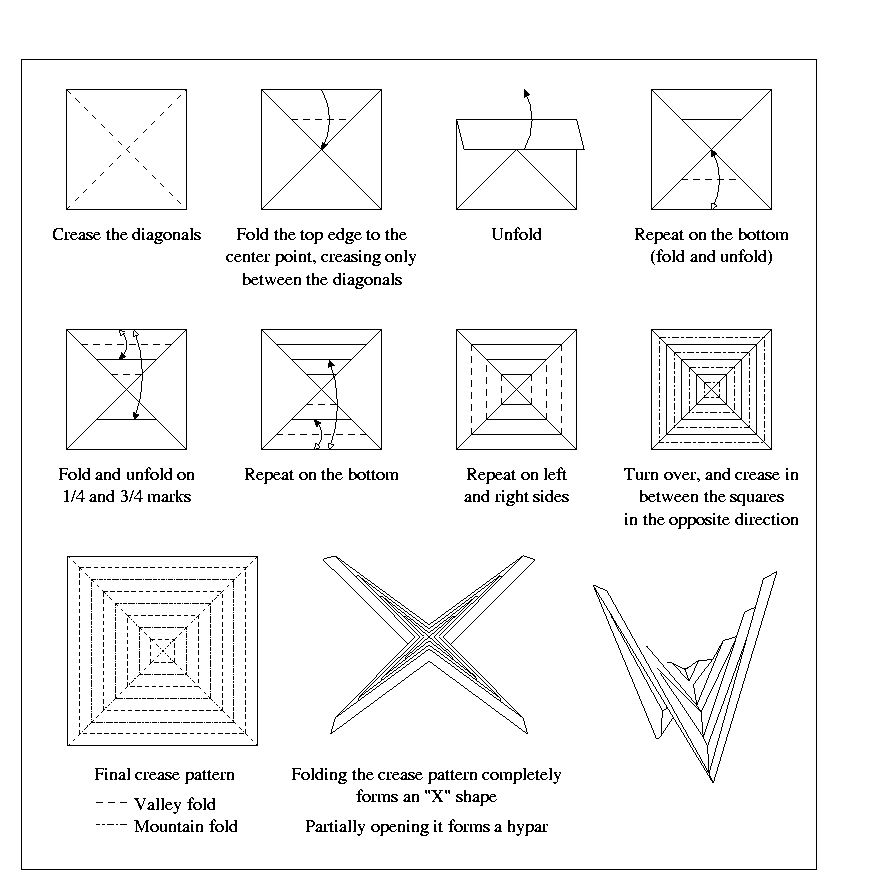
Want to learn how to fold your own hyperbolic paraboloid?  Erik has these instructions for making one out of a square piece of paper with straight folds.

Finally, here is a wonderful video made of Norton Juster’s picture book, The Dot and the Line.  Enjoy!

Bon appetit!

Alphametics, Hyperbolic Crochet, and a Puzzle Contest

Welcome to the first Math Munch of December!


Did you know that SEND + MORE = MONEY?  Or that DOUBLE + DOUBLE + TOIL = TROUBLE?  It does if you replace the letters with the appropriate digits!  These very clever puzzles, where the digits in numbers of addition, subtraction, or multiplication problems are replaced by letters in words, are called alphametics (or sometimes cryptarithms).  Mathematician, software engineer, and writer Mike Keith calls them the “most elegant of puzzles” on his page devoted to some alphametics he’s found and created.  Check out the “doubly-true” alphametics – puzzles where the words are numbers – and Mike’s alphametic poetry.  In this poem, written in what Mike calls “Strict Alphametish,” the last word in each line is the sum of the previous words in that line!  Wow!

Next, take a look at these cool objects!

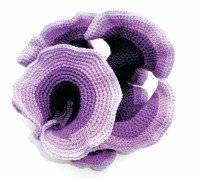
Purple hyperbolic plane

If you draw a line on a hyperbolic plane and a point not on that line, you can make an infinite number of lines parallel to the first line through the point.

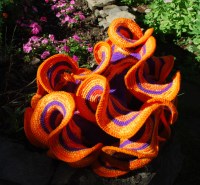
These are models of hyperbolic planes crocheted by Cornell University mathematician and artist Daina Taimina.  A hyperbolic plane is a surface that is kind of like the opposite of a sphere: on a sphere, the surface always curves in towards itself, but on a hyperbolic plane, the surface always curves away from itself.

Before Daina figured out how to crochet a hyperbolic plane, mathematicians had no durable, easy-to-use models of this very important geometric object!  But now, anyone with a little crocheting skill (or a willingness to learn!) can make a hyperbolic plane!  Here are instructions on how to crochet your very own hyperbolic plane, and here’s a link to Daina’s blog.

By the way, our favorite mathematical doodler Vi Hart also makes models of hyperbolic planes out of balloons.

Finally, do you like to play with Rubik’s Cubes, stacking puzzles, or other physical math puzzles?  Think you could make one of your own?   These are some of the entries in the 2011 Nob Yoshigahara Puzzle Design Competition.  Here are the winners!  The designer of the first-place puzzle won this cool trophy!

Bon Appetit!

Pennies, Knights, and Origami Mazes

Welcome to this week’s Math Munch!

How many pennies do you think this is? Click to find out.

Big numbers are sometimes hard to get a feel for.  A billion is a lot, but so is a million.  The MegaPenny Project is a cool attempt at making the difference between large numbers easier to grasp.  Would 1,000,000 pennies fill a football field or would you need a billion pennies for that?  MegaPenny can help you figure it out.

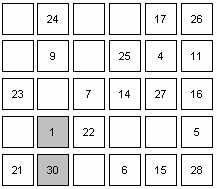
The first kixote puzzle

Next up, we have kixote, a puzzle in the spirit of Sudoku and Ken-Ken, but involving knight’s moves.  Dan Mackinnon–its creator–has a blog called mathrecreation that he says, “helps me go a little further in my mathematical recreations, helps me understand things better, and sometimes connects me to other people who share similar interests. I hope that it might encourage you to play with math too.”  I’m sure we’ll be linking to more of Dan’s posts in the future!

Finally, since the mazes and paper-folding were so popular last week, we thought that this week we would share some paper-folding mazes! Here is a clip of MIT professor Erik Demaine talking about how he has created origami mazes, preceded by a discussion of origami robots that fold themselves!  The clip is a part of a lecture about origami that Erik gave last spring in New York City for the Math Encounters series put on by the Museum of Mathematics.  You can watch Erik’s entire origami lecture from the beginning by clicking here.

frame from lecture video

Eric Demaine with a sheet of origami cubes

You can also check out Erik’s Maze Folder applet–but if you try it out, take his warning and start with a small maze!

Bon appetit!