One of my favorite math sites on the internet is mathpuzzle. It’s written and curated by recreational mathematician Ed Pegg Jr. About once a month, Ed makes a post that shares a ton of awesome math—interesting tilings, tricky puzzles, results about polyhedra and polyominos, and so much more. Below are some of my favorite finds at mathpuzzles. Go to the site to discover much more to explore!
Shapes that three kinds of polyominoes can tile.
Erich Friedman’s 2012 holiday puzzles
A slideable, flexible hypercube you can hold in your hands! Video below.
Next, have you ever wanted to be a movie star? How about a math movie star? Then there are two math video contests that you should know about. The first is for middle schoolers— the Reel Math Challenge. It’s run by MATHCOUNTS, which has for many years run a middle school problem solving contest. (I competed in it when I was in middle school.) This is only the second year for the Reel Math Challenge, but lots of videos have already been created. You can check them out here.
The second contest is for high schoolers and is called Math-O-Vision. The challenge is to make a video that shows “the way Math fills our world.” Math-O-Vision is sponsored by the Dartmouth College Math Department and the Neukom Institute.
Finally, here’s a fun little applet I found called Make-a-Flake. You can use it to make intricate digital snowflake designs.
Two snowflakes from the Make-a-Flake gallery.
Of course, it’s a lot of fun to make non-virtual snowflakes as well—find a pair of scissor and some paper and go for it! For basic instructions, head over to snowflakes.info. And for some inspiration, check out this Flickr group!
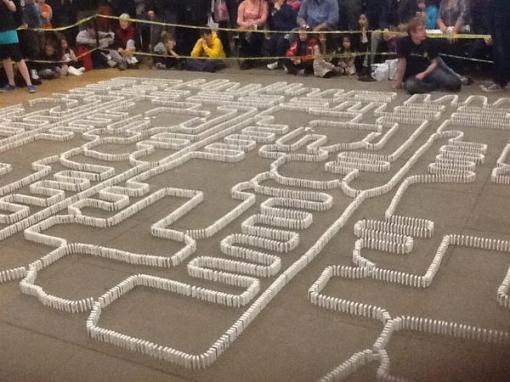
First up this week is one of the coolest things I’ve seen in a long time: the world’s largest computer made out of dominoes. A computer made out of dominoes?! you say. How??
The Domputer, as it’s been called, was the great idea of mathematician, teacher, and entertainer Matt Parker (see a previous post about Matt here), and he and many volunteers built it at the Manchester Science Festival at the end of October.
Matt and some of his teammates testing domino circuits.
So, what is a domino computer, and how does it work? As Matt is quoted saying in a podcast that featured the project, “A domino computer is exactly that: a computer made out of chains of dominoes. Flicking over one domino sends a signal racing along the chain, just like current flows down a wire. And then interacting lines of dominoes can manipulate the signal exactly the way circuit components do.”
At its very, very basic level, a computer is a machine that does calculations in binary. You input some sequence of 0s and 1s by flipping signals on and off, and your input starts a chain of electrical communications that results in an output of 0s and 1s. Most computers do this with electrical circuits. But it can also be done with dominoes – sending an “on” signal means flipping a domino over, and sending an “off” signal means not flipping a domino, or having a chain of falling dominoes that becomes blocked and stops falling.
Making the domputer.
There are lots of different kinds of commands that you can send by flipping switches on and off and making those signals interact. For example, suppose you want something to happen only if two switches are on – if the first switch is on AND the second switch is on. For this you would need to make something called an “AND gate” – an interaction in chains of current that will continue the chain if both switches are on and will stop the chain if either (or both) is off. How would you do that with dominoes? In this video, Matt demonstrates how to make an AND gate out of dominoes: Domino AND gate. Check out this video for OR (the chain continues if one or the other or both are on) and XOR (“exclusive or,” the chain continues if one or the other, but not both, are on) gates:
Matt’s Domputer does something very simple: it adds numbers in binary. But, as you might imagine, it was extremely complicated to build! According to the Manchester Science Festival Twitter feed, the Domputer used about 10,000 dominoes and would take about 13,600 years to do what a normal processor could do in a second. Wow!
Here it is in action. It messed up on this calculation (9+3), but succeeded in later attempts – and is fascinating to watch nonetheless!
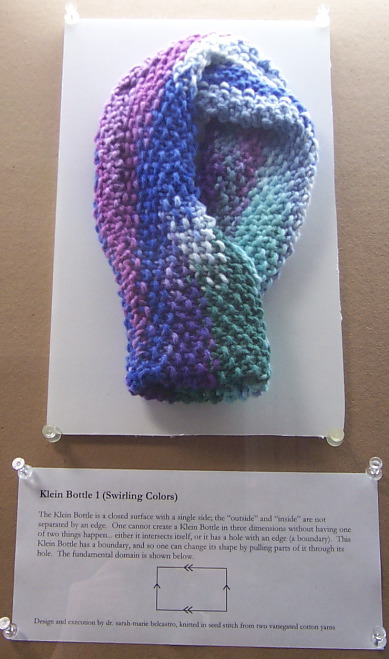
This site is full of articles and about and patterns for all kinds of cool mathematical objects – like Klein bottles (which make great hats, by the way)! In her post about knitted Klein bottles (and all of the other objects she makes), Sarah-Marie not only describes how to knit the objects but a lot of mathematics about them. I don’t know about you, but I always find mathematical ideas easier to understand when I can make models of them, or at least read about models being made. Sarah-Marie does a great job of blending mathematical descriptions with how-to-make-it recipes.
Finally, are you wondering what to do with all those campaign posters you have left over from the election? Here’s George Hart’s take on what to do with them:
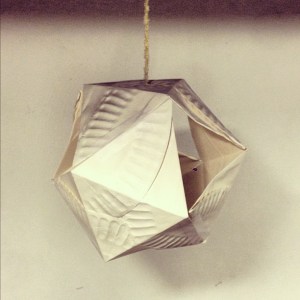
Icosahedron made from 4 paper plates. Click for instructions.
Big news this week, but first let’s have a look at some construction projects you can easily do at home using paper plates, paper clips, and some tape. They come to us from wholemovement.com, the website of Bradford Hansen-Smith. It’s not a stretch to say that Bradford is kind of cuckoo for circles, as you can probably tell form this introductory video. Naturally, the website is all about the amazing things you can do and learn from folding circles. Check out his gallery and you’ll see what I mean. Using these instructions and 4 paper plates I made the sculptures in these pictures. Above is an icosahedron with 4 of the 20 triangles left as empty space, and down below you can see the cuboctahedron of sorts. There’s even an instruction video for this one. So grab some cheap plates, fold ’em up, experiment, and send us your pictures.
Born 11.14.12
OK, now for the big news. Last Wednesday, my daughter was born!!! I’m so so so happy. In honor of Nora’s 0th birthday (you turn 1 on your 1st birthday, right?), let’s check out some birthday math. Here’s a cool little birthday number trick I found. It’s sort of magical, but it actually works because that tangle of arithmetic actually just multiplies the month by 10,000, the day by 100, and adds those together with the year. Hopefully you can see how this much simpler version works.
Here’s a well-known birthday problem: How many people need to be in a room before it’s likely that two of them share a birthday? If there’s 400 people in a room, then there’s definitely a birthday match, but if there’s 300 it’s almost certain as well. What’s the smallest crowd so that the probability of a match birthday is over 50%? For the answer and analysis, check out this Numberphile video on the subject featuring James Grime or this New York Times article, by Steven Strogatz, a wonderful mathematician and author.
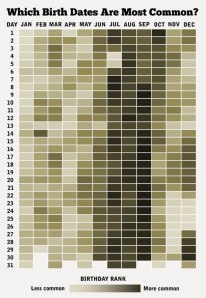
Both of these solutions are actually wrong! That’s because they make the false assumptions that each day has the same likelihood of being someone’s birthday. You can see in the graphs above that that’s not true at all! On the left, look how dark the summer months are, and look at how gray the days are around Thanksgiving and Christmas. You can click on the left image for an interactive version, or click on the right for more graphs and analysis.
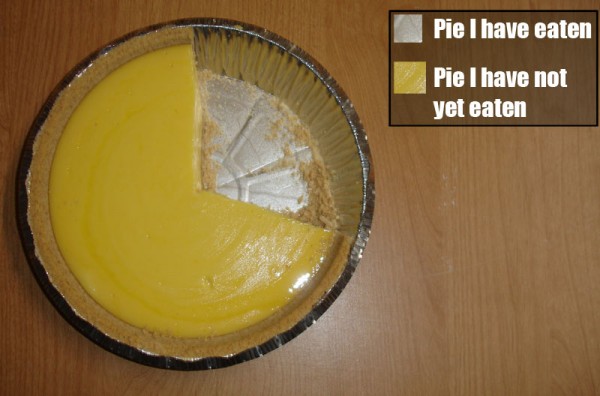
A Thanksgiving Pie Chart
Finally, I’m incredibly excited for Thanksgiving (my very favorite holiday), and in that spirit, I want to take a few lines to say “thank you” to you, dear reader. THANK YOU! Whether you’re a weekly muncher or a first time reader, it’s great to know you’re out there enjoying the math we share.
Obviously of course, Thanksgiving is also about the food. Delicious delicious food. Yummmmm! So, Vi Hart is making a series of Thanksgiving themed videos to showcase the math of the meal. Enjoy the videos, but be careful. You may get terribly hungry.





 The second contest is for high schoolers and is called Math-O-Vision. The challenge is to make a video that shows “the way Math fills our world.” Math-O-Vision is sponsored by the Dartmouth College Math Department and the Neukom Institute.
 Finally, here’s a fun little applet I found called Make-a-Flake. You can use it to make intricate digital snowflake designs.







 Math Munch