Tag Archives: video

Partitions, Riddles, and Escher Videos

Welcome to this week’s Math Munch!

Meet James Tanton, one of my very favorite mathematicians. According to his bio, James is “deeply interested in bridging the gap between the mathematics experienced by school students and the creative mathematics practiced and explored by mathematicians.” Me too! Dr. Tanton is an author and math teacher, but I know him best through his internet videos. Some of them cover some pretty advanced mathematics, but this video on partitions and the Fibonacci numbers is very clear and WAY COOL!

o o oo ooo ooooo

Up next, check out Steve Miller’s Math Riddles, a website full of fantastic (you guessed it) math riddles collected by Steve Miller. Steve’s a math professor at Williams College, and according to him, these riddles, “have two very desirable properties: they have an elegant solution, and that solution doesn’t involve advanced mathematics… What you do need is some patience, and a willingness to explore. Don’t be afraid to try something — see where it leads!”

With that in mind, why not give some a try? You can sort the riddles by topic or difficulty, but here a few possible starters:
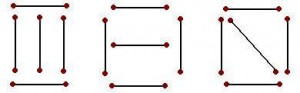
There are fifteen sticks. Remove six sticks and be left with ten.

Finally, some relaxing videos I’ve found to showcase once again the fantastic artwork of Dutch graphic artist, M.C. Escher. We’ve featured his work before, but I can never get enough.
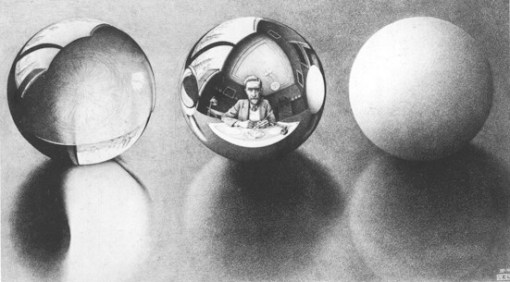
3 Spheres II by M.C. Escher

“Mathematicians know their subject is beautiful. Escher shows us that it’s beautiful.” That’s a lovely little quote from mathematician Ian Stewart in this short little clip called, The Mathematical Art of M.C. Escher. If you’re up for something more substantial, here’s an hour-long documentary called Metamorphose, which features video of Escher himself hard at work, something I had never seen before! If you end up watching, leave us a comment and let us know what you think.

We’ve also put together a YouTube playlist of every video ever featured on Math Munch, which we will continue to update. If you want to find the coolest math vids on the internet, I’d say that’s a good place to start.

Bon appetit!

Faces, Blackboards, and Dancing PhDs

Welcome to this week’s Math Munch!

What does a mathematician look like? What does a mathematician do? Here are a couple of things I ran across recently that give a window into what it’s like to be a professional research mathematician—someone who works on figuring out new math as their job.

Gary Davis, who blogs over at Republic of Mathematics, recently posted a short piece that challenges stereotypes about mathematicians. It’s called What does a mathematician look like?

Who here is a mathematician? Click through to find out!

Gary’s point is that you can’t tell who is or isn’t a mathematician just by looking at them. Mathematicians come from every background and heritage. Gary followed up on this idea in another post where he highlighted some notable mathematicians who are black women. Here’s a website called Black Women in Mathematics that shares some biographies and history. And here’s a link to the Infinite Possibilities Conference, a yearly gathering “designed to promote, educate, encourage and support minority women interested in mathematics and statistics.” Suzanne Weekes, one of the five mathematicians pictured above, was a speaker at this conference in 2010.

Richard Tapia, another of the mathematicians above, is featured in the following video. His life story both inspires and delights.

And what does this diversity of mathematicians do all day? Well, one thing they do is talk to each other about math! And though there are many new technologies that help people to do and share and collaborate on mathematics (like blogs!), it’s hard to beat a handy chalkboard as a scribble pad for sharing ideas.

At Blackboard of the Day, Mathieu Rémy and Sylvain Lumbroso share the results of these impromptu math jam sessions. Every day they post a photograph of a blackboard covered in doodles and calculations and sketches of ideas. The website is in French, but the mathematical pictures are a universal language.

Diana Davis, putting the finishing touches on a blackboard masterpiece

Sharing mathematical ideas can take many forms, and sometimes choosing the right medium can make all the difference. Mathematicians use pictures, words, symbols, sculptures, movies, songs—even dances! Let me point you to the “Dance your Ph.D.” Contest. It’s exactly what it sounds like—people sharing the ideas of their dissertations (their first big piece of original work) through dance. Entries come in from physicists, chemists, biologists, and more.  Below you’ll find an entry by Diana Davis, a mathematician who completed her dissertation at Brown University this past spring. Diana often studies regular polgyons and especially ways of “dissecting” them—breaking them up into pieces in interesting ways.

Thanks to The Aperiodical—a great math blog—for sharing Diana’s wonderful video!

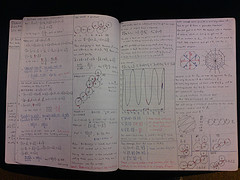
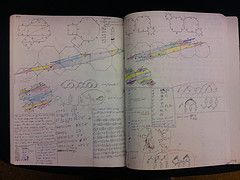
Some pages from Diana’s notebooks

All kinds of mathematicians study math and share it in so many ways. It’s like a never-ending math buffet!

Bon appetit!

Math Cats, Frieze Music, and Numbers

Welcome to this week’s Math Munch!

I just ran across a website that’s chock full of cool math applets, links, and craft ideas – and perfect for fulfilling those summer math cravings!  Math Cats was created by teacher and parent Wendy Petti to, as she says on her site, “promote open-ended and playful explorations of important math concepts.”

Math Cats has a number of pages of interesting mathematical things to do, but my favorite is the Math Cats Explore the World page.  Here you’ll find links to cool math games and explorations made by Wendy, such as…

… the Crossing the River puzzle!  In this puzzle, you have to get a goat, a cabbage, and a wolf across a river without any of your passengers eating each other!  And…

… the Encyclogram!  Make beautiful images called harmonograms, spirographs, and lissajous figures with this cool applet.  Wendy explains some of the mathematics behind these images, too. And, one of my favorites…

Scaredy Cats!  If you’ve ever played the game NIM, this game will be very familiar.  Here you play against the computer to chase cats away – but don’t be left with the last cat, or you’ll lose!

These are only a few of the fun activities to try on Math Cats.  If you happen to be a teacher or parent, I recommend that you look at Wendy’s Idea Bank.  Here Wendy has put together a very comprehensive and impressive list of mathematics lessons, activities, and links contributed by many teachers.

Next, Vi Hart has a new video that showcases one of my favorite things in mathematics – the frieze.  A frieze is a pattern that repeats infinitely in one direction, like the footsteps of the person walking in a straight line above.  All frieze patterns have translation symmetry – or symmetry that slides or hops – but some friezes have additional symmetries.  The footsteps above also have glide reflection symmetry – a symmetry that flips along a horizontal line and then slides.  Frieze patterns frequently appear in architecture.  You can read more about frieze patterns here.

Reading about frieze patterns is all well and good – but what if you could listen to them?  What would a translation sound like?  A glide reflection?  The inverse of a frieze pattern?  Vi sings the sounds of frieze patterns in this video.

[youtube http://www.youtube.com/watch?v=Av_Us6xHkUc&feature=BFa&list=UUOGeU-1Fig3rrDjhm9Zs_wg]

Do you have your own take on frieze music?  Send us your musical compositions at MathMunchTeam@gmail.com .

Finally, if I were to ask you to name the number directly in the middle of 1 and 9, I bet you’d say 5.  But not everyone would.  What would these strange people say – and why would they also be correct?  Learn about this and some of the history, philosophy, and psychology of numbers – and hear some great stories – in this podcast from Radiolab.  It’s called Numbers.

Bon appetit!

P.S. – Paul made a new Yoshimoto video!  The Mega-Monster Mesh comes alive!  Ack!

[youtube https://www.youtube.com/watch?v=PMpr8pA5lJw&feature=player_embedded]

P.P.S. – Last week – June 28th, to be exact – was Tau Day.  For more information about Tau Day and tau, check out the last bit of this old Math Munch post.  In honor of the occasion, Vi Hart made this new tau video.  And there’s a remix.