Author Archives: Justin Lanier

We Use Math, Integermania, and Best-of-Seven

Welcome to this week’s Math Munch!

astronaut“When will I use math?” Have you ever asked this question? Well, then you are in for a treat, because the good people of We Use Math have some answers for you! This site was created by the Math Department at Brigham Young University to help share information about career paths that are opened up by studying mathematics. Here’s their introductory video:

The We Use Math site shares write-ups about a wide range of career opportunities that involve doing mathematics. I was glad to learn more about less-familiar mathy careers like technical writing and cost estimation. Also, my brother has studied some operations management in college, so it was great to read the overview of that line of work. In addition, the We Use Math site has pages about recent math discoveries and about unsolved math problems. Check them out!

Next up is one of my long-time favorite websites: Integermania!

Perhaps you’ve heard of the four 4’s problem before. Using four 4’s and some arithmetic operations, can you make the numbers from 1 to 20? Or even higher? Some numbers are easy to make, like 16. It’s 4+4+4+4. Some are sneakier, like 1. One way it can be created is (4+4)/(4+4). But what about 7? Or 19? This is a very common type of problem in mathematics—which math objects of a certain type can be built with limited tools?

swilson21-e1315080873212

Steven J. Wilson

Integermania is a website where people from around the world have submitted number creations made of four small numbers and operations. It’s run by Steven J. Wilson, a math professor at Johnson County Community College in Kansas. (Steven has even more great math resources at his website Milefoot.com)

There are many challenges at Integermania: four 4’s, the first four prime numbers, the first four odds, and even the digits of Ramanujan’s famous taxicab number (1729).
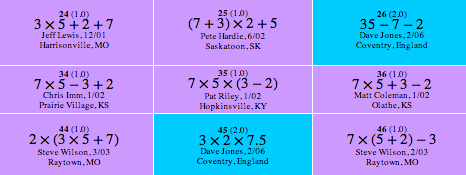
Here are some number creations made of the first four prime numbers. Can you make some of your own?

Here are some number creations made of the first four prime numbers.
Can you make some of your own?

One of my favorite aspects of Integermania is the way it rates number creations by “exquisiteness level“. If a number creation is made using only simple operations—like addition or multiplication—then it’s regarded as more exquisite than if it uses operations like square roots or percentages. I also love how Integermania provides an opportunity for anyone to make their mark in the big world of mathematical research—it’s like scrawling a mathematical “I wuz here!” After years of visiting the site, I just submitted for the first time some number creations of my own. I’ll let you know how it goes, and I’d love to hear about it if you decide to submit, too.

Here are recaps of all the World Series since 1903 from MLB.com

Here are recaps of all the World Series since 1903 from MLB.com

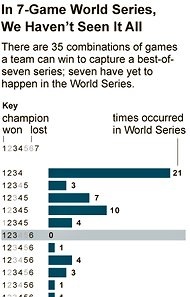
Now coming to the plate: my final link of the week! Monday was the first day of the new Major League Baseball season. I want to share with you a New York Times article from last December. It’s called Keeping Score: Over in Four About a Fifth of the Time. The article digs into the outcomes of all of the World Series championships—not so much who won as how they won. It takes four victories to win a seven-game series, and there are 35 different ways that a best-of-seven series can play out, put in terms of wins and losses for the overall winner. For instance, a clean sweep would go WWWW, while another sequence would be WWLLWW. The article examines which of these win-loss sequences have been the most common in the World Series.

(Can you figure out why there are 35 possible win-loss sequences in a seven-game series? What about for a best-of-five series? And what if we tried to model the outcome of a series by assuming each team has a fixed chance of winning each game?)
worldseriesstats

A clip of the stats that are displayed in the Times article. Click through to see it all.

I was curious to know if the same results held true in other competitions. Are certain win-loss sequences rare across different sports? Are “sweeps” the most common outcome? After sifting through Wikipedia for a while, I was able to compile the statistics about win-loss sequences for hockey’s Stanley Cup Finals. This has been a best-of-seven series since 1939, and it has been played 73 times since then. (It didn’t happen in 2005 because of a lockout.) You can see the results of my research in this document. Two takeaways: sweeps are also the most common result in hockey, but baseball more frequently requires the full seven games to determine a winner.

It could be a fun project to look at other best-of-seven series, like the MLB’s League Championship Series or basketball’s NBA Finals. If you pull that data together, let us know in the comments!

Batter up, and bon appetit!

******

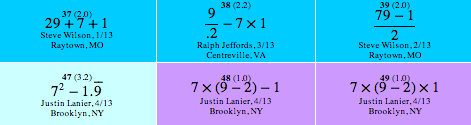
UPDATE (4/4/13): My first set of five number creations was accepted and are now posted on the Ramanujan challenge page. Here are the three small ones! Can you find a more exquisite way of writing 47 than I did?
myintegermania

Dots-and-Boxes, Choppy Waves, and Psi Day

Welcome to this week’s Math Munch!

And happy Psi Day! But more on that later.

dots

Click to play Dots-and-Boxes!

Recently I got to thinking about the game Dots-and-Boxes. You may already know how to play; when I was growing up, I can only remember tic-tac-toe and hangman as being more common paper and pencil games. If you know how to play, maybe you’d like to try a quick game against a computer opponent? Or maybe you could play a low-tech round with a friend? If you don’t know how to play or need a refresher, here’s a quick video lesson:

In 1946, a first grader in Ohio learned these very same rules. His name was Elwyn Berlekamp, and he went on to become a mathematician and an expert about Dots-and-Boxes. He’s now retired from being a professor at UC Berkeley, but he continues to be very active in mathematical endeavors, as I learned this week when I interviewed him.

Elwyn Berlekamp

Elwyn Berlekamp

In his book The Dots and Boxes Game: Sophisticated Child’s Play, Elwyn shares: “Ever since [I learned Dots-and-Boxes], I have enjoyed recurrent spurts of fascination with this game. During several of these burst of interest, my playing proficiency broke through to a new and higher plateau. This phenomenon seems to be common among humans trying to master any of a wide variety of skills. In Dots-and-Boxes, however, each advance can be associated with a new mathematical insight!”

Elwyn's booklet about Dots-and-Boxes

Elwyn’s booklet about
Dots-and-Boxes

In his career, Elywen has studied many mathematical games, as well as ideas in coding. He has worked in finance and has been involved in mathematical outreach and community building, including involvement with Gathering for Gardner (previously).

Elywn generously took the time to answer some questions about Dots-and-Boxes and about his career as a mathematician. Thanks, Elywn! Again, you should totally check out our Q&A session. I especially enjoyed hearing about Elwyn’s mathematical heros and his closing recommendations to young people.

As I poked around the web for Dots-and-Boxes resources, I enjoyed listening to the commentary of Phil Carmody (aka “FatPhil”) on this high-level game of Dots-and-Boxes. It was a part of a tournament held on a great games website called Little Golem where mathematical game enthusiasts from around the world can challenge each other in tournaments.

What's the best move?A Sam Loyd Dots-and-Boxes Puzzle

What’s the best move?
A Dots-and-Boxes puzzle by Sam Loyd.

And before I move on, here are two Dots-and-Boxes puzzles for you to try out. The first asks you to use the fewest lines to saturate or “max out” a Dots-and-Boxes board without making any boxes. The second is by the famous puzzler Sam Loyd (previously). Can you help find the winning move in The Boxer’s Puzzle?

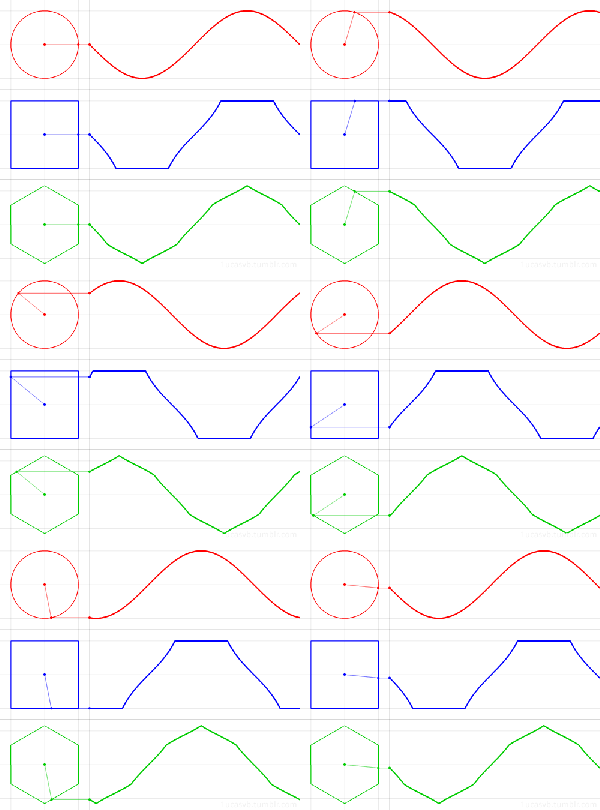
Next up, check out these fantastic “waves” traced out by “circling” these shapes:

Click the picture to see the animation!

Lucas Vieira—who goes by LucasVB—is 27 years old and is from Brazil. He makes some amazing mathematical illustrations, many of them to illustrate articles on Wikipedia. He’s been sharing them on his Tumblr for just over a month. I’ll let his images and animations speak for themselves—here are a few to get you started!

A colored-by-arc-length Archimedean spiral.

A colored-by-arc-length Archimedean spiral.

File:Sphere-like_degenerate_torus

A sphere-like degenerate torus.

A Koch cube.

A Koch cube.

There’s a great write-up about Lucas over at The Daily Dot, which includes this choice quote from him: “I think this sort of animated illustration should be mandatory in every math class. Hopefully, they will be some day.” I couldn’t agree more. Also, Lucas mentioned to me that one of his big influences in making mathematical imagery has always been Paul Nylander. More on Paul in a future post!

Psi is the 23rd letter in the Greek alphabet.

Psi is the 23rd letter in the Greek alphabet.

Finally, today—March 11—is Psi Day! Psi is an irrational number that begins 3.35988… And since March is the 3rd month and today is .35988… of the way through it–11 out of 31 days—it’s the perfect day to celebrate this wonderful number!

What’s psi you ask? It’s the Reciprocal Fibonacci Constant. If you take the reciprocals of the Fibonnaci numbers and add them add up—all infinity of them—psi is what you get.

psisum

Psi was proven irrational not too long ago—in 1989! The ancient irrational number phi—the golden ratio—is about 1.61, so maybe Phi Day should be January 6. Or perhaps the 8th of May—8/5—for our European readers. And e Day—after Euler’s number—is of course celebrated on February 7.

That seems like a pretty good list at the moment, but maybe you can think of other irrational constants that would be fun to have a “Day” for!

And finally, I’m sure I’m not the only one who’d love to see a psi or Fibonacci-themed “Gangham Style” video. Get it?

Bon appetit!

******

EDIT (3/14/13): Today is Pi Day! I sure wish I had thought of that when I was making my list of irrational number Days…

Folds, GIMPS, and More Billiards

Welcome to this week’s Math Munch!

First up, we’ve often featured mathematical constructions made of origami. (Here are some of those posts.) Origami has a careful and peaceful feel to it—a far cry from, say, the quick reflexes often associated with video games. I mean, can you imagine an origami video game?

heartfolds

One of Fold’s many origami puzzles.

Well, guess what—you don’t have to, because Folds is just that! Folds is the creation of Bryce Summer, a 21-year-old game designer from California. It’s so cool. The goal of each level of its levels is simple: to take a square piece of paper and fold it into a given shape. The catch is that you’re only allowed a limited number of folds, so you have to be creative and plan ahead so that there aren’t any loose ends sticking out. As I’ve noted before, my favorite games often require a combo of visual intuition and careful thinking, and Folds certainly fits the bill. Give it a go!

Once you’re hooked, you can find out more about Bryce and how he came to make Folds in this awesome Q&A. Thanks so much, Bryce!

gimpsNext up, did you know that a new largest prime number was discovered less than a month ago? It’s very large—over 17 million digits long! (How many pages would that take to print or write out?) That makes it way larger than the previous record holder, which was “only” about 13 million digits long. Here is an article published on the GIMPS website about the new prime number and about the GIMPS project in general.

What’s GIMPS you ask? GIMPS—the Great Internet Mersenne Primes Search—is an example of what’s called “distributed computing”. Testing whether a number is prime is a simple task that any computer can do, but to check many or large numbers can take a lot of computing time. Even a supercomputer would be overwhelmed by the task all on its own, and that’s if you could even get dedicated time on it. Distributed computing is the idea that a lot of processing can be accomplished by having a lot of computers each do a small amount of work. You can even sign up to help with the project on your own computer. What other tasks might distributed computing be useful for? Searching for aliens, perhaps?

GIMPS searches only for a special kind of prime called Mersenne primes. These primes are one less than a power of two. For instance, 7 is a Mersenne prime, because it’s one less that 8, which is the third power of 2. For more on Mersenne primes, check out this video by Numberphile.

Finally, we’ve previously shared some resources about the math of billiards on Math Munch. Below you’ll find another take on bouncing paths as Michael Moschen combines the math of billiards with the art of juggling.

So lovely. For more on this theme, here’s a second video to check out.

Bon appetit!