Author Archives: Justin Lanier

Pentomino Puzzles, Knight’s Tours, and Decimal Maxing

Welcome to this week’s Math Munch!

Have a pentomino tiling problem that’s got you stumped?  Then perhaps the Pentominos Puzzle Solver will be right up your alley! Recently I’ve been thinking a lot about using computer programming and search algorithms to solve mathematical problems, and the Pentomino Puzzle Solver is a great example of the power of coding.  Written by David Eck, a professor of math and computer science at Brandeis University, the solver can find tilings of a variety of shapes.  Watch the application in slow-mo to see how it works; put it into high-gear to see the power of doing mathematics with computers!

Next, here’s a wonderful page about knight’s tours maintained by George Jelliss, a retiree from the UK.  He says on his introductory page, “I have been interested in questions related to the geometry of the knight’s move since the early 1970s.” George has investigated “leapers” or “generalized knights”—pieces that move in other L-shapes than the traditional 2×1—and he even published his own chess puzzle magazine for a number of years.  His webpage includes a great section about the history of knights tours, and I’m a fan of the beautiful catalog of “crosspatch” tours. Great stuff!

Multiplication, addition, division: which gives the biggest result?

Last but not “least”, to the left you’ll find a tiny chunk of a very large table that was constructed and colored by Debra Borkovitz, a math professor at Wheelock College.  Debra describes how, “Students often have poor number sense about multiplication and division with numbers less than one.”  She created an investigation where students decide, for any pair of decimals, which is biggest–multiplying them, adding them, or subtracting them.  For 1.0 and 1.0 the answer is easy–you should add them, so that you get 2.  .5 and 1 is trickier–adding yields 1.5, multiplying gives .5, but dividing 1 by .5 makes 2, since there are two halves in 1. Finding the biggest value possible given some restrictions is called “maximization” in mathematics, and it’s a very popular type of problem with many applications.

This investigation about makes me wonder: what other kinds of tables could I try to make?

Debra mentions that she got the inspiration for this problem from a newsletter put out by the Association of Women in Mathematics.  There’s lots to explore on their website, including an essay contest for middle schoolers, high schoolers, and undergraduates.

I hope you found something here to enjoy.  Bon appetit!

Triangles, Triangles, Triangles!

Welcome to this week’s Math Munch!

Inspired by Vi Hart’s most recent doodling video “Triangle Party!”, this week’s post is all about triangles.

Connie Liu

One of the most amazing things about mathematics is that there are always new discoveries to be made about even the simplest of objects–even triangles!  Check out this article about Connie Liu, a Hawaiian teenager who just last year discovered some new formulas that relate special points of triangles to each other.  Connie has found some new, simple, and interesting ways of describing the triangle inequality – just by sticking with her questions and digging into a particular part of mathematics a little deeper than anyone had before.

Next up, here are some visual perspectives on Pascal’s triangle.  Even folks who are well acquainted with this numerical cascade are likely to find something new to see in these blog posts by Tao Wang.  Tao is a math and computer teacher in NYC.  My favorite visualization is the video that depicts the entries of Pascal’s triangle as blocks that are as tall as their numerical value.

Hat tip to Patrick Honner, a math teacher from Brooklyn, for the Pascal’s triangle visualizations.  Patrick writes a sweet mathematical blog, including a running series of photographs about the math that he sees in the world.  Check out his posts about which of these isosceles triangles is “more equilateral.”

Zooming in on the corner of a Koch snowflake.

Finally, Vi mentions and doodles a Koch snowflake in her video.  This seems timely, what with snowfalls likely just around the corner.  Here are some great images of generalizations of the Koch snowflake by Phil Keenan that he made using computers.

Wow, what a great crop of other blogs for you to explore!

Here is a list of them all:

Math Laoshi by Tao Wang

Math Appreciation by Patrick Honner

Meandering Through Mathematics by Phil Keenan

and of course Vi Hart’s Blog

Stay tuned for more winter-inspired mathematics next week!

Bon appetit!

Math Craft, Philippa Fawcett, and Mandelbrot

Welcome to this week’s Math Munch!

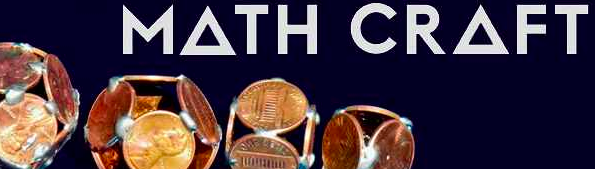
Math Craft is a supersweet website where members submit their mathematically inspired art and instructions about how to make your own.  I love the polyhedra made out of pennies in the masthead, these curve stitches, and these polyhedral pumpkins!  Here is a link to Math Craft’s welcome page, authored by admin Cory Poole.  Cory is a math and physics teacher at University Preparatory School in California. The welcome page includes some instructions for creating some great paper polyhedra. Math Craft is just starting up; I’m sure there will be many more great project to be found there in the future!

Philippa Fawcett, who broke the glass ceiling of Cambridge mathematics

An article recently appeared on the Past Imperfect blog on Smithsonian.com about the compelling story of Philippa Fawcett. Fawcett was the first and only woman to make the highest score on the Cambridge tripos mathematical exam.  She did so during an age when the predominant opinion was that women were incapable and weak and certainly couldn’t excel at mathematics.  Fawcett’s performance on this exam did much to dispel this prejudice.  The article not only relates an interesting chapter from history, but also give an inspiring account of a person’s drive to success despite enormous obstacles.

Finally, by request, a journey through the Mandelbrot set:

[youtube http://www.youtube.com/watch?v=F_nfHY61T-U&feature=related]

Benoit Mandelbrot, the father of fractal geometry, passed away about a year ago. You can listen to his outstanding TED talk about his life’s work here. I love his enthusiasm and curiosity, as well as how he can find marvels in the seemingly ordinary.  Also, how much fun is the way he pronounces “cauliflower”?!  You can find a memorial to Benoit Mandelbrot in last November’s edition of Peer Points.

Bon appetit!