Author Archives: Paul Salomon

Möbius, Escher, Hart

Happy New Year, and welcome to this week’s Math Munch!

Next week, the Math Munch team will be part of a Mathematical Art seminar, so we are featuring some great art.
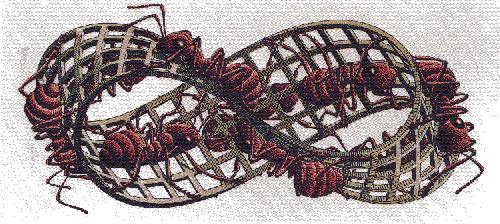
Möbius Strip II (Red Ants) | M.C. Escher

Check out the Möbius strip.  It’s a topological space you can make by by putting a twist in a looped strip of paper.  It has the bizarre property of being one-sided!  Here’s a video of someone making it, but the music is pretty strange.  I found some Möbius info on an amazing math website called Cut The Knot.  Click herehere and here for three different Möbius pages.
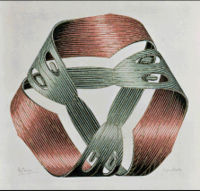
Möbius Strip I | M.C. Escher

M.C. Escher popularized the Möbius strip by featuring them in his famous and mathematical prints.  The picture to the right gives you some idea what happens if you cut a Möbius strip in half.  You could give that a try.

If you look at these pictures, you’ll see why mathematicians love Escher’s art so much.  Escher liked to play with the impossible in his art, but several mathematicians have made his dreams reality.  Take a look at this site called Escher For Real.  If you liked that, check out the sequel, Beyond Escher for Real.

And of course, Vi Hart has done it again, this time with two pieces of Möbius art.  First, Vi bought a DIY (do-it-yourself) music box and wrote a Möbius song!  You can get your own music box here.  She also wrote a Möbius story called Wind and Mr. Ug, and the video is embedded below.

Hoping you have a mathematical week.  Bon appetit!

Number Gossip, Travels, and Topology

Thanksgiving was great, but I hope you saved room for this week’s Math Munch!

First up, meet Tanya Khovonova, a mathematician and blogger who works at MIT.  Number Gossip is a website of hers where you can find the mysterious facts behind your favorite numbers.  For instance, did you know that the opposite sides of a die add to 7, or that 7 is the only prime number followed by a cube (8=23)? Speaking of 7, I also found this cool test for divisibility by 7 on Tanya’s website.

Tanya Khovonova

Is that divisible by 7? Let's take a walk.

Read about how to use it here, but basically you follow that diagram a certain way, and if you land back at the white dot, then you’re number is divisible by 7. I’m amazed and trying to figure out how it works!

Infographic - Holiday Travel Patterns

Next up, I wanted to share this incredible picture I found today.  It’s an infographic showing travel patterns in the US during the holiday season.  The picture must represent millions of little pieces of data, so I’ve spent a lot of time staring and analyzing it.  Did you notice the bumps in the bottom?  Why is that happening?  Why are the blue lines different from the white lines? There are so many good things to be seen.

Finally, take a look at these pictures!  They’re from Kenneth Baker’s Sketches of Topology blog.  Kenneth makes images demonstrating ideas in topology, one of the most visually appealing branches of mathematics.  Some of it is tough to understand, but the pictures certainly are fascinating.

On a related point, have you taken a look at the Math Munch page of math games? (You can always find the link at the top of the column to the right.)  I just added a topology game, the Four Color Game, and I’m kind of loving it.  It’s based on a famous math result about only needing 4 colors to nicely color any flat map.  This is called the Four Color Theorem, and it’s a part of topology.

Bon appetit!

Balloons, Numbers, and Mathemusic

Welcome to this week’s Math Munch!  We’ve got a full plate for you.

Vi Hart and Balloon Art

Vi Hart is a “recreational mathemusician,” which means she spends a lot of her free time making math, music, and art of all kinds.  She is best known for her “doodling in math class” videos, but her website is full of cool and creative projects.  This week we’re featuring Vi’s balloon art. There are lots of cool pictures and instructions to make your own balloon creations!

Landon Curt Noll

Next up, Landon Curt Noll is a number theorist, computer scientist, and astronomer who does and makes all kinds of cool things.  Three different times, he discovered the largest prime numbers anyone had ever found!  Here’s a link to his list of curious patterns in the prime numbers.  In another venture, Landon wrote a neat little program that tells you the English name of a number.  How do you pronounce 1,213,141,516,171,819?  Give it a try.  I know million, billion, trillion, quadrillion, and quintillion, but what’s after that?  Check it out: Landon lists the first 10,000 powers of ten!

Finally, the connections between math and music often inspire awesome creations.  Here’s a beautiful video by Michael John Blake in which he converts the digits of pi to notes, and we get to hear what pi sounds like.

Here’s a similar video by Lars Erickson who wrote an entire symphony based on the idea.  “The Pi Symphony” also includes the sound of e, another important math number which is about 2.71828…

Bon appetit!