Category Archives: Math Munch

Braids, Hacktastic, and Rock Climbing

Welcome to this week’s Math Munch!
lym_angel

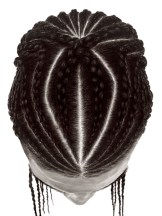
Math hair braiding art by So Yoon Lym, shown at the 2014 Joint Mathematics Meetings.

First up, a little about one of my favorite things to do (and part of what got me into math in the first place!): hair braiding. If you’ve ever done a complicated braid in someone’s hair before, you might have had an inkling that something mathematical was going on. Well, you’re right! Mathematicians Gloria Ford Gilmer and Ron Eglash have spent much of their careers studying and teaching about the math that goes into hair braiding.

SYL_Diosnedys_new1

See the tessellation?

In their research, Gloria and Ron investigate how math can improve hair braiding, how hair braiding can improve math, and how the overlap between the two can teach us about how different cultures use and understand math. As Gloria shows in her article on math and braids, tessellations are very important to braided designs.

braids

And so are fractals! Ron studies how fractals are used in African and African American designs, including in the layouts of towns, tile patterns, and cornrow braids. (Watch his TED Talk to learn more!) On his beautiful website dedicated to the math of cornrows, Ron shows how braiders use tools essential to making fractals to design their braids.

programmed braid

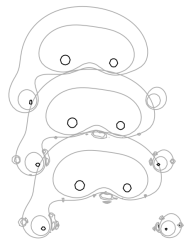
Just like when making a fractal, braid designers repeat the same shape while shifting, rotating, reflecting, and shrinking it. You can design your own mathematical cornrow braid using Ron’s braid programming app! If you’ve ever used Scratch, this app will look very familiar. I made the spiral braid on the right using the app. Next challenge: try to make your braid on a real head of hair…

trig bracelets Laura Taalman

Next up, a little about something I wish I could do: make awesome 3D-printed art! Here’s a blog that might help me (and you) get started. Mathematician Laura Taalman (who calls herself @mathgrrl on Twitter) writes a blog called Hacktastic all about making math designs, using a 3D-printer and many other tools. She has designs for all kinds of awesome things, from Menger sponges to trigonometric bracelets. One of the best things about Laura’s site is that she tells you the story behind how she came up with her designs, along with all the instructions and code you’ll ever need to make her designs yourself.

Rock climbing Skip

Skip Garibaldi, climbing

Finally, a little about something I’m trying to learn to do better: rock climbing! Mathematician Skip Garibaldi loves both math and rock climbing– so he decided to combine his interests for the better of each. In this video, Skip discusses some of the mathematical ideas important to rock climbing– including some essential to a type of climbing that I find most intimidating, lead climbing. Check it out!

Bon appetit!

Dearing, Edmark, and The Octothorpean Order

Welcome to this week’s Math Munch!

Dearing Wang

Dearing Wang

First up is a wonderful mathematical artist I found on instagram, under the name dearing_draws. Click to see the wonderful work of Dearing Wang. The instagram stream includes lots of timelapse videos showing the creation of the images, which is lovely, but even better is that Dearing has a youtube channel and a website devoted to teaching people how to make their own!! You should click over and follow a tutorial. Make something beautiful and send us a picture.

3 Fish in a Pond

3 Fish in a Pond

Tutorial Video

The Diamond Wedge Pattern

The Diamond Wedge Pattern

Tutorial Video

Impossible Octagon

Impossible Octagon

Tutorial Video

Another great thing about Dearing’s website is that he has a page where you can print out blank sheets to color, if that’s your thing. Not quite as mathematical, maybe, but it is nice. I like to color sometimes, and if you color systematically, maybe symmetrically, then it’s fairly mathematical after all. UPDATE: Dearing has agreed to let us host some some of his coloring sheets on Math Munch.  Click here for easily downloadable sheets to color.

John Edmark

John Edmark

Up next is another mathematical artist, John Edmark, a designer and adjunct professor at Stanford University. I was introduced to John’s incredible work through the following video. Just watch and let your jaw hit the floor in amazement.

This is a video of a zoetrope. The pieces spin and the camera shutter is timed to only show certain points in their rotation. What we see is sort of like a little loop of film showing us several frames of the animation. It’s impressive that John put all those frames together into sculptures that are beautiful, even when they’re not spinning.

PatTurn

PatTurn

But that isn’t all, there’s lots more to see on John’s website. I found his spiral videos pretty mesmerizing and fantastic. I also really like his artist statement, which begins “If change is the only constant in nature, it is written in the language of geometry.” I also just really like hearing artists talk about their work, because it’s a sort of behind the scenes look into their creative process and thinking.

(3D printable files are also available here for the incredibly fortunate among us with access to a 3D printer.)

An octothorpe

An Octothorpe

Finally, if you like solving riddles and puzzles, check out The Octothorpean Order. This is sort of an online puzzle hunt, with clues and tips on the website. You can read about it, but the best thing to do is dive in and start solving puzzles. You probably have to create a user name, but it’s good fun. I recommend it.

By the way,  “octothorpe” is the technical word for the “hashtag” or “pound” or “number sign.” It means eight fields, and I think it represents a farmers house in the middle and eight fields arround it. Cool right?

Here’s to having a mathematical week.  Bon appetit!

Squircles, Coloring Books, and Snowfakes

Welcome to this week’s Math Munch!

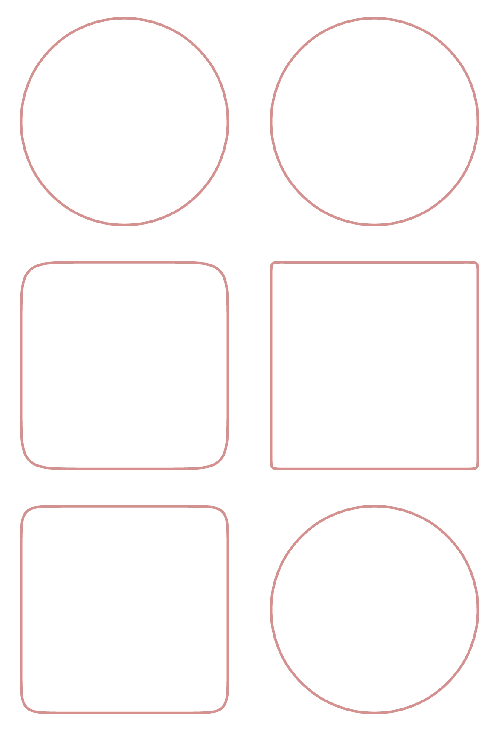
Squares and circles are pretty different. Squares are boxy and have their feet firmly on the ground. Circles are round and like to roll all over the place.

Superellipses.

Superellipses.

Since they’re so different, people have long tried to bridge the gap between squares and circles. There’s an ancient problem called “squaring the circle” that went unsolved for thousands of years. In the 1800s, the gap between squares and circles was explored by Gabriel Lamé. Gabriel invented a family of curves that both squares and circles belong to. In the 20th century, Danish designer Piet Hein gave Lamé’s family of curves the name superellipses and used them to lay out parts of cities. One particular superellipse that’s right in the middle is called a squircle. Squircles have been used to design everything from dinner plates to touchpad buttons.

The space of superellipsoids.

The space of superellipsoids.

Piet had the following to say about the gap between squares and circles:

Things made with straight lines fit well together and save space. And we can move easily — physically or mentally — around things made with round lines. But we are in a straitjacket, having to accept one or the other, when often some intermediate form would be better. … The super-ellipse solved the problem. It is neither round nor rectangular, but in between. Yet it is fixed, it is definite — it has a unity.

"Squaring the Circle" by Troika.

“Squaring the Circle” by Troika.

These circles aren't what they seem to be.

These circles aren’t what they seem to be.

There’s another kind of squircular object that I ran across recently. It’s a sculpture called “Squaring the Circle”, and it was created by a trio of artists known as Troika. Check out the images on this page, and then watch a video of the incredible transformation. You can find more examples of room-sized perspective-changing objects in this article.

Next up: it’s been a snowy week here on the east coast, so I thought I’d share some ideas for a great indoor activity—coloring!

Marshall and Violet.

Marshall and Violet.

Marshall Hampton is a math professor at University of Minnesota, Duluth. Marshall studies n-body problems—a kind of physics problem that goes all the way back to Isaac Newton and that led to the discovery of chaos. He also uses math to study the genes that cause mammals to hibernate. Marshall made a coloring book full of all kinds of lovely mathematical images for his daughter Violet. He’s also shared it with the world, in both pdf and book form. Check it out!

Screen Shot 2015-01-27 at 1.35.54 PM Screen Shot 2015-01-27 at 1.36.11 PM Screen Shot 2015-01-27 at 1.36.31 PM

Inspired by Mashrall’s coloring book, Alex Raichev made one of his own, called Contours. It features contour plots that you can color. Contour plots are what you get when you make outlines of areas that share the same value for a given function. Versions of contour plots often appear on weather maps, where the functions are temperature, atmospheric pressure, or precipitation levels.

Contour plots are useful. Alex shows that they can be beautiful, too!

Screen Shot 2015-01-27 at 1.19.18 PM Screen Shot 2015-01-27 at 1.19.48 PM Screen Shot 2015-01-27 at 1.20.13 PM

And there are even more mathematical patterns to explore in the coloring sheets at Patterns for Colouring.

Screen Shot 2015-01-27 at 10.55.35 AM
Screen Shot 2015-01-27 at 10.51.45 AM
Screen Shot 2015-01-27 at 11.07.17 AM

Last up, that’s not a typo in this week’s post title. I really do want to share some snowfakes with you—some artificial snowflake models created with math by Janko Gravner and David Griffeath. You can find out more by reading this paper they authored, or just skim it for the lovely images, some of which I’ve shared below.

Screen Shot 2015-01-27 at 2.05.49 PM Screen Shot 2015-01-27 at 2.05.28 PM Screen Shot 2015-01-27 at 2.06.04 PM

I ran across these snowfakes at the Mathematical Imagery page of the American Mathematical Society. There are lots more great math images to explore there.

Bon appetit!

Reflection sheet – Squircles, Coloring Books, and Snowfakes