Category Archives: Math Munch

Folds, GIMPS, and More Billiards

Welcome to this week’s Math Munch!

First up, we’ve often featured mathematical constructions made of origami. (Here are some of those posts.) Origami has a careful and peaceful feel to it—a far cry from, say, the quick reflexes often associated with video games. I mean, can you imagine an origami video game?
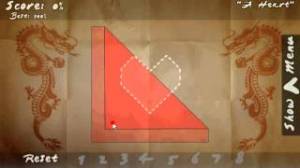
heartfolds

One of Fold’s many origami puzzles.

Well, guess what—you don’t have to, because Folds is just that! Folds is the creation of Bryce Summer, a 21-year-old game designer from California. It’s so cool. The goal of each level of its levels is simple: to take a square piece of paper and fold it into a given shape. The catch is that you’re only allowed a limited number of folds, so you have to be creative and plan ahead so that there aren’t any loose ends sticking out. As I’ve noted before, my favorite games often require a combo of visual intuition and careful thinking, and Folds certainly fits the bill. Give it a go!

Once you’re hooked, you can find out more about Bryce and how he came to make Folds in this awesome Q&A. Thanks so much, Bryce!
gimpsNext up, did you know that a new largest prime number was discovered less than a month ago? It’s very large—over 17 million digits long! (How many pages would that take to print or write out?) That makes it way larger than the previous record holder, which was “only” about 13 million digits long. Here is an article published on the GIMPS website about the new prime number and about the GIMPS project in general.

What’s GIMPS you ask? GIMPS—the Great Internet Mersenne Primes Search—is an example of what’s called “distributed computing”. Testing whether a number is prime is a simple task that any computer can do, but to check many or large numbers can take a lot of computing time. Even a supercomputer would be overwhelmed by the task all on its own, and that’s if you could even get dedicated time on it. Distributed computing is the idea that a lot of processing can be accomplished by having a lot of computers each do a small amount of work. You can even sign up to help with the project on your own computer. What other tasks might distributed computing be useful for? Searching for aliens, perhaps?

GIMPS searches only for a special kind of prime called Mersenne primes. These primes are one less than a power of two. For instance, 7 is a Mersenne prime, because it’s one less that 8, which is the third power of 2. For more on Mersenne primes, check out this video by Numberphile.

Finally, we’ve previously shared some resources about the math of billiards on Math Munch. Below you’ll find another take on bouncing paths as Michael Moschen combines the math of billiards with the art of juggling.

So lovely. For more on this theme, here’s a second video to check out.

Bon appetit!

The Sierpinski Valentine, Cardioids, and Möbius Hearts

Welcome to this week’s Math Munch!

With Valentine’s Day this Thursday, let’s take a look at some mathy Valentine stuff. If you’re searching for the perfect card design for your valentine, search no more. Math Munch has you covered!

Sierpinski Valentine

Randall Munroe

xkcd creator Randall Munroe

Above you can see a clever twist on the classic Sierpinski Triangle, which I found on xkcd, a wonderfully mathematical webcomic. You can read more about xkcd creator Randall Munroe in this interview from the Sept. 2012 issue of Math Horizons. (pdf version)

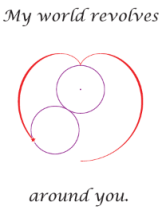
LargeCardRon Doerfler designed another math-insprired Valentine’s Day card, which you can check out here. The image to the left is only part of it. Don’t get it? Well it’s a reference to a mathematical curve called the cardioid (from the Greek word for “heart”). Look what happens if you follow a point on one circle as it rolls around another. You’ll have to imagine it tipped the other way so it’s oriented like a typical heart, but that curve is a cardioid. The second animation was created by the amazing and previously featured Matt Henderson. If you have a compass, then you can make the second one at home.

Cardioid Animation

A cardioid generated by one circle rolling around another

Cardioid Animation 2

A completely different way to generate a cardioid

SierpinskiLove

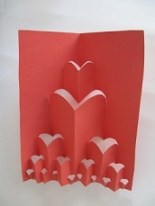
Pop-up Sierpinski Heart Card

Really though, nothing says “I Love you” like a Möbius strip. Am I right? Here’s a quick little project you can do to make a pair of linked Möbius hearts. You can find directions here on a blog called 360, or you can watch the video below. Oh, and as if that wasn’t enough great stuff, here’s one more project from the 360 blog, a pop-up version of the Sierpinski Heart!

Happy Valentine’s Day, and bon appetit!


Mathematical Impressions, Modular Origami, and the Tenth Dimension

Welcome to this week’s Math Munch!

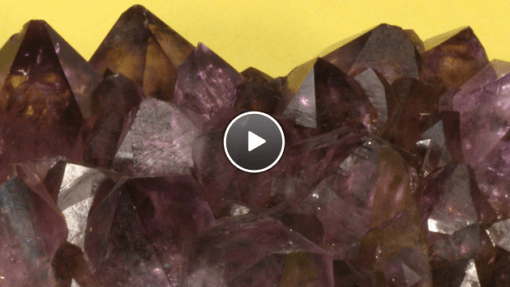
First up, check out the latest video in George Hart‘s series called “Mathematical Impressions.”  George has been making videos for “Mathematical Impressions,” which is sponsored by the Simons Foundation, since summer, when he made his video debut – so there are many videos to watch!  Here’s his newest video, called, “Attesting to Atoms,” about how the geometric structure of crystals gives clues to the existence of atoms.  (Click on the picture below to watch the video.)

Atoms video

I love how this video shows a real way in which knowledge of mathematics – which can seem very abstract at times – can help us to understand the structure of the world, which is very concrete.  In this second video, one of my favorites, George talks about the reverse of that – allowing our knowledge of something concrete to help us understand abstract mathematics.  This video is called, “Knot Possible.”  (Again, click on the picture to watch the video!)

Knot video

I could have used these words of wisdom from George when I was thinking about the problem he poses in this video: “Don’t let your knowledge of mathematics artificially limit what you think is physically possible.  Quite to the contrary!  Mathematics is a tool which can empower us to do amazing things that no one has ever done before.”  Well said, George!

sierpinski-tetrahedron-tri-2Speaking of using mathematics to do and make amazing things, check out this website of modular origami models and patterns!

This site was put together by Michal Kosmulski, who lives in Poland and works in information technology.  In addition, however, he folds these amazing modular origami polyhedra, fractals, and other awesome mathematical objects!  Michal’s site is full of pictures of his modular origami creations and links to patterns for how to make them yourself as well as information about the mathematics behind the objects.  He has also included some useful tips on how to make the more challenging shapes.

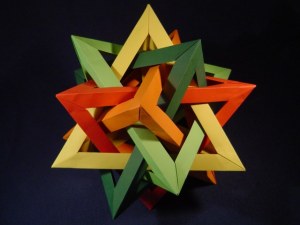
fit-five-intersecting-tetrahedra-60deg-2One of my favorites is the object to the left, “Five Intersecting Tetrahedra.”  I think that this structure is both beautiful and very interesting.  It can be made by intersecting five tetrahedra, or triangular-based pyramids, as shown, or by making a stellation of an icosahedron.  What does that mean?  Well, an icosahedron is a polyhedron with twenty equilateral triangular faces.  To stellate a polyhedron, you extend some element of the polyhedron – such as the faces or edges – in a symmetric way until they meet to form a new polyhedron.  There are 59 possible stellations of the icosahedron!  Michal has models of several of them, including the Five Intersecting Tetrahedra and the great stellated icosahedron shown below on the left.  The figure on the right is called “Cube.”

spiked-dodecahedron-ssitcube-oxi

Finally, all the talking about dimensions that we’ve been doing for the past few weeks reminded me of my favorite video about higher dimensions.  It’s called, “Imagining the Tenth Dimension,” and it shows a way of thinking about dimensions, from the zero dimension all the way up to the tenth.  I can watch this video again and again and still find it mind-blowing and fascinating.

Bon appetit!