Category Archives: Math Munch

Squaring, Water Calculator, and Snap the Turtle

Welcome to this week’s Math Munch!

I’ve been really into squares lately. Maybe it’s because I recently ran across a new puzzle involving squares– something called Mrs. Perkin’s quilt.
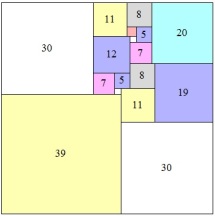
Mrs. Perkin's quilt 1

69 by 69 Mrs. Perkin’s quilt.

The original version of the puzzle was published way back in 1907, and it went like this: “For Christmas, Mrs. Potipher Perkins received a very pretty patchwork quilt constructed of 169 square pieces of silk material. The puzzle is to find the smallest number of square portions of which the quilt could be composed and show how they might be joined together. Or, to put it the reverse way, divide the quilt into as few square portions as possible by merely cutting the stitches.”
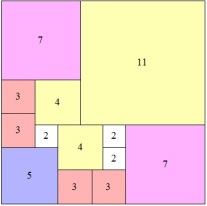
Mrs. Perkin's quilt 18

18 by 18 Mrs. Perkin’s quilt

Said in another way, if you have a 13 by 13 square, how can you divide it up into the smallest number of smaller squares? Don’t worry, you get to solve it yourself– I’m not including a picture of the solution to that version of the puzzle because there are so many beautiful pictures of solutions to the puzzle when you start with larger and smaller squares. Some are definitely more interesting than others. If you want to start simple, try the 4 by 4 version. I particularly like the look of the solution to the 18 by 18 version.
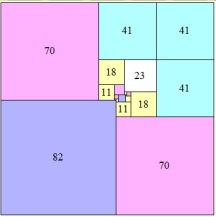
Mrs. Perkin's quilt 152

152 by 152 Mrs. Perkin’s quilt

Maybe you’re wondering where I got all these great pictures of Mrs. Perkin’s quits. And– wait a second– is that the solution to the 152 by 152 version? It sure is– and I got it from one of my favorite math websites, the Wolfram Demonstrations Project. The site is full of awesome visualizations of all kinds of things, from math problems to scans of the human brain. The Mrs. Perkin’s quilts demonstration solves the puzzle for up to a 1,098 by 1,098 square!

Next up, we here at Math Munch are big fans of unusual calculators. Marble calculators, domino calculators… what will we turn up next? Well, here for your strange calculator enjoyment is a water calculator! Check out this video to see how it works:

I might not want to rely on this calculator to do my homework, but it certainly is interesting!
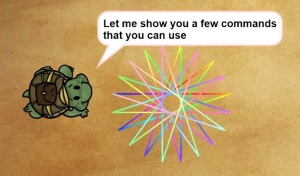
Snap the TurtleFinally, meet Snap the Turtle! This cute little guy is here to teach you how to make beautiful math art stars using computer programming.

On the website Tynker, Snap can show you how to design a program to make intricate line drawings– and learn something about computer programming at the same time. Tynker’s goal is to teach kids to be programming “literate.” Combine computer programming with a little math and art (and a turtle)– what could be better?

I hope something grabbed your interest this week! Bon appetit!
Lucea, Fiber Bundles, and Hamilton

Welcome to this week’s Math Munch!

The Summer Olympics are underway in Brazil. I have loved the Olympics since I was a kid. The opening ceremony is one of my favorite parts—the celebration of the host country’s history and culture, the athletes proudly marching in and representing their homeland. And the big moment when the Olympic cauldron is lit! This year I was just so delighted by the sculpture that acted as the cauldron’s backdrop.

https://www.youtube.com/watch?v=JCVPx1py5lk

Isn’t that amazing! The title of this enormous metal sculpture is Lucea, and it was created by American sculptor Anthony Howe. You can read about Anthony and how he came to make Lucea for the Olympics in this article. Here’s one quote from Anthony:

“I hope what people take away from the cauldron, the Opening Ceremonies, and the Rio Games themselves is that there are no limits to what a human being can accomplish.”

Here’s another view of Lucea from Anthony’s website:

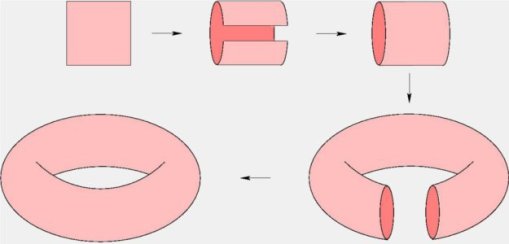
Lucea is certainly hypnotizing in its own right, but I think it jumped out at me in part because I’ve been thinking a lot about fiber bundles recently. A fiber bundle is a “twist” on a simpler kind of object called a product space. You are familiar with some examples of products spaces. A square is a line “times” a line. A cylinder is a line “times” a circle. And a torus is a circle “times” a circle.

squarecylindertorus

Square, cylinder, and torus.

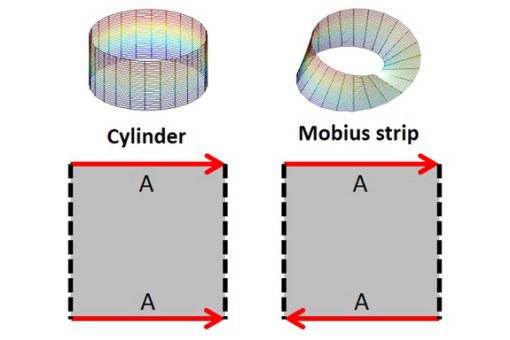
So, what does it mean to introduce a “twist” to a product space? Well, it means that while every little patch of your object will look like a product, the whole thing gets glued up in some fancy way. So, instead of a cylinder that goes around all normal, we can let the line factor do a flip as it goes around the circle and voila—a Mobius strip!

cylinder-mobius

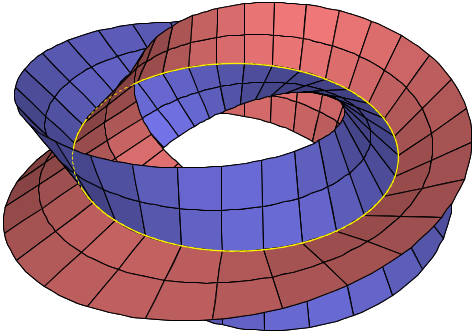
Now, check out this image:

lBUHy

It’s two Mobius strips stuck together! Does this remind you of Lucea?! Instead of a line “times” a circle that’s been twisted, we have an X shape “times” a circle.

Do you think you could fill up all of space with an infinity of circles? You might try your hand at it. One answer to this puzzle is a wonderful example of a fiber bundle called the Hopf fibration. Just as you can think about a circle as a line plus one extra point to close it up, and a sphere as a plane with one extra point to close it up, the three-sphere is usual three-dimenional space plus one extra point. The Hopf fibration shows that the three-sphere is a twisted product of a sphere “times” a circle. For a really lovely visualization of this fact, check out this video:

https://www.youtube.com/watch?v=UlZ7KDm3iCc

That is some tough but also gorgeous mathematics. Since you’ve made it this far in the post, I definitely think you deserve to indulge and maybe rock out a little. And what’s the hottest ticket on Broadway this summer? I hope you’ll enjoy this superb music video about Hamilton!

William Rowan Hamilton, that is. The inventor of quaternions, explorer of Hamiltonian circuits, and reformulator of physics. Brilliant.

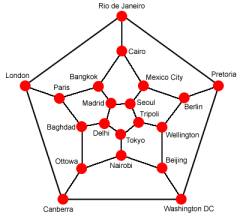
citymapHere are a couple of pages of Hamiltonian circuit puzzles. The goal is to visit every dot exactly once as you draw one continuous path. Try them out! Rio, where the Olympics is happening, pops up as a dot in the first one. You might even try your hand at making some Hamiltonian puzzles of your own.

Happy puzzling, and bon appetit!

Maria Chudnovsky, Puzzlebomb, and Some Futility

Welcome to this week’s Math Munch!

This week we meet an incredible mathematician, take on a tough number puzzle, check out a wonderful mathematical card trick, and much more.

Maria Chudnovsky

A while ago we shared an interview with mathematician Fan Chung Graham.  The interview was posted by Anthony Bonato, The Intrepid Mathematician. Well, this week we share another of his interviews, this time with Maria Chudnovsky, graph theorist and star of not one, but two television commercials. (A rare feat for a mathematician.) Maria is also a winner of the extraordinary MacArthur “Genius” Grant. You can check out the video below or click here for the full interview.

Up next, our friends over at The Aperiodical do a lot of great things for the math world. One contribution is the monthly Puzzlebomb put on by Katie Steckles.

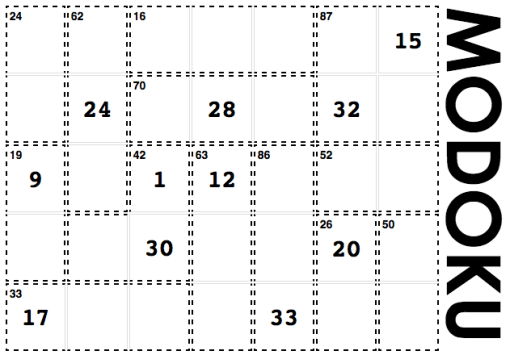
Screen Shot 2016-07-21 at 12.34.25 AM

This month’s puzzle is MODOKU, a sort of sudoku style puzzle where columns and rows span the possible remainders mod 7 and mod 5. Check it out! Thanks to Katie for such a lovely puzzle! You can click below for an interactive version with complete instructions.

Screen Shot 2016-07-21 at 12.45.47 AM

Finally this week, it’s time again to look at a Futility Closet, a phenomenal blog containing the odd mathematical tidbit. We’ll take a look at three of them.

Screen Shot 2016-07-21 at 12.51.33 AMHere’s a weird arithmetic fact I found there. Do you see what’s going on there? I have absolutely no idea how often this kind of thing is true, if ever again, but it gets me thinking.
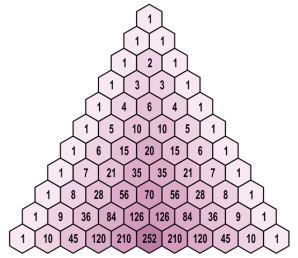
2016-07-14-a-square-triangleHere’s another incredible one. We’ve posted about Pascal’s (Yang-Hui’s) Triangle lots of times (1 2), and I’ve come across a lot of fascinating stuff about it, but this is new to me. Apparently, “the product of the six numbers surrounding any interior number in Pascal’s triangle is a perfect square.” Can you prove it?

Now on to the biggie…  This is such a cool card trick! Here’s the trick as explained by Futility Closet:

“I hand you an ordinary deck of 52 cards. You inspect and shuffle it, then choose five cards from the deck and hand them to my assistant. She looks at them and passes four of them to me. I name the fifth card.”         !!!!!!!!!!

2016-05-31-the-fifth-card

The key to the magic is this chart:

{low, middle, high} = 1
{low, high, middle} = 2
{middle, low, high} = 3
{middle, high, low} = 4
{high, low, middle} = 5
{high, middle, low} = 6

Can you figure out how it works from the chart alone? You’ll need a good assistant to get on board, and it wouldn’t hurt to practice a bit. Then get ready to impress. Oh, and if you can’t figure out the trick from the chart alone, then just head over to Futility Closet and read the full explanation.

Well that’s it for this week. Hope you found something delicious. Bon appetit!