Tag Archives: art

Newroz, a Math Factory, and Flexagons

Welcome to this week’s Math Munch!

You’ve probably seen Venn diagrams before. They’re a great way of picturing the relationships among different sets of objects.

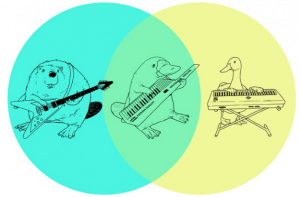
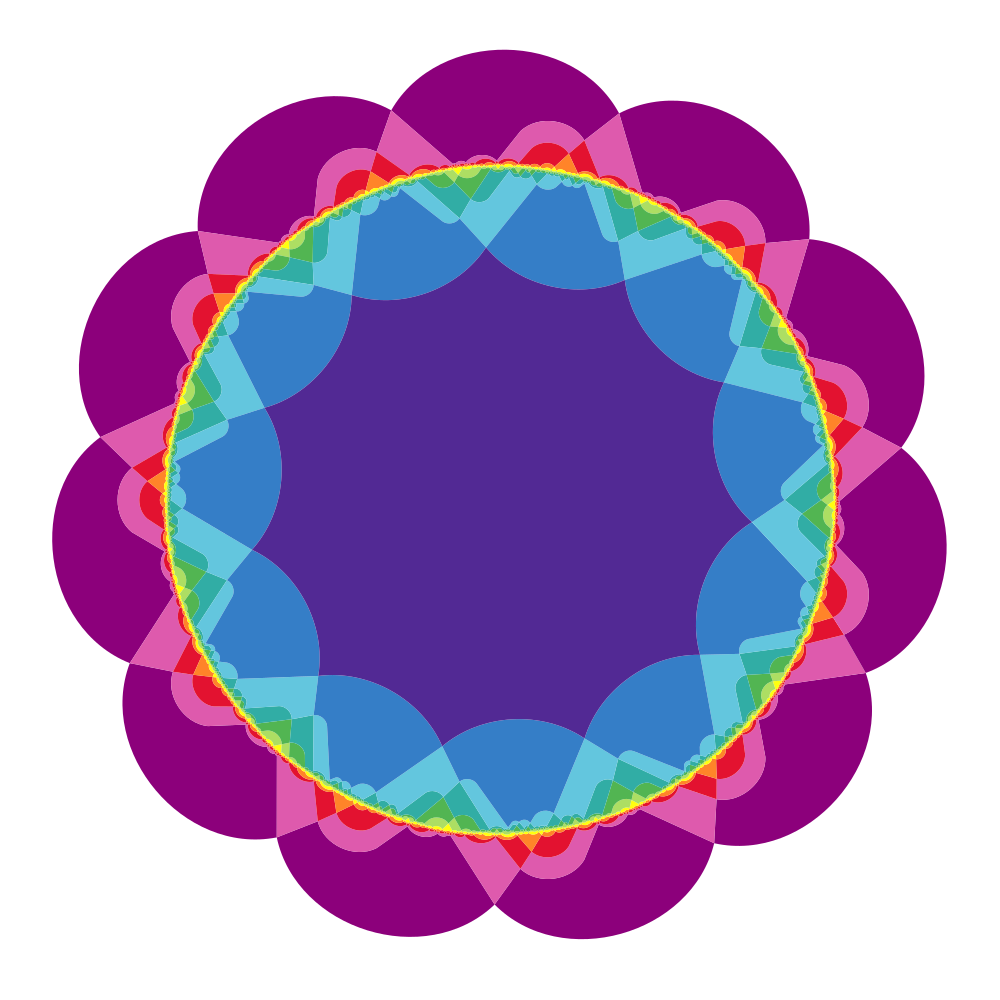
But I bet you’ve never seen a Venn diagram like this one!
Frank Ruskey

That’s because its discovery was announced only a few weeks ago by Frank Ruskey and Khalegh Mamakani of the University of Victoria in Canada. The Venn diagrams at the top of the post are each made of two circles that carve out three regions—four if you include the outside. Frank and Khalegh’s new diagram is made of eleven curves, all identical and symmetrically arranged. In addition—and this is the new wrinkle—the curves only cross in pairs, not three or more at a time. All together their diagram contains 2047 individual regions—or 2048 (that’s 2^11) if you count the outside.

Frank and Khalegh named this Venn diagram “Newroz”, from the Kurdish word for “new day” or “new sun”. Khalegh was born in Iran and taught at the University of Kurdistan before moving to Canada to pursue his Ph.D. under Frank’s direction.

Khalegh Mamakani

“Newroz” to those who speak English sounds like “new rose”, and the diagram does have a nice floral look, don’t you think?

When I asked Frank what it was like to discover Newroz, he said, “It was quite exciting when Khalegh told me that he had found Newroz. Other researchers, some of my grad students and I had previously looked for it, and I had even spent some time trying to prove that it didn’t exist!”

Khalegh concurred. “It was quite exciting. When I first ran the program and got the first result in less than a second I didn’t believe it. I checked it many times to make sure that there was no mistake.”

You can click these links to read more of my interviews with Frank and Khalegh.

I enjoyed reading about the discovery of Newroz in these articles at New Scientist and Physics Central. And check out this gallery of images that build up to Newroz’s discovery. Finally, Frank and Khalegh’s original paper—with its wonderful diagrams and descriptions—can be found here.

A single closed curve—or “petal”— of Newroz. Eleven of these make up the complete diagram.

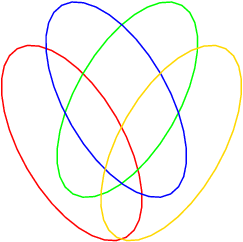
A Venn diagram made of four identical ellipses. It was discovered by John Venn himself!

For even more wonderful images and facts about Venn diagrams, a whole world awaits you at Frank’s Survey of Venn Diagrams.
On Frank’s website you can also find his Amazing Mathematical Object Factory! Frank has created applets that will build combinatorial objects to your specifications. “Combinatorial” here means that there are some discrete pieces that are combined in interesting ways. Want an example of a 5×5 magic square? Done! Want to pose your own pentomino puzzle and see a solution to it? No problem! Check out the rubber ducky it helped me to make!

A pentomino rubber ducky!

Finally, Frank mentioned that one of his early mathematical experiences was building hexaflexagons with his father. This led me to browse around for information about these fun objects, and to re-discover the work of Linda van Breemen. Here’s a flexagon video that she made.

And here’s Linda’s page with instructions for how to make one. Online, Linda calls herself dutchpapergirl and has both a website and a YouTube channel. Both are chock-full of intricate and fabulous creations made of paper. Some are origami, while others use scissors and glue.
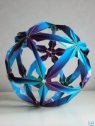
I can’t wait to try making some of these paper miracles myself!

Bon appetit!
3D Printer MArTH, Polyhedra, and Hart Videos

Welcome to this week’s Math Munch!

It’s my turn now to post about how much fun we had at Bridges!  One of the best parts of Bridges was seeing the art on display, both in the galleries and in the lobby where people were displaying and selling their works of art.  We spent a lot of time oogling over the 3D printed sculptures of Henry Segerman.  Henry is a research fellow at the University of Melbourne, in Australia, studying 3-dimensional geometry and topology.  The sculptures that he makes show how beautiful geometry and topology can be.

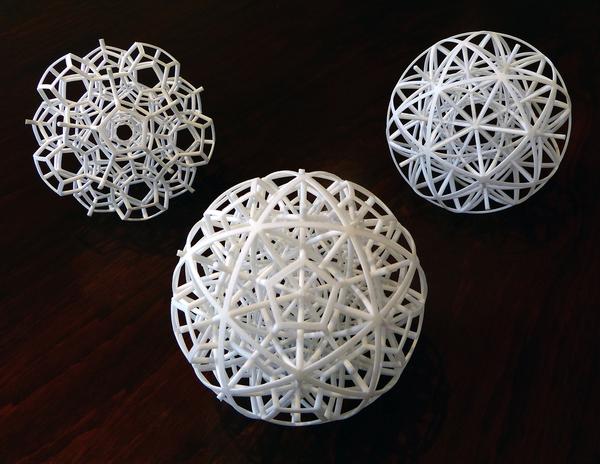
These are the sculptures that Henry had on display in the gallery at Bridges.  They won Best Use of Mathematics!  These are models of something called 4-dimensional regular polytopes.  A polytope is a geometric object with flat sides – like a polygon in two dimensions or a polyhedron in three dimensions.  4-dimensional polyhedra?  How can we see these in three dimensions?  The process Henry used to make something 4-dimensional at least somewhat see-able in three dimensions is called a stereographic projection.  Mapmakers use stereographic projections to show the surface of the Earth – which is a 3-dimensional object – on a flat sheet of paper – which is a 2-dimensional object.

A stereographic projection of the Earth.

To do a stereographic projection, you first set the sphere on the piece of paper, or plane.  It’ll touch the plane in exactly 1 point (and will probably roll around, but let’s pretend it doesn’t).  Next, you draw a straight line starting at the point at the top of the sphere, directly opposite the point set on the plane, going through another point on the sphere, and mark where that line hits the plane.  If you do that for every point on the sphere, you get a flat picture of the surface of the sphere.  The point where the sphere was set on the plane is drawn exactly where it was set – or is fixed, as mathematicians say.  The point at the top of the sphere… well, it doesn’t really have a spot on the map.  Mathematicians say that this point went to infinity.  Exciting!

A stereographic projection like this draws a 3-dimensional object in 2-dimensions.  The stereographic projection that Henry did shows a 4-dimensional object in 3-dimensions.  Henry first drew, or projected, the vertices of his 4-dimensional polytope onto a 4-dimensional sphere – or hypersphere.  Then he used a stereographic projection to make a 3D model of the polytope – and printed it out!  How beautiful!

Here are some more images of Henry’s 3D printed sculptures.  We particularly love the juggling one.

Henry will be dropping by to answer your questions! So if you have a question for him about his sculptures, the math he does, or something else, then leave it for him in the comments.

Speaking of polyhedra, check out this site of applets for visualizing polyhedra.  You can look at, spin, and get stats on all kinds of polyhedra – from the regular old cube to the majestic great stellated dodecahedron to the mindbogglingly complex uniform great rhombicosidodecahedron.  You can also practice your skills with Greek prefixes and suffixes.

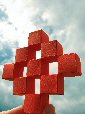
Finally, two Math Munches ago, we told you about some videos made by the mathematical artist George Hart.  He’s the man who brought us the Yoshimoto cube.  And now he’s brought us… Pentadigitation.  In this video, George connects stars, knots, and rubber bands.  Enjoy watching – and trying the tricks!

Bon appetit!

Mike Naylor, Math Magic, and Mazes

Mathematical artist, Mike Naylor juggling 5 balls.

Welcome to this week’s Math Munch!

Last week, Justin told you about our time at Bridges 2012, the world’s largest conference of mathematics and art, and I must reiterate: this was one of the coolest things I’ve ever been a part of. The art was gorgeous. The people were great. I’m pretty sure I was beaming with excitement. At dinner we met, Mike Naylor, a mathematical artist and generally fantastic guy living in Norway. You can read his full artist’s statement and artwork from the Bridges exhibition, but here’s an excerpt:

“Much of my artwork focuses on the use of the human body to represent geometric concepts, but I also enjoy creating abstract works that capture mathematical ideas in ways that are pleasing, surprising and invite further reflection.”

Meeting Mike was especially exciting for me, because just days earlier, I’d fallen in love with Mike’s math blog. This week, I’ll be sharing some of the gems I’ve found there:

I didn’t even mention abacaba.org, yet another amazing Mike Naylor project.  It’s a site devoted entirely to one pattern: A, aBa, abaCaba, abacabaDabacaba,…

Since Justin introduced mathematical poetry last week, check out one of Mike’s mathematical poems called “Decision Tree.” What a clever idea! Like Mike, I’m a juggler, so I absolutely loved his Fractal Juggler animation, which shows a juggler juggling jugglers juggling jugglers… Clever idea #2! And for a third clever idea, check out the Knight Maze he designed. Wow!

“Decision Tree”

“Fractal Juggler”

“Knight Maze”

The most squares of whole area that will fit in a square of area 17.

Speaking of mazes, I found a whole bunch of cool ones when I was poking around the Math Magic site hosted by Stetson University. Each month Math Magic poses a math question for readers to work on and then submit their solutions. This month’s question is about packing squares in squares. (Click to see the submissions so far.)  At the bottom of the page you can find links to many more cool math sites, but as promised, I’ll share some of the mazes I found.

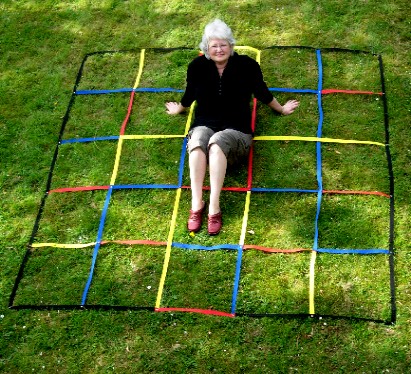
A puzzle designer for over 40 years, here Andrea Gilbert lays across one of her step-over sequence mazes.

First there’s Andrea Gilbert’s site, Click Mazes, which has all sorts of online mazes and puzzles.  In the picture you can see Andrea laying in one of her step-over sequence mazes.  How do you figure they work?

Then there’s Logic Mazes, a website of mazes by Robert Abbott. I don’t know much about Robert, but his site caught my eye because it begins with Five Easy Mazes: 1 2 3 4 5, but there are better mazes after that. I really liked the number mazes. Play around, think your way through, and have some fun!

Bon appetit!

Number Mazes

Eyeball Mazes

Alice Mazes