Tag Archives: art

Bridges, Meander Patterns, and Water Sports

This past week the Math Munch team got to attend the Bridges 2012. Bridges is a mathematical art conference, the largest one in the world. This year it was held at Towson University outside of Baltimore, Maryland. The idea of the conference is to build bridges between math and the arts.

Participants gave lectures about their artwork and the math that inspired or informed it. There were workshop sessions about mathematical poetry and chances to make baskets and bead bracelets involving intricate patterns. There was even a dance workshop about imagining negative-dimensional space! There were also some performances, including two music nights (which included a piece that explored a Fibonacci-like sequence called Narayana’s Cows) and a short film festival (here are last year’s films). Vi Hart and George Hart talked about the videos they make and world-premiered some new ones. And at the center of it all was an art exhibition with pieces from around the world.

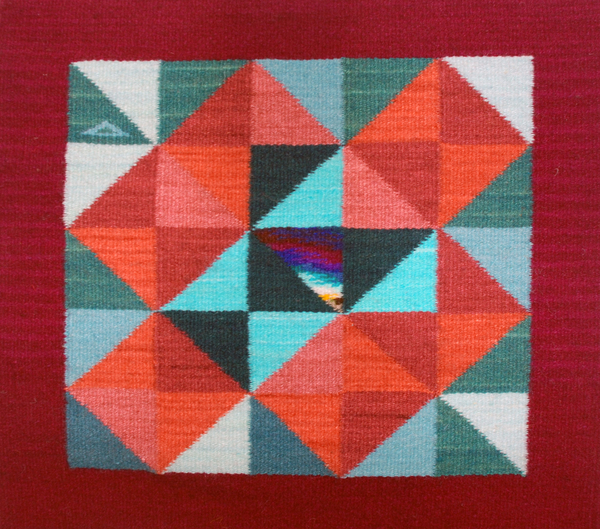
The Zen of the Z-Pentomino by Margaret Kepner

Does this piece by Bernhard Rietzl
remind you of a certain sweater?

5 Rhombic Screens by Alexandru Usineviciu

Pythagorean Proof by Donna Loraine

To see more, you should really just browse the Bridges online gallery.

A shot of the gallery exhibition

I know that Paul, Anna, and I will be sharing things with you that we picked up at Bridges for months to come. It was so much fun!

David Chappell

One person whose work and presentation I loved at Bridges is David Chappell. David is a professor of astronomy at the University of La Verne in California.

David shared some thinking and artwork that involve meander patterns. “Meander” means to wander around and is used to describe how rivers squiggle and flow across a landscape. David uses some simple and elegant math to create curve patterns.

Instead of saying where curves sit in the plane using x and y coordinates, David describes them using more natural coordinates, where the direction that the curve is headed in depends on how far along the curve you’ve gone. This relationship is encoded in what’s called a Whewell equation. For example, as you walk along a circle at a steady rate, the direction that you face changes at a contant rate, too. That means the Whewell equation of a circle might look like angle=distance. A smaller circle, where the turning happens faster, could be written down as angle=2(distance).

Look at how the Cauto River “meanders” across the Cuban landscape.

In his artwork, David explores curves whose equations are more complicated—ones that involve multiple sine functions. The interactions of the components of his equations allow for complex but rhythmic behavior. You can create meander patterns of your own by tinkering with an applet that David designed. You can find both the applet and more information about the math of meander patterns on David’s website.

David Chappell’s Meander #6
Make your own here!

When I asked David about how being a scientist affects his approach to making art, and vice versa, he said:

My research focuses on nonlinear dynamics and pattern formation in fluid systems. That is, I study the spatial patterns that arise when fluids are agitated (i.e. shaken or stirred). I think I was attracted to this area because of my interest in the visual arts. I’ve always been interested in patterns. The science allows me to study the underlying physical systems that generate the patterns, and the art allows me to think about how and why we respond to different patterns the way we do.  Is there a connection between how we respond to a visual image and the underlying “rules” that produced the image?  Why to some patterns look interesting, but others not so much?

For more of my Q&A with David, click here. In addition, David will be answering questions in the comments below, so ask away!

Since bridges and meandering rivers are both water-related, I thought I’d round out this post with a couple of interesting links about water sports and the Olympics. My springboard was a site called Maths and Sport: Countdown to the Games.

No wiggle rigs

Arrangements of rowers that are “wiggle-less”

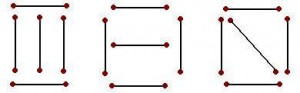
Here’s an article that explores different arrangements of rowers in a boat, focusing on finding ones where the boat doesn’t “wiggle” as the rowers row. It’s called Rowing has its Moments.

Next, here’s an article about the swimming arena at the 2008 Beijing games, titled Swimming in Mathematics.


Paul used to be a competitive diver, and he says there’s an interesting code for the way dives are numbered.  For example, the “Forward 1 ½ Somersaults in Tuck Position” is dive number 103C.  How does that work?  You can read all about it here.  (Degree of difficulty is explained as well.)

Finally, enjoy these geometric patterns inspired by synchronized swimming!

Stay cool, and bon appetit!

Fractions, Sam Loyd, and a MArTH Journal

Welcome to this week’s Math Munch!

Check out this awesome graph:

What is it?  It’s a graph of the Farey Fractions, with the denominator of the (simplified) fraction on the vertical axis and the value of the fraction on the horizontal axis, made by mathematician and professor at Wheelock College Debra K. Borkovitz (previously).  Now, I’d never heard of Farey Fractions before I saw this image – but the graph was so cool that I wanted to learn all about them!

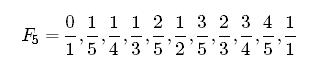
So, what are Farey Fractions, you ask?  Debra writes all about them and the cool visual patterns they make in this post.  To make a list of Farey Fractions you first pick a number – say, 5.  Then, you list all of the fractions between 0 and 1 whose denominators are less than or equal to the number you picked.  So, as Debra writes in her post, for 5 the list of Farey Fractions is:

As Debra writes, there are so many interesting patterns in Farey Fractions – many of which become much easier to see (literally) when you make a visualization of them.  Debra has made several awesome applets using the program GeoGebra, which she links to in her post.  (You can download GeoGebra and make applets of your own by visiting our Free Math Software page.)  These applets really show the power of using graphs and pictures to learn more about numbers.  To play with the applet that made the picture above, click here.  Check out her post to play with another applet, and to read more about the interesting patterns in Farey Fractions.

Next, check out this website devoted to the puzzles of puzzlemaster Sam Loyd.  Sam Loyd was a competitive chess player and professional puzzle-writer who lived at the end of the nineteenth century.  He wrote many puzzles that are still famous today – like the baffling Get Off the Earth puzzle.  Click the link to play an interactive version of the Get Off the Earth puzzle.

The site has links to numerous Sam Loyd puzzles.  Check out the Picture Puzzles, in which you have to figure out what object is described by the picture, or the Puzzleland Puzzles, which feature characters from the fictional place Puzzleland that Sam created.

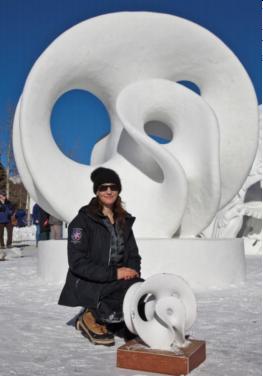
Snow MArTH, made by MArTHist Eva Hild and others at a snow sculpture event in Colorado. From the Spring, 2011 Hyperseeing.

Finally, take a look at some of the beautiful pictures and fascinating articles in this journal about mathematical art (a.k.a., MArTH) called Hyperseeing.  Hyperseeing is edited by mathematicians and artists Nat Friedman and Ergun Akleman.  Hyperseeing is published by the International Society of the Arts, Mathematics, and Architecture, which Nat founded to encourage education connecting the arts, architecture, and math – which we here at Math Munch love!  In one of his articles, Nat defines hyperseeing as, “Interdisciplinary education… concerned with seeing from multiple viewpoints in a very general sense.  Hyperseeing is a more complete way of seeing.”

There are so many beautiful images to look at and interesting articles to read in Hyperseeing.  Among other things, each edition of Hyperseeing features a mathematical comic by Ergun.  Here are some of my favorite Hyperseeings from the archives:

This edition of Hyperseeing features art made from Latin Squares and “organic geometry” art, among many other things.

This edition of Hyperseeing features crocheted hyperbolic surfaces (which we featured not long ago in this Math Munch!) and sculptures made with a 3-D printer, among many other things.

This is the first edition of Hyperseeing. In it, Nat describes the mission of Hyperseeing and the International Society of the Arts, Mathematics, and Architecture.

Bon appetit!

P.S. – You may have noticed a new thing to click off to the right, below the Favorite Munches.  This is our For Teachers section.  The Math Munch team has put together several pages to describe how we use Math Munch in our classes and give suggestions for how you might use it, too.  Teachers and non-teachers alike may want to check out our new Why Math Munch? page, which gives our mission statement.

P.P.S. – The Math Munch team is going to Bridges on Thursday!  Maybe we’ll see you there.

Partitions, Riddles, and Escher Videos

Welcome to this week’s Math Munch!

Meet James Tanton, one of my very favorite mathematicians. According to his bio, James is “deeply interested in bridging the gap between the mathematics experienced by school students and the creative mathematics practiced and explored by mathematicians.” Me too! Dr. Tanton is an author and math teacher, but I know him best through his internet videos. Some of them cover some pretty advanced mathematics, but this video on partitions and the Fibonacci numbers is very clear and WAY COOL!

o o oo ooo ooooo

Up next, check out Steve Miller’s Math Riddles, a website full of fantastic (you guessed it) math riddles collected by Steve Miller. Steve’s a math professor at Williams College, and according to him, these riddles, “have two very desirable properties: they have an elegant solution, and that solution doesn’t involve advanced mathematics… What you do need is some patience, and a willingness to explore. Don’t be afraid to try something — see where it leads!”

With that in mind, why not give some a try? You can sort the riddles by topic or difficulty, but here a few possible starters:

There are fifteen sticks. Remove six sticks and be left with ten.

Finally, some relaxing videos I’ve found to showcase once again the fantastic artwork of Dutch graphic artist, M.C. Escher. We’ve featured his work before, but I can never get enough.

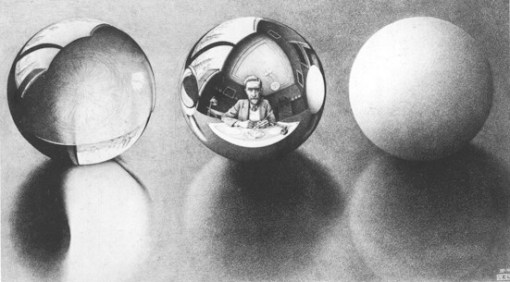
3 Spheres II by M.C. Escher

“Mathematicians know their subject is beautiful. Escher shows us that it’s beautiful.” That’s a lovely little quote from mathematician Ian Stewart in this short little clip called, The Mathematical Art of M.C. Escher. If you’re up for something more substantial, here’s an hour-long documentary called Metamorphose, which features video of Escher himself hard at work, something I had never seen before! If you end up watching, leave us a comment and let us know what you think.

We’ve also put together a YouTube playlist of every video ever featured on Math Munch, which we will continue to update. If you want to find the coolest math vids on the internet, I’d say that’s a good place to start.

Bon appetit!