Tag Archives: building

Prime Gaps, Mad Maths, and Castles

Welcome to this week’s Math Munch!

It has been a thrilling last month in the world of mathematics. Several new proofs about number patterns have been announced. Just to get a flavor for what it’s all about, here are some examples.

I can make 15 by adding together three prime numbers: 3+5+7. I can do this with 49, too: 7+11+31. Can all odd numbers be written as three prime numbers added together? The Weak Goldbach Conjecture says that they can, as long as they’re bigger than five. (video)

11 and 13 are primes that are only two apart. So are 107 and 109. Can we find infinitely many such prime pairs? That’s called the Twin Prime Conjecture. And if we can’t, are there infinitely many prime pairs that are at most, say, 100 apart? (video, with a song!)

Harald Helfgott

Harald Helfgott

Yitang "Tom" Zhang

Yitang “Tom” Zhang

People have been wondering about these questions for hundreds of years. Last month, Harald Helfgott showed that the Weak Goldbach Conjecture is true! And Yitang “Tom” Zhang showed that there are infinitely many prime pairs that are at most 70,000,000 apart! You can find lots of details about these discoveries and links to even more in this roundup by Evelyn Lamb.

What’s been particularly fabulous about Tom’s result about gaps between primes is that other mathematicians have started to work together to make it even better. Tom originally showed that there are an infinite number of prime pairs that are at most 70,000,000 apart. Not nearly as cute as being just two apart—but as has been remarked, 70,000,000 is a lot closer to two than it is to infinity! That gap of 70,000,000 has slowly been getting smaller as mathematicians have made improvements to Tom’s argument. You can see the results of their efforts on the polymath project. As of this writing, they’ve got the gap size narrowed down to 12,006—you can track the decreasing values down the page in the H column. So there are infinitely many pairs of primes that are at most 12,006 apart! What amazing progress!

Two names that you’ll see in the list of contributors to the effort are Andrew Sutherland and Scott Morrison. Andrew is a computational number theorist at MIT and Scott has done research in knot theory and is at the Australian National University. They’ve improved arguments and sharpened figures to lower the prime gap value H. They’ve contributed by doing things like using a hybrid Schinzel/greedy (or “greedy-greedy”) sieve. Well, I know what a sieve is and what a greedy algorithm is, but believe me, this is very complicated stuff that’s way over my head. Even so, I love getting to watch the way that these mathematicians bounce ideas off each other, like on this thread.

Andrew Sutherland

Andrew Sutherland

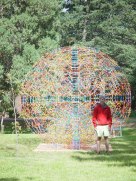
Click through to see Andrew next to an amazing Zome creation!

Andrew. Click this!

Scott Morrison

Scott Morrison

Andrew and Scott have agreed to answer some of your questions about their involvement in this research about prime gaps and their lives as mathematicians. I know I have some questions I’m curious about! You can submit your questions in the form below:

I can think of only two times in my life where I was so captivated by mathematics in the making as I am by this prime gaps adventure. Andrew Wiles’s proof of Fermat’s Last Theorem was on the fringe of my awareness when it came out in 1993—its twentieth anniversary of his proof just happened, in fact. The result still felt very new and exciting when I read Fermat’s Enigma a couple of years later. Grigori Perelman’s proof of the Poincare Conjecture made headlines just after I moved to New York City seven years ago. I still remember reading a big article about it in the New York Times, complete with a picture of a rabbit with a grid on it.

This work on prime gaps is even more exciting to me than those, I think. Maybe it’s partly because I have more mathematical experience now, but I think it’s mostly because lots of people are helping the story to unfold and we can watch it happen!

fig110u2bNext up, I ran across a great site the other week when I was researching the idea of a “cut and slide” process. The site is called Mad Maths and the page I landed on was all about beautiful dissections of simple shapes, like circles and squares. I’ve picked out one that I find especially charming to feature here, but you might enjoy seeing them all. The site also contains all kinds of neat puzzles and problems to try out. I’m always a fan of congruent pieces problems, and these paper-folding puzzles are really tricky and original. (Or maybe, origaminal!) You’ll might especially like them if you liked Folds.
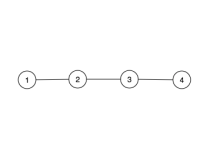
Christian's applet displaying the original four-room castle.

Christian’s applet displaying the original four-room castle.

Finally, we previously posted about Matt Parker’s great video problem about a princess hiding in a castle. Well, Christian Perfect of The Aperiodical has created an applet that will allow you to explore this problem—plus, it’ll let you build and try out other castles for the princess to hide in. Super cool! Will I ever be able to find the princess in this crazy star castle I designed?!

Crazy star castle!

My crazy star castle!

And as summer gets into full swing, the other kind of castle that’s on my mind is the sandcastle. Take a peek at these photos of geometric sandcastles by Calvin Seibert. What shapes can you find? Maybe Calvin’s creations will inspire your next beach creation!

Bon appetit!

167739151_ec142bbfe8 3342635687_f847918e0e 5945114420_c950231830

Domino Computer, Knitting, and Election MArTH

Welcome to this week’s Math Munch!

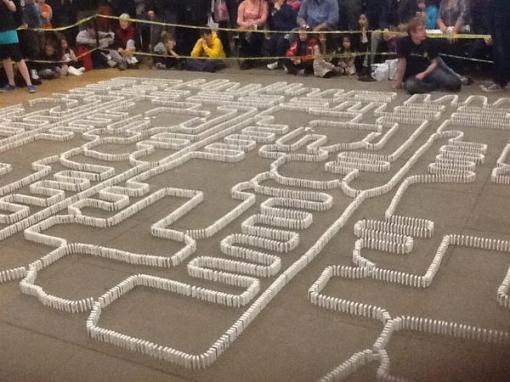
First up this week is one of the coolest things I’ve seen in a long time: the world’s largest computer made out of dominoes.  A computer made out of dominoes?! you say.  How??

The Domputer, as it’s been called, was the great idea of mathematician, teacher, and entertainer Matt Parker (see a previous post about Matt here), and he and many volunteers built it at the Manchester Science Festival at the end of October.

Matt and some of his teammates testing domino circuits.

So, what is a domino computer, and how does it work?  As Matt is quoted saying in a podcast that featured the project, “A domino computer is exactly that: a computer made out of chains of dominoes.  Flicking over one domino sends a signal racing along the chain, just like current flows down a wire.  And then interacting lines of dominoes can manipulate the signal exactly the way circuit components do.”

At its very, very basic level, a computer is a machine that does calculations in binary.  You input some sequence of 0s and 1s by flipping signals on and off, and your input starts a chain of electrical communications that results in an output of 0s and 1s.  Most computers do this with electrical circuits.  But it can also be done with dominoes – sending an “on” signal means flipping a domino over, and sending an “off” signal means not flipping a domino, or having a chain of falling dominoes that becomes blocked and stops falling.

Making the domputer.

There are lots of different kinds of commands that you can send by flipping switches on and off and making those signals interact.  For example, suppose you want something to happen only if two switches are on – if the first switch is on AND the second switch is on.  For this you would need to make something called an “AND gate” – an interaction in chains of current that will continue the chain if both switches are on and will stop the chain if either (or both) is off.  How would you do that with dominoes?  In this video, Matt demonstrates how to make an AND gate out of dominoes: Domino AND gate.  Check out this video for OR (the chain continues if one or the other or both are on) and XOR (“exclusive or,” the chain continues if one or the other, but not both, are on) gates:

Matt’s Domputer does something very simple: it adds numbers in binary.  But, as you might imagine, it was extremely complicated to build!  According to the Manchester Science Festival Twitter feed, the Domputer used about 10,000 dominoes and would take about 13,600 years to do what a normal processor could do in a second.  Wow!

Here it is in action.  It messed up on this calculation (9+3), but succeeded in later attempts – and is fascinating to watch nonetheless!

Awesome!

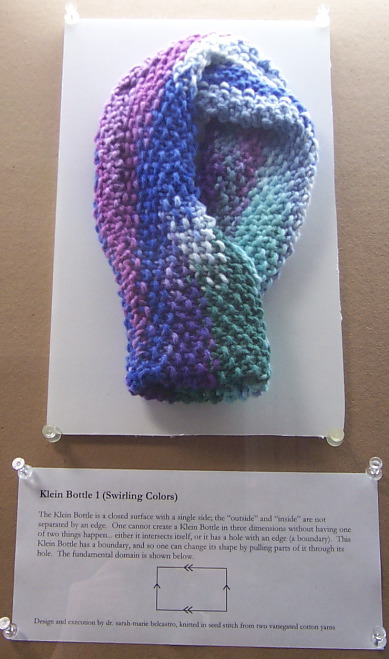
Next up, we’ve written about mathematical knitting before (remember Wooly Thoughts and the prime factorization sweater?), but here’s a great site I recently found made by mathematician, knitter, and dancer Sarah-Marie Belcastro.

This site is full of articles and about and patterns for all kinds of cool mathematical objects – like Klein bottles (which make great hats, by the way)!  In her post about knitted Klein bottles (and all of the other objects she makes), Sarah-Marie not only describes how to knit the objects but a lot of mathematics about them.  I don’t know about you, but I always find mathematical ideas easier to understand when I can make models of them, or at least read about models being made.  Sarah-Marie does a great job of blending mathematical descriptions with how-to-make-it recipes.

Some other patterns that I love are Sarah-Marie’s 8-colored two-hole torus pants and this knitted trefoil knot.

Finally, are you wondering what to do with all those campaign posters you have left over from the election?  Here’s George Hart’s take on what to do with them:

Bon appetit!

Algorithmic House, Billiards, and Picma

Welcome to this week’s Math Munch!

Check out this beautiful building:

This is the Endesa Pavilion, located in Barcelona, Spain.  It’s also called Solar House 2.0, and that’s because the tops of all of those pyramid-spikes are covered in solar panels.  But that’s not all – this house was designed to best capture sunlight in the exact location it was built using a mathematical algorithm.

To build this house, architect Rodrigo Rubio, who works for the Institute for Advanced Architecture of Catalonia, first tracked the path of the sun over the spot he wanted to build the house.  He then plugged that data into a computer program.  This program is a set of mathematical steps called an algorithm that turns data about the movement of the sun in the sky into a geometric building.  The building it creates is the best – or optimal – building for that spot.

It puts solar panels in locations on the building that get the most sunlight and orients them to get the most exposure.  It places windows of different sizes and overhangs at different angles around the house to get the best ventilation, block sunlight from entering the house, and keep the house cool in the summer and warm in the winter.   And, because it’s an algorithm, it can be used to design the optimal house for any location.  The program then creates a pattern for the wooden pieces that make up the house.  This pattern can be sent to a machine that cuts out the pieces, which builders put together like a puzzle.

In this video, Rodrigo explains how the building was designed, how the design works, and how this design can be used to make eco-friendly houses all over the world.

[youtube http://www.youtube.com/watch?v=3R1CBFBxuew&feature=player_embedded]

Next, have you ever played billiards?  Maybe you’ve played pool or watched Donald Duck play billiards.  It’s interesting to see how a pool ball moves around on a rectangular billiards table, which is how the table is usually shaped.  But it’s even more interesting to see how a ball moves around on a triangular, pentagonal, circular, or elliptical billiards table!

Want to try?  Check out this series of applets from Serendip, an exploratory math and science website started by some professors at Bryn Mawr College in Pennsylvania.  Serendip aims to help people ask and answer their own questions about the world we live in.  In these billiards applets, you can explore dynamical systems – mathematical structures in which an object moves according to a rule.   In some situations, the object will move in a predictable way.  But in other situations, the object moves chaotically.  As you play with the applets, see if you can figure out how the shape of the table effects whether the billiard ball will move chaotically or predictably.  These applets also make some beautiful star-like designs!

Finally, here’s a new game: Picma Squared.  In this game, you use logic to figure out how to color the squares in the grid to make a picture.  It starts out simple, but the higher levels are really challenging!  Enjoy!


Look for this game and others on our Games page!


Bon appetit!