Welcome to this week’s Math Munch!
 First up, have you ever been stuck on a gnarly math problem and wished that a math ninja would swoop in and solve the problem before it knew what hit it? Have you ever wished that you had a math dojo who would impart wisdom to you in cryptic but, ultimately, extremely timely and useful ways? Well, meet Colin Beverige, a math (or, as he would say, maths) tutor from England who writes a fun blog called Flying Colours Maths. On his blog, he publishes a weekly series called, “Secrets of the Mathematical Ninja,” in which the mathematical ninja (maybe Colin himself? He’s too stealthy to tell) imparts nuggets of sneaky wisdom to help you take down your staunchest math opponent.
 For example, you probably know the trick for multiplying by 9 using your fingers – but did you know that there’s a simple trick for dividing by 9, too? Ever wondered how to express thirteenths as decimals, in your head? (Probably not, but maybe you’re wondering now!) Want to know how to simplify fractions like a ninja? Well, the mathematical ninja has the answers – and some cute stories, too. Check it out!
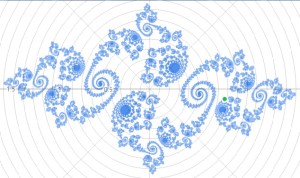
A picture of a Julia set.
Next, I find fractals fascinating, but – I’ll admit it – I don’t know much about them. I do know a little about the number line and graphing, though. And that was enough to learn a lot more about fractals from this excellent post on the blog Hackery, Math, and Design by Steven Wittens. In the post How to Fold a Julia Fractal, Steven describes how the key to understanding fractals is understanding complex numbers, which are the numbers we get when we combine our normal numbers with imaginary numbers.
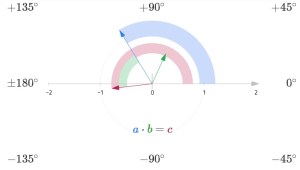 Now, I think imaginary numbers are some of the most interesting numbers in mathematics – not only because they have the enticing name “imaginary,” but because they do really cool things and have some fascinating history behind them. Steven does a really great job of telling their history and showing the cool things they do in this post. One of the awesome things that imaginary numbers do is rotate. Normal numbers can be drawn on a line – and multiplying by a negative number can be thought of as changing directions along the number line. Steven uses pictures and videos to show how multiplying by an imaginary number can be thought of as rotating around a point on a plane.

A Julia set in the making.
The Julia set fractal is generated by taking complex number points and applying a function to them that squares each point and adds some number to it. The fractal is the set of points that don’t get infinitely larger and larger as the function is applied again and again. Steven shows how this works in a series of images. You can watch the complex plane twist around on itself to make the cool curves and figures of the Julia set fractal.
Steven’s blog has many more interesting posts. Check out another of my favorites, To Infinity… and Beyond! for an exploration of another fascinating, but confusing, topic – infinity.
Finally, a Pi Day doesn’t go by without the mathematicians and mathematical artists of the world putting out some new Pi Day videos! Pi Day was last Thursday (3/14, of course). Here’s a video from Numberphile in which Matt Parker calculates pi using pies!
In this video, also from Numberphile, shows how you only need 39 digits of pi to make really, really accurate measurements for the circumference of the observable universe:
Finally, it wouldn’t be Pi Day without a pi video from Vi Hart. Here’s her contribution for this year:
Bon appetit!






 Math Munch