Tag Archives: fractals

Andrew Hoyer, Cameron Browne, & Sphere Inversion

Welcome to this week’s Math Munch! Fractals, origami, math art, games, and a mind-bending video are all ahead, so let’s get into it.

Andrew Hoyer

Andrew Hoyer

First up, let’s take a look at the work of Andrew Hoyer.  According to his website, he’s a “software engineer in his mid-twenties living it up in sometimes sunny San Francisco.” I came across his work when I found his beautiful and completely engaging introduction to simple fractals.  (Go on! Click. Then read, experiment and play!)

Cantor Set

A Cantor set

At the bottom of that page, Andrew links to a wonderful, long list of fractals, arranged by Hausdorff dimension, which is a way of measuring fractals as being something like 2.5 dimensions.  A line is 1 dimensional.  A plane is 2D, and you can find many fractals with dimension in between!!  Weird, right?

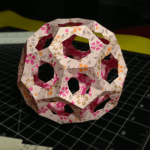
I was also really pleased to find Andrew’s Instagram feed, which features some of his beautiful origami creations.  Andrew’s agreed to answer your questions for an upcoming Q&A, so ask away!

Compound of 5 tetrahedra Truncated Icosahedron Cube Dodecahedron
Cameron Browne

Cameron Browne

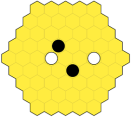
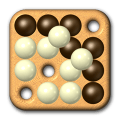
Up next, meet Cameron Browne. He’s an accomplished researcher who designs and studies games. Take a look at the many many games Cameron has created. The rules and descriptions are there, and Cameron sent along links to playable versions of a few, which you can find by clicking the pictures below.  For the third one, you’ll need to search for “Margo” or “Spargo.” For his research, Cameron investigates the possibilities of artificial intelligence, and how a computer can be used to generate games and puzzles.
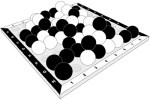
Yavalath

Yavalath
description

Margo and Spargo

Margo and Spargo
description
description

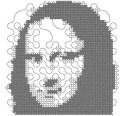
Cameron is also an artist, and he has a page full of his graphic designs.  I found Cameron through his page of Truchet curves.  I love the way his pages are full of diagrams and just enough information to start making sense of things, even if it’s not perfectly clear.  Cameron also has MANY pages of wonderful fractal-ish graphics: Impossible Fractals, Cantor Knots, Fractal Board Games, Woven Horns, Efficient Trees, and on and on…  And he has agreed to do a Q&A with us, so please, submit a question. What are you wondering?

A Cantor Knot

A Cantor Knot

A Truchet curve "Mona Lisa"

A Truchet curve “Mona Lisa”

An "impossible" fractal

An “impossible” fractal

And, as if that wasn’t enough mathy awesomeness, check out this video about turning a sphere inside out.  A bit of personal history, I actually used this video  (though it was only on VHS back then, checked out from the library) as part of the research for my independent research project during my senior year of college.  It gets pretty tricky, but if you watch it all the way through it starts to make some sense.

Have a great week.  Bon appetit!

Reflection sheet – Andrew Hoyer, Cameron Browne, & Sphere Inversion

Coasts, Clueless Puzzles, and Beach Math Art

summerAh, summertime. If it’s as hot where you are as it is here in New York, I bet this beach looks great to you, too. A huge expanse of beach all to myself sounds wonderful… And that makes me wonder – how much coastline is there in the whole world?

Interestingly, the length of the world’s coastline is very much up for debate. Just check out this Wikipedia page on coastlines, and you’ll notice that while the CIA calculates the total coastline of the world to be 356,000 kilometers, the World Resources Institute measures it to be 1,634,701! What???

Measuring the length of a coastline isn’t as simple as it might seem, because of something called the Coastline Paradox. This paradox states that as the ruler you use to measure a coastline gets shorter, the length of the coastline gets longer – so that if you used very, very tiny ruler, a coastline could be infinitely long! This excellent video by Veritasium explains the problem very well:

2000px-KochFlakeAs Vertitasium says, many coastlines are fractals, like the Koch snowflake shown at left – never-ending, infinitely complex patterns that are created by repeating a simple process over and over again. In this case, that simple process is the waves crashing against the shore and wearing away the sand and rock. If coastlines can be infinitely long when you measure them with the tiniest of rulers, how to geographers measure coastline? By choosing a unit of measurement, making some approximations, and deciding what is worth ignoring! And, sometimes, agreeing to disagree.

Need something to read at the beach, and maybe something puzzle-y to ponder? Check out this interesting article by four mathematicians and computer scientists, including James Henle, a professor in Massachusetts. They’ve invented a Sudoku-like puzzle they call a “Clueless Puzzle,” because, unlike Sudoku, their puzzle never gives any number clues.

Clueless puzzleHow does this work? These puzzles use shapes instead of numbers to provide clues. Here’s an example from the paper: Place the numbers 1 through 6 in the cells of the figure at right so that no digit appears more than once in a row or column AND so that the numbers in each region add to the same sum. The paper not only walks you through the solution to this problem, but also talks about how the mathematicians came up with the idea for the puzzles and studied them mathematically. It’s very interesting – I recommend you read it!

Finally, if you’re not much of a beach reader, maybe you’d like to make some geometrically-inspired beach art! Check out this land art by artist Andy Goldsworthy:

Andy Goldsworthy 1
Andy Goldsworthy 2

Or make one of these!

Happy summer, and bon appetit!

The Numbers Project, Epidemics, and Cut ‘n Slide

Welcome to this week’s Math Munch!

It’s an end-of-the-year group post!

Brandon Todd WilsonPaul: This week I found Brandon Todd Wilson, a graphic artist who lives in Kansas City. He started a new and ambitious project. He wants to make a design for each of the numbers 0 through 365, making a new one each day of the year. That’s tough, but he’s done some amazing things so far. Check them out over at the numbers project. I’m amazed by the sneaky, clever ways he comes up with to showcase the numbers. Can you tell what numbers these three are below? Click to find out.

40 Screen Shot 2013-06-07 at 12.22.20 AM 118

Maybe you could try a numeric design of your own. Perhaps for your favorite number or your birthday. If you make something your proud of, email us at mathmunchteam@gmail.com, and we could feature your work on Math Munch!

[Here are some numeric creations inspired by Brandon’s!]

ninaAnna: Next up, it’s probably the end of the school year for most of you readers out there. Our school year is wrapping up, too. It’s sad, but also exciting, because we’re looking forward to what comes in the future. Recently, some of my students, looking to their futures, have been wondering what many students wonder: If I like math, what are some things I can do with it after I leave school? (We’ve posted about this question before – check out this post on the site We Use Math and any of the interviews on our Q&A page.) We here at Math Munch had the honor last week to meet an awesome woman who uses math all the time in her work as a scientist – Nina Fefferman!

green_virus_tNina works mainly as a biologist at Rutgers University in New Jersey researching all kinds of cool and interesting things relating to epidemiology, or the study of infectious diseases and how they spread into epidemics in groups of people. How does she use math? In everything! Since dealing with infectious diseases is best done before they become epidemics, scientists like Nina make mathematical models to predict how a disease will spread before it hits. These models are really important for governments and hospitals, who use them to figure out how they can prepare for possible epidemics.

Nina loves math and her work – and you can hear all about it in this TEDx talk she did in 2010.

Justin: Finally, check out this short video by Sander Huisman, of mathematical pasta fame:

Sander has some more great videos, too. The shape that Sander’s cut and slide pattern gets closer and closer to is called the twindragon. It’s related to the more famous dragon fractal. Notice how the area of the shape stays the same throughout the video. Thanks to the kind folks at math.stackexchange for helping me to identify this fractal so quickly!

An earlier stage and a later stage of my cut & slide exploration.

An earlier stage and a later stage of my cut & slide exploration.

In searching about this geometry idea of “cut and slide”, I ran across some great stuff. One thing I found was this neat applet by Frederik Vanhoutte. (Warning: JAVA required.) Frederik is a med­ical radi­a­tion physi­cist who lives in Belgium and who likes to make wonderful graphics in his spare time. Frederik has shared many of these on his site—check out his portfolio.

On his About page, Frederik says this about why he makes his generative graphics:

“When rain hits the wind­screen, I see tracks alpha par­ti­cles trace in cells. When I pull the plug in the bath tub, I stay to watch the lit­tle whirlpool. When I sit at the kitchen table, I play with the glasses to see the caus­tics. At a can­dle light din­ner, I stare into the flame. Sometimes at night, I find myself behind the com­puter. When I finally blink, a mess of code is draw­ing ran­dom struc­tures on the screen. I spend the rest of the night staring.”

Bon appetit!