Tag Archives: geometry

Faces, Blackboards, and Dancing PhDs

Welcome to this week’s Math Munch!

What does a mathematician look like? What does a mathematician do? Here are a couple of things I ran across recently that give a window into what it’s like to be a professional research mathematician—someone who works on figuring out new math as their job.

Gary Davis, who blogs over at Republic of Mathematics, recently posted a short piece that challenges stereotypes about mathematicians. It’s called What does a mathematician look like?

Who here is a mathematician? Click through to find out!

Gary’s point is that you can’t tell who is or isn’t a mathematician just by looking at them. Mathematicians come from every background and heritage. Gary followed up on this idea in another post where he highlighted some notable mathematicians who are black women. Here’s a website called Black Women in Mathematics that shares some biographies and history. And here’s a link to the Infinite Possibilities Conference, a yearly gathering “designed to promote, educate, encourage and support minority women interested in mathematics and statistics.” Suzanne Weekes, one of the five mathematicians pictured above, was a speaker at this conference in 2010.

Richard Tapia, another of the mathematicians above, is featured in the following video. His life story both inspires and delights.

And what does this diversity of mathematicians do all day? Well, one thing they do is talk to each other about math! And though there are many new technologies that help people to do and share and collaborate on mathematics (like blogs!), it’s hard to beat a handy chalkboard as a scribble pad for sharing ideas.

At Blackboard of the Day, Mathieu Rémy and Sylvain Lumbroso share the results of these impromptu math jam sessions. Every day they post a photograph of a blackboard covered in doodles and calculations and sketches of ideas. The website is in French, but the mathematical pictures are a universal language.

Diana Davis, putting the finishing touches on a blackboard masterpiece

Sharing mathematical ideas can take many forms, and sometimes choosing the right medium can make all the difference. Mathematicians use pictures, words, symbols, sculptures, movies, songs—even dances! Let me point you to the “Dance your Ph.D.” Contest. It’s exactly what it sounds like—people sharing the ideas of their dissertations (their first big piece of original work) through dance. Entries come in from physicists, chemists, biologists, and more.  Below you’ll find an entry by Diana Davis, a mathematician who completed her dissertation at Brown University this past spring. Diana often studies regular polgyons and especially ways of “dissecting” them—breaking them up into pieces in interesting ways.

Thanks to The Aperiodical—a great math blog—for sharing Diana’s wonderful video!
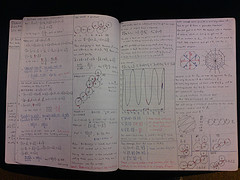
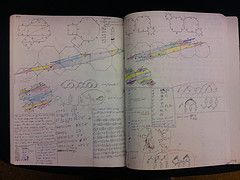
Some pages from Diana’s notebooks

All kinds of mathematicians study math and share it in so many ways. It’s like a never-ending math buffet!

Bon appetit!

A Sweater, Paper Projects, and Math Art Tools

Sondra Eklund and her Prime Factorization Sweater

Welcome to this week’s Math Munch!

Check out Sondra Eklund and her awesome prime factorization sweater! Sondra is a librarian and a writer who writes a blog where she reviews books. She also is a knitter and a lover of math!

Each number from two to one hundred is represented in order on the front of Sondra’s sweater. Each prime number is a square that’s a different color; each composite number has a rectangle for each of the primes in its prime factorization. This number of columns that the numbers are arranged into draws attention to different patterns of color. For instance, you can see a column that has a lot of yellow in it on the front of the sweater–these are all number that contain five as a factor.

You can read more about Sondra and her sweater on her blog. Also, here’s a response and variation to Sondra’s sweater by John Graham-Cumming.

Next up, do you like making origami and other constructions out of paper? Then you’ll love the site made by Laszlo Bardos called CutOutFoldUp.

Laszlo Bardos

A Rhombic Spirallohedron

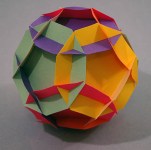
A decagon slide-together

Laszlo is a high school math teacher and has enjoyed making mathematical models since he was a kid. On CutOutFoldUp you’ll find gobs of projects to try out, including printable templates. I’ve made some slide-togethers before, but I’m really excited to try making the rhombic spirallohedron pictured above! What is your favorite model on the site?

Last up, Paul recently discovered a great mathematical art applet called Recursive Drawing. The tools are extremely simple. You can make circles and squares. You can stretch these around. But most importantly, you can insert a copy of one of your drawings into itself. And of course then that copy has a copy inside of it, and on and on. With a very simple interface and very simple tools, incredible complexity and beauty can be created.

Recursive Drawing was created by Toby Schachman, an artist and programmer who graduated from MIT and now lives in New York City and attends NYU.  You can watch a demo video below.

Recursive Drawing is one of the first applets on our new Math Art Tools page. We’ll be adding more soon. Any suggestions? Leave them in the comments!

Bon appetit!

(Beat, Beat, Beat…)

Welcome to this week’s Math Munch!

What could techno rhythms, square-pieces dissections, and windshield wipers have in common?

Animation in which progressively smaller square tiles are added to cover a rectangle completely.

The Euclidean Algorithm!

Say what?  The Euclidean Algorithm is all about our good friend long division and is a great way of finding the greatest common factor of two numbers. It relies on the fact that if a number goes into two other numbers evenly, then it also goes into their difference evenly.  For example, 5 goes into both 60 and 85–so it also goes into their difference, 25.  Breaking up big objects into smaller common pieces is a big idea in mathematics, and the way this plays out with numbers has lots of awesome aural and visual consequences.

Here’s the link that prompted this post: a cool applet where you can create your own unique rhythms by playing different beats against each other.  It’s called “Euclidean Rhythms” and was created by Wouter Hisschemöller, a computer and audio programmer from the Netherlands.

(Something that I like about Wouter’s post is that it’s actually a correction to his original posting of his applet.  He explains the mistake he made, gives credit to the person who pointed it out to him, and then gives a thorough account of how he fixed it.  That’s a really cool and helpful way that he shared his ideas and experiences.  Think about that the next time you’re writing up some math!)

For your listening pleasure, here’s a techno piece that Wouter composed (not using his applet, but with clear influences!)

Breathing Pavement

Here’s an applet that demonstrates the geometry of the Euclidean Algorithm.  If you make a rectangle with whole-number length sides and continue to chop off the biggest (non-slanty) square that you can, you’ll eventually finish.  The smallest square that you’ll chop will be the greatest common factor of the two original numbers.  See it in action in the applet for any number pair from 1 to 100, with thanks to Brown mathematics professor Richard Evan Schwartz, who maintains a great website.

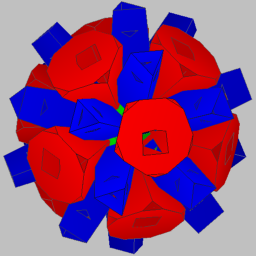
Holyhedron, layer three

One more thing, on an entirely different note: Holyhedron! A polyhedron where every face contains a hole. The story is given briefly here. Pictures and further details can be found on the website of Don Hatch, finder of the smallest known holyhedron.  It’s a mathematical discovery less than a decade old–in fact, no one had even asked the question until John Conway did so in the 1990s!

Have a great week! Bon appétit!