Tag Archives: geometry

MoMA, Pop-Up Books, and A Game of Numbers

Welcome to this week’s Math Munch!

Thank you so much to everyone who participated in our Math Munch “share campaign” over the past two weeks. Over 200 shares were reported and we know that even more sharing happened “under the radar”. Thanks for being our partners in sharing great math experiences and curating the mathematical internet.

Of course, we know that the sharing will continue, even without a “campaign”. Thanks for that, too.

All right, time to share some math. On to the post!

N_JoshiTo kick things off, you might like to check out our brand-new Q&A with Nalini Joshi. A choice quote from Nalini:

In contrast, doing math was entirely different. After trying it for a while, I realized that I could take my time, try alternative beginnings, do one step after another, and get to glimpse all kinds of possibilities along the way.
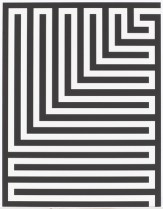
By Philippe Decrauzat.

By Philippe Decrauzat.

I hope the math munches I share with you this week will help you to “glimpse all kinds of possibilities,” too!

Recently I went to the Museum of Modern Art (MoMA) in New York City. (Warning: don’t confuse MoMA with MoMath!) On display was an exhibit called Abstract Generation. You can view the pieces of art in the exhibit online.

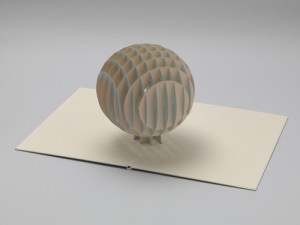
As I browsed the galley, the sculptures by Tauba Auerbach particularly caught my eye. Here are two of the sculptures she had on display at MoMA:
CRI_244599 CRI_244605

Just looking at them, these sculptures are definitely cool. However, they become even cooler when you realize that they are pop-up sculptures! Can you see how the platforms that the sculptures sit on are actually the covers of a book? Neat!

Here’s a video that showcases all of Tauba’s pop-ups in their unfolding glory. Why do you think this series of sculptures is called [2,3]?

This idea of pop-up book math intrigued me, so I started searching around for some more examples. Below you’ll find a video that shows off some incredible geometric pop-ups in action. To see how you can make a pop-up sculpture of your own, check out this how-to video. Both of these videos were created by paper engineer Peter Dahmen.

Taura Auerbach.

Tauba Auerbach.

Tauba got me thinking about math and pop-up books, but there’s even more to see and enjoy on her website! Tauba’s art gives me new ways to connect with and reimagine familiar structures. Remember our post about the six dimensions of color? Tauba created a book that’s a color space atlas! The way that Tauba plays with words in these pieces reminds me both of the word art of Scott Kim and the word puzzles of Douglas Hofstadter. Some of Tauba’s ink-on-paper designs remind me of the work of Chloé Worthington. And Tauba’s piece Componants, Numbers gives me some new insight into Brandon Todd Wilson’s numbers project.

0108 MM MM-Tauba-Auerbach-large

This piece by Tauba is a Math Munch fave!

For me, both math and art are all about playing with patterns, images, structures, and ideas. Maybe that’s why math and art make such a great combo—because they “play” well together!

Speaking of playing, I’d like to wrap up this week’s post by sharing a game about numbers I ran across recently. It’s called . . . A Game of Numbers! I really like how it combines the structure of arithmetic operations with the strategy of an escape game. A Game of Numbers was designed by a software developer named Joseph Michels for a “rapid” game competition called Ludum Dare. Here’s a Q&A Joseph did about the game.

A Game of Numbers.

A Game of Numbers.

If you enjoy A Game of Numbers, maybe you’ll leave Joseph a comment on his post about the game’s release or drop him an email. And if you enjoy A Game of Numbers, then you’d probably enjoy checking out some of the other games on our games page.

Bon appetit!

PS Tauba also created a musical instrument called an auerglass that requires two people to play. Whooooooa!

Reflection Sheet – MoMA, Pop-Up Books, and A Game of Numbers

Bridges, Unfolding the Earth, and Juggling

Welcome to this week’s Math Munch – from the Netherlands!

I’m at the Bridges Mathematical Art Conference, which this year is being held in Enschede, a city in the Netherlands. I’ve seen so much beautiful mathematical artwork, met so many wonderful people, and learned so many interesting new things that I can’t wait to start sharing them with you! In the next few weeks, expect many more interviews and links to sites by some of the world’s best mathematical artists.

But first, have a look at some of the artwork from this year’s art gallery at Bridges.

Hyperbolic lampshade

By Gabriele Meyer

Bunny!

By Henry Segerman and Craig Kaplan

Here are three pieces that I really love. The first is a crocheted hyperbolic plane lampshade. I love to crochet hyperbolic planes (and we’ve posted about them before), and I think the stitching and lighting on this one is particularly good. The second is a bunny made out of the word bunny! (Look at it very closely and you’ll see!) It was made by one of my favorite mathematical artists, Henry Segerman. Check back soon for an interview with him!

Hexagonal flower

By Francisco De Comite

This last is a curious sculpture. From afar, it looks like white arcs surrounding a metal ball, but up close you see the reflection of the arcs in the ball – which make a hexagonal flower! I love how this piece took me by surprise and played with the different ways objects look in different dimensions.

Jack van WijkMathematical artists also talk about their work at Bridges, and one of the talks I attended was by Jack van Wijk, a professor from Eindhoven University of Technology in the Netherlands. Jack works with data visualization and often uses a mixture of math and images to solve complicated problems.

One of the problems Jack tackled was the age-old problem of drawing an accurate flat map of the Earth. The Earth, as we all now know, is a sphere – so how do you make a map of it that fits on a rectangular piece of paper that shows accurate sizes and distances and is simple to read?

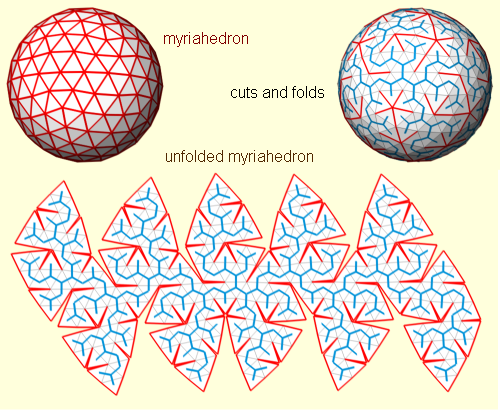
myriahedronTo do this, Jack makes what he calls a myriahedral projection. First, he draws many, many polygons onto the surface of the Earth – making what he calls a myriahedron, or a polyhedron with a myriad of faces. cylindrical mapThen, he decides how to cut the myriahedron up. This can be done in many different ways depending on how he wants the map to look. If he wants the map to be a nice, normal rectangle, maybe he’ll cut many narrow, pointed slits at the North and South Poles to make a map much like one we’re used to. But, maybe he wants a map that groups all the continents together or does the opposite and emphasizes how the oceans are connected…crazy maps

Jack made a short movie that he submitted to the Bridges gallery. He animates the transformation of the Earth to the map projections beautifully.

Jack’s short movie wasn’t the only great film I saw at Bridges. The usual suspects – Vi Hart and her father, George Hart – also submitted movies. George’s movie is about a math topic that I find particularly fascinating: juggling! The movie stars professional juggler Rod Kimball. Click on the picture below to watch:

juggling

This is only the tip of the iceberg that is the gorgeous and interesting artwork I saw at Bridges. Check out the gallery to see more (including artwork by our own Paul and a video by Paul and Justin!), or visit Math Munch again in the coming weeks to learn more about some of the artists.

Bon appetit!

Yang Hui, Pascal, and Eusebeia

Yanghui_triangleWelcome to this week’s Math Munch! I’ve got some mathematical history, an interactive visualization site, some math art, and a mathematical story from the fourth dimension for you.

Yang Hui's Triangle animated

First, take a look at the animation and picture above. What do you notice? This is sometimes called Pascal’s Triangle (click for background info and cool properties of the triangle.) It’s named for Blaise Pascal, the mathematician who published a treatise on its properties in 1653. (Click here for some history of Pascal’s life and work.)

Yang Hui

Yang Hui

BUT actually, Pascal wasn’t the first to play with the triangle. Yang Hui, a 13th century Chinese mathematician, published writings about the triangle more than 500 years earlier! Maybe we ought to be calling it Yang Hui’s Triangle! The picture above is the original image from Yang Hui’s 13th century book. (Also look at the way the Chinese did numbers at that time. Can you see out how it works at all?)  Edit: David Masunaga sent us an email telling us about an error in Yang Hui’s chart.  He says some editors will even correct the error before publishing.  Can you find the mistake?

I bring this all up, because I found a neat website that illustrates patterns in this beautiful triangle. Justin posted before on the subject, including this wonderful link to a page of visual patterns in Yang Hui’s triangle. But I found a website that lets you explore the patterns on your own! The website lets you pick a number and then it colors all of its multiples in the triangle. Below you can see the first 128 lines of the triangle with different multiples colored. NOW YOU TRY!

2s

Evens

Multiples of 4

Multiples of 4

Ends in 5 or 0

Ends in 5 or 0

* * *

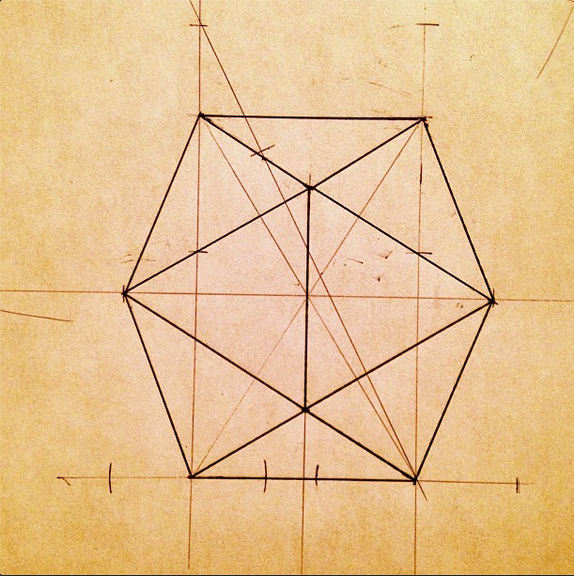
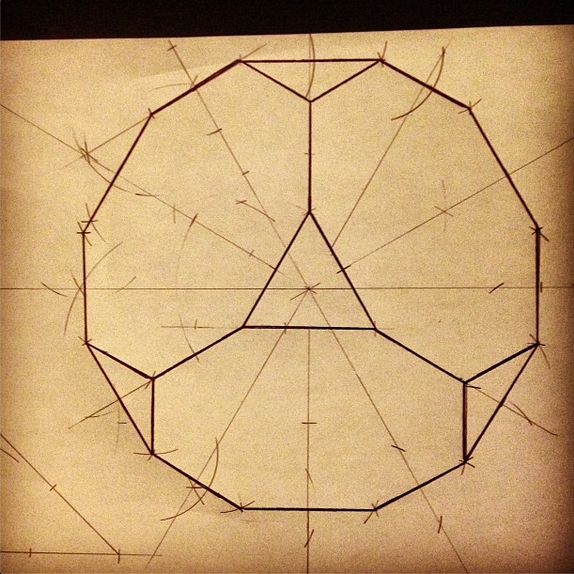
Recently, I’ve been working on a series of artworks based on the Platonic and Archimedean solids. You can see three below, but I’ll share many more in the future. These are compass and straight-edge constructions of the solids, viewed along various axes of rotational symmetry.

All of these drawings were done without “measuring” with a ruler, but I still had to get all of the sizes right for the lines and angles, which meant a lot of research and working things out. Along the way, I found eusebeia, a brilliant site that shows off some beautiful geometric objects in 3D and 4D. There’s a rather large section of articles (almost a book’s worth) describing 4D visualization. This includes sections on vision, cross-sections, projections, and anything you need to understand how to visualize the 4th dimension.

Uniform Polyhedra

A few uniform solids

The 5-cell and a story about it called "Legend of the Pyramid"

The 5-cell, setting for the short story, “Legend of the Pyramid

The site goes through all of the regular and uniform polyhedra, also known as the Platonic and Archimedean solids, and shows their analogs in 4D, the regular and uniform polychora. You may know the hypercube, but it’s just one of the 6 regular polychora.

I got excited to share eusebeia with you  when I found this “4D short story” at the bottom of the index. “Legend of the Pyramid” gives us a sense of what it would be like to live inside of the 5-cell, the 4D analog of the tetrahedron.

Well there you have it. Dig in. Bon appetit!

Yanghui_magic_squareBonus: Yang Hui also spent time studying magic squares.  (Remember this?)  In the animation to the right, you can see a clever way in which Yang Hui constructed a 3 by 3 magic square.