Tag Archives: history

Digital Art, Mastermind, and Pythagoras

Welcome to this week’s Math Munch… on (approximately) Math Munch’s second birthday! Hooray!

Check out this video of mathematical art made by artist Nathan Selikoff:

Cool, right? This piece is called “Beautiful Chaos.” The curves on the screen are made from equations (if you’ve ever graphed a line or a parabola you’ll know what I mean). As the viewer waves her hands around, the equations change– and as the equations change, so do the curves! The result is something that might remind you of the images your computer makes when you play music on it or maybe of something you’d make using a spirograph. All in all, a beautiful and interactive piece of mathematical art.

nathanNathan lives and works as a mathematical artist in Orlando, Florida. As he writes on his website, Nathan uses computer code along with other materials to make art that plays with the mathematical ideas of space, motion, and interaction between objects. To see more of how Nathan does this, check out his giant, interactive marionette or this song that explores the first, second, third, and fourth dimensions:

My school is really lucky to be hosting Nathan this week! We didn’t want any of you, dear readers, to miss out on the excitement, though– so Nathan has kindly agreed to answer your interview questions! Got a question for Nathan? Write it in the box below. He’ll answer seven of your best questions in two weeks!

565px-MastermindNext up, who doesn’t love to play Mastermind? It’s a great combination of logic, patterns, and trickery… but I just hate having to use all those tiny pegs. Well, guess what? You can play it online— no pegs (or opponent) necessary!

As I was playing Mastermind, I started wondering about strategy. What’s the best first guess to make? If I were as smart as a computer, is there a number of guesses in which I could guess any Mastermind code? (This kind of question reminds me of God’s Number and the Rubik’s cube…)

Well, it turns out there is a God’s Number for Mastermind – and that number is five. Just five. If you played perfectly and followed the strategy demonstrated by recreational mathematician Toby Nelson on his website, you could guess ANY Mastermind code in five guesses or less. Toby shares many more interesting questions about Mastermind on his website— I suggest you check it out.

What ARE those irrational numbers, so weird that they get their own bubble??

What ARE those irrational numbers, so weird that they get their own bubble??

Finally, sometime in your mathematical past you may have heard of irrational numbers. These are numbers like the square-root of 2 or pi or e that can’t be written as a fraction– or so people claim. When you start thinking about this claim, however, it may seem strange. There are A LOT of fractions– and none of them equal the square-root of 2? Really? What kind of number is that? It seems like only an irrational person would believe that, at least without proof.

Vi Hart to the rescue! Irrational numbers were encountered long, long ago by the ancient Greek mathematician (and cult leader) Pythagoras– and he didn’t like them much. In this great video, Vi tells all about Pythagoras and the controversial discovery of numbers that aren’t fractions.

If you didn’t follow her explanation of why the square-root of 2 is irrational on your first watch, don’t worry– it’s a complicated idea that’s worth a second (or third or fourth) run-through.

Thanks for a great two years of Math Munch! Bon appetit!
TesselManiac, Zeno’s Paradox, and Platonic Realms

Welcome to this week’s Math Munch!

Before we begin, we’d like to thank all of you who have checked out the site in the past week. Since we’ve kicked off our share campaign, we’ve had so many new visitors and heard from many of them, too! Reading your feedback – whether a recommendation, some praise, a question, or just a brief, “Hello!” – brings us great joy and helps us to know that you all are out there.

Whether you’re a regular reader or visiting the site for the first time, we’d like to ask you for a little favor. If you see some math you like, share it with someone who you think would like it, too! Do you love the burst of excitement that you get from reading about a new mathematical idea, seeing an original piece of math artwork, or trying out a new game? Do you know someone who would love that, too? Then tell them about Math Munch – we’d love to spread the joy.

If you enjoy Math Munch, join in our “share campaign” this week.

You can read more about the share campaign here. There are lots of ways to participate, and you can let us know about your sharing through this form. We’d love to see the share total rise up to 1000 over the course of the next week.

Now for the post!

***

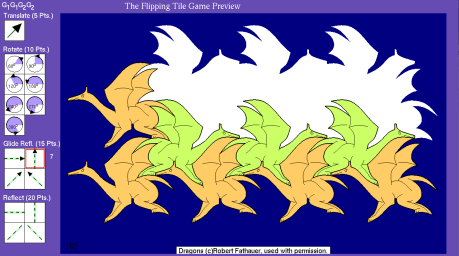
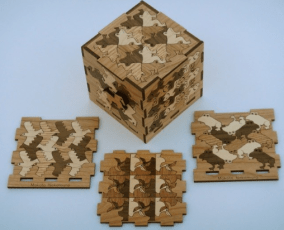
Lee boxThis beautiful tessellated wooden box was made by computer scientist and mathematical artist Kevin Lee. I met Kevin two weeks ago at the MOVES conference (which Justin and Paul have both written about already). Kevin teaches computer science at Normandale Community College in Minnesota. He makes woodcut tessellations (which won an award for the “Best Textile, Sculpture, or Other Medium” at the Joint Mathematics Meetings art exhibition this year!). He’s also used a combination of his knowledge of computer science and his love of Escher-type tessellations to make software that helps you create tessellations. His new software, TesselManiac!, is due out soon (watch this short movie Kevin made about it for the Bridges conference), but you can download an older version of the software here and play a preview version of The Flipping Tile Game.

tesselmaniac pictures

To play this game, you must fill in an outline of a tessellation with the piece given. You can use any of four symmetry motions – translation (or shift), rotation, reflection, or glide reflection (which reflects the tile and then translates it along a line parallel to the line of reflection). You get points for each correct tile placed (and lose points if you have to delete). Translations are the simplest, and only give you 5 points each. Reflections are the most difficult – you get 20 points for each one used!

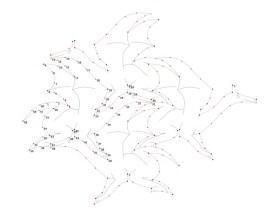
dot to dotWhile you’re downloading The Flipping Tile Game, try one of Kevin’s Dot-to-Dot puzzles. These are definitely not your typical dot-to-dot. Only the portion of the image corresponding to one tile in the tessellation is numbered. Once you figure out the shape of that single tile, you have to figure out how to number the rest of the puzzle!

Lucky for us, Kevin has agreed to answer some questions about his life and work as a math artist and computer scientist. Leave a question for Kevin here. (We’ll take questions for the next two weeks.)

tortoiseI’ve recently been thinking about a paradox that has puzzled mathematicians for centuries. Maybe you’ve heard of it. It’s one of the ancient Greek philosopher Zeno‘s paradoxes of motion, and it goes like this: Achilles (a really fast Greek hero) and a tortoise are going to run a race. Achilles agrees to give the tortoise a head-start, because the tortoise is so slow. Achilles then starts to run. But as Achilles catches up with the tortoise, the tortoise moves a little further. So the tortoise is still ahead. And as Achilles moves to catch up again, the tortoise moves even further! Sounds like Achilles will never catch up to the tortoise, let alone pass him… But that doesn’t make sense…

Will Achilles lose the race??? Check out this great video from Numberphile that explains both the paradox and the solution.

logo_PR_225_160While I was looking for information about this paradox, I stumbled across a great math resource site called Platonic Realms. The homepage of this site has a daily historical fact, mathematical quote, and puzzle.

The site hosts a math encyclopedia with explanations of all kinds of math terms and little biographies of famous mathematicians. You can also read “mini-texts” about different mathematical topics, such as this one about M. C. Escher (the inspiration behind the art at the beginning of this post!) or this one about coping with math anxiety.

I hope we here at Math Munch have given you something to tantalize your mathematical taste buds this week! If so, we’d love it if you would pass it along.

Thank you for reading, and bon appetit!

Rush hourP.S. – We’ve posted a new game, suggested to us by one of our readers! It’s an online version of Rush Hour. Check it out!

Lincoln, Blinkin’, and Fraud

Welcome to this week’s Math Munch!

Lincoln problem

Abraham Lincoln, figuring out a word problem.
Can you decipher his steps?

About a month ago I ran across an article about Abraham Lincoln and math. Lincoln is often celebrated as a self-made frontiersman who had little formal education. The article describes how two professors from Illinois State University recently discovered two new pages of math schoolwork done by Lincoln, which may show that he had somewhat more formal schooling than was previously believed. The sheet shows the young Abe figuring problems like, “If 4 men in 5 days eat 7 lb. of bread, how much will be sufficient for 16 men in 15 days?” Here are some further details about the manuscript’s discovery from the Illinois State University website and a high-quality scan of Lincoln’s figuring from the Harvard University Library.

Lincoln is also known for his study of Euclid’s Elements—that great work of mathematics from ancient times. Lincoln began to read the Elements when he was a young lawyer interested in what exactly it means to “prove” something. Euclid’s work even made a brief appearance in the recent movie about Lincoln. Thinking about Lincoln and math got me to wondering about how our presidents in general have interacted with the subject. Certainly they must all have had some kind of experience with math! In my searching and remembering, I’ve run across these tidbits about Ulysses S. Grant, James Garfield, and President Obama. Still, my searches haven’t turned up so very much. Maybe you’ll keep your eyes open for further bits of mathy presidential trivia?

481121_466454960066144_511840398_nNext up, check out these math problems about blinking on a wonderful online resource called Bedtime Math. Every day, the site posts a few math problems that parents and children can share and ponder at bedtime—just like families often do with storybooks. Bedtime Math was founded by Laura Bilodeau Overdeck. She is involved with several math-related nonprofits and is the mother of three kids. Bedtime Math grew out of the way that Laura shared math problems with her own children. A few of my favorite Bedtime Math posts are “You Otter Know” and “Booking Down the Hall“.

Today’s Bedtime Math is titled “Space Saver” and contains some problems about hexagon tilings and our mathematical chum, the honeybee. Here is today’s “big kid” problem: If a bee builds 5 hexagons flush in a horizontal row, how many total sides did the bee make, given the shared sides? I hope you find some problems to enjoy at Bedtime Math. You can sign up to receive their daily email of problems on the righthand side of the Bedtime Math frontpage.

Zome inventor Paul Hildebrand and a PCMI Fourth of July float!

Zome inventor Paul Hildebrandt and
a mathy PCMI Fourth of July float!

Did you know that people blink differently when they lie? I’ve been thinking a lot these past few weeks about frauds and fakes as I’ve worked with some teacher friends on this year’s PCMI problem sets. PCMI—the Park City Math Institute—is a math event held each summer that gathers math professors, math teachers, and college math students to do mathematics together for three weeks. It all happens in beautiful Park City, Utah. The first week of PCMI coincides with the Fourth of July, and the PCMI crew always makes a mathy entry in the local Independence Day Parade!

The theme of the high school teachers’ program this year is “Probability, Randomization, and Polynomials”. The first problem set introduces the following conundrum:

Suppose you were handed two lists of 120 coin flips, one real and
one fake. Devise a test you could use to decide which was which.
Be as precise as possible.

Which is real? Which is fake?

Which is real? Which is fake?

If you understand what this problem is all about, then you can understand my recent fascination with frauds! Over to the left I’ve shared two sequences I concocted. One I made by actually flipping a coin, while the other I made up out of my head. Can you tell which is which?

For more sleuthing fun, check out this applet on Khan Academy, which challenges you to distinguish lists of coin flips. Some are created by a fair coin, others are made by an unfair coin, and still others are made by human guesses. This coin-flipping challenge is a part of Khan Academy’s Journey into Cryptography series. You should also know that the PCMI problem sets from previous years are all online, filed by years under “Class Notes”. They are rich with fantastic, brain-teasing problems that are woven together in expert fashion.

And finally, to go along with your Bedtime Math, how about a little bedtime poetry? Check out the video below.

Sweet dreams, and bon appetit!