Tag Archives: history

Newroz, a Math Factory, and Flexagons

Welcome to this week’s Math Munch!

You’ve probably seen Venn diagrams before. They’re a great way of picturing the relationships among different sets of objects.

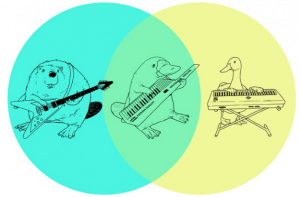
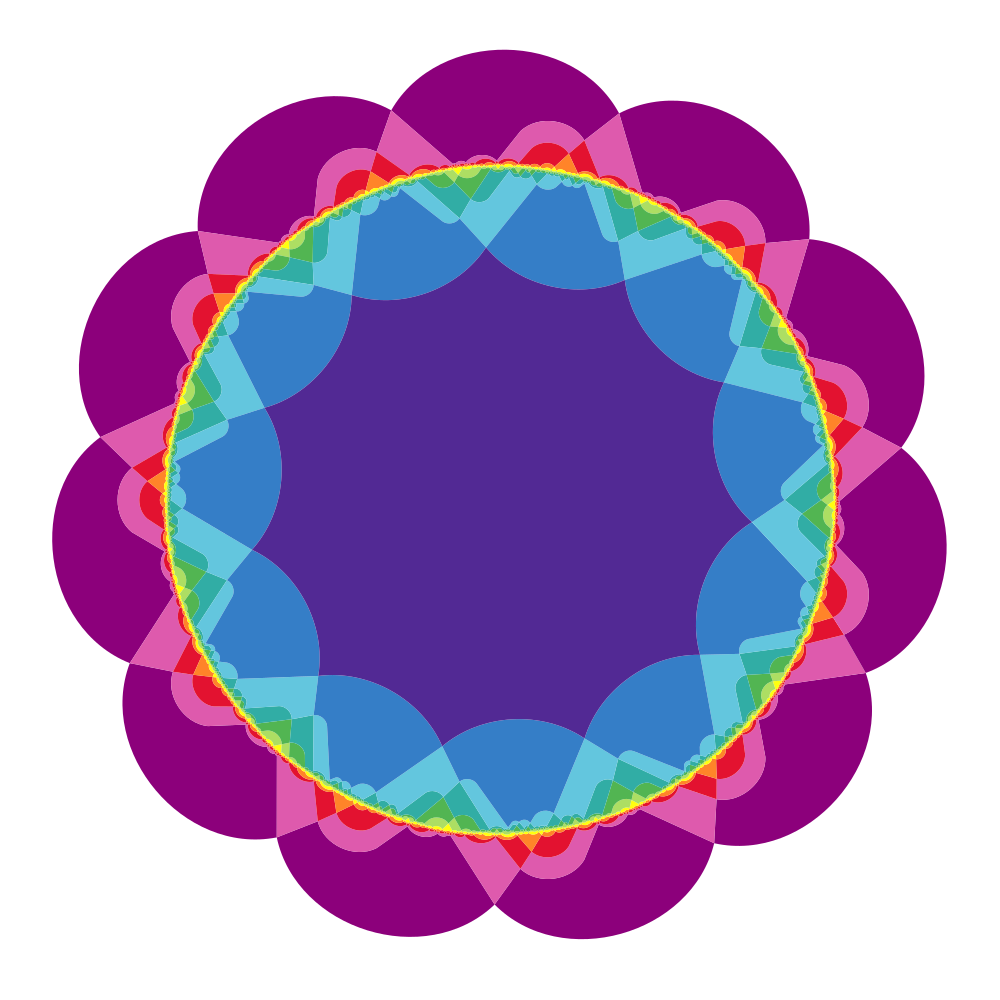
But I bet you’ve never seen a Venn diagram like this one!
Frank Ruskey

That’s because its discovery was announced only a few weeks ago by Frank Ruskey and Khalegh Mamakani of the University of Victoria in Canada. The Venn diagrams at the top of the post are each made of two circles that carve out three regions—four if you include the outside. Frank and Khalegh’s new diagram is made of eleven curves, all identical and symmetrically arranged. In addition—and this is the new wrinkle—the curves only cross in pairs, not three or more at a time. All together their diagram contains 2047 individual regions—or 2048 (that’s 2^11) if you count the outside.

Frank and Khalegh named this Venn diagram “Newroz”, from the Kurdish word for “new day” or “new sun”. Khalegh was born in Iran and taught at the University of Kurdistan before moving to Canada to pursue his Ph.D. under Frank’s direction.

Khalegh Mamakani

“Newroz” to those who speak English sounds like “new rose”, and the diagram does have a nice floral look, don’t you think?

When I asked Frank what it was like to discover Newroz, he said, “It was quite exciting when Khalegh told me that he had found Newroz. Other researchers, some of my grad students and I had previously looked for it, and I had even spent some time trying to prove that it didn’t exist!”

Khalegh concurred. “It was quite exciting. When I first ran the program and got the first result in less than a second I didn’t believe it. I checked it many times to make sure that there was no mistake.”

You can click these links to read more of my interviews with Frank and Khalegh.

I enjoyed reading about the discovery of Newroz in these articles at New Scientist and Physics Central. And check out this gallery of images that build up to Newroz’s discovery. Finally, Frank and Khalegh’s original paper—with its wonderful diagrams and descriptions—can be found here.

A single closed curve—or “petal”— of Newroz. Eleven of these make up the complete diagram.

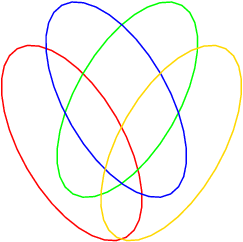
A Venn diagram made of four identical ellipses. It was discovered by John Venn himself!

For even more wonderful images and facts about Venn diagrams, a whole world awaits you at Frank’s Survey of Venn Diagrams.
On Frank’s website you can also find his Amazing Mathematical Object Factory! Frank has created applets that will build combinatorial objects to your specifications. “Combinatorial” here means that there are some discrete pieces that are combined in interesting ways. Want an example of a 5×5 magic square? Done! Want to pose your own pentomino puzzle and see a solution to it? No problem! Check out the rubber ducky it helped me to make!

A pentomino rubber ducky!

Finally, Frank mentioned that one of his early mathematical experiences was building hexaflexagons with his father. This led me to browse around for information about these fun objects, and to re-discover the work of Linda van Breemen. Here’s a flexagon video that she made.

And here’s Linda’s page with instructions for how to make one. Online, Linda calls herself dutchpapergirl and has both a website and a YouTube channel. Both are chock-full of intricate and fabulous creations made of paper. Some are origami, while others use scissors and glue.
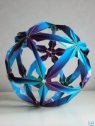
I can’t wait to try making some of these paper miracles myself!

Bon appetit!

Fractions, Sam Loyd, and a MArTH Journal

Welcome to this week’s Math Munch!

Check out this awesome graph:

What is it?  It’s a graph of the Farey Fractions, with the denominator of the (simplified) fraction on the vertical axis and the value of the fraction on the horizontal axis, made by mathematician and professor at Wheelock College Debra K. Borkovitz (previously).  Now, I’d never heard of Farey Fractions before I saw this image – but the graph was so cool that I wanted to learn all about them!

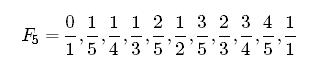
So, what are Farey Fractions, you ask?  Debra writes all about them and the cool visual patterns they make in this post.  To make a list of Farey Fractions you first pick a number – say, 5.  Then, you list all of the fractions between 0 and 1 whose denominators are less than or equal to the number you picked.  So, as Debra writes in her post, for 5 the list of Farey Fractions is:

As Debra writes, there are so many interesting patterns in Farey Fractions – many of which become much easier to see (literally) when you make a visualization of them.  Debra has made several awesome applets using the program GeoGebra, which she links to in her post.  (You can download GeoGebra and make applets of your own by visiting our Free Math Software page.)  These applets really show the power of using graphs and pictures to learn more about numbers.  To play with the applet that made the picture above, click here.  Check out her post to play with another applet, and to read more about the interesting patterns in Farey Fractions.

Next, check out this website devoted to the puzzles of puzzlemaster Sam Loyd.  Sam Loyd was a competitive chess player and professional puzzle-writer who lived at the end of the nineteenth century.  He wrote many puzzles that are still famous today – like the baffling Get Off the Earth puzzle.  Click the link to play an interactive version of the Get Off the Earth puzzle.

The site has links to numerous Sam Loyd puzzles.  Check out the Picture Puzzles, in which you have to figure out what object is described by the picture, or the Puzzleland Puzzles, which feature characters from the fictional place Puzzleland that Sam created.

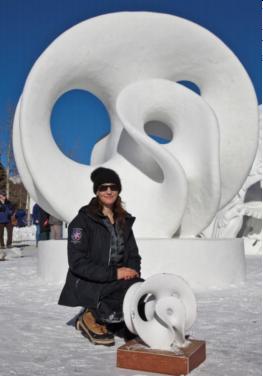
Snow MArTH, made by MArTHist Eva Hild and others at a snow sculpture event in Colorado. From the Spring, 2011 Hyperseeing.

Finally, take a look at some of the beautiful pictures and fascinating articles in this journal about mathematical art (a.k.a., MArTH) called Hyperseeing.  Hyperseeing is edited by mathematicians and artists Nat Friedman and Ergun Akleman.  Hyperseeing is published by the International Society of the Arts, Mathematics, and Architecture, which Nat founded to encourage education connecting the arts, architecture, and math – which we here at Math Munch love!  In one of his articles, Nat defines hyperseeing as, “Interdisciplinary education… concerned with seeing from multiple viewpoints in a very general sense.  Hyperseeing is a more complete way of seeing.”

There are so many beautiful images to look at and interesting articles to read in Hyperseeing.  Among other things, each edition of Hyperseeing features a mathematical comic by Ergun.  Here are some of my favorite Hyperseeings from the archives:

This edition of Hyperseeing features art made from Latin Squares and “organic geometry” art, among many other things.

This edition of Hyperseeing features crocheted hyperbolic surfaces (which we featured not long ago in this Math Munch!) and sculptures made with a 3-D printer, among many other things.

This is the first edition of Hyperseeing. In it, Nat describes the mission of Hyperseeing and the International Society of the Arts, Mathematics, and Architecture.

Bon appetit!

P.S. – You may have noticed a new thing to click off to the right, below the Favorite Munches.  This is our For Teachers section.  The Math Munch team has put together several pages to describe how we use Math Munch in our classes and give suggestions for how you might use it, too.  Teachers and non-teachers alike may want to check out our new Why Math Munch? page, which gives our mission statement.

P.P.S. – The Math Munch team is going to Bridges on Thursday!  Maybe we’ll see you there.

Faces, Blackboards, and Dancing PhDs

Welcome to this week’s Math Munch!

What does a mathematician look like? What does a mathematician do? Here are a couple of things I ran across recently that give a window into what it’s like to be a professional research mathematician—someone who works on figuring out new math as their job.

Gary Davis, who blogs over at Republic of Mathematics, recently posted a short piece that challenges stereotypes about mathematicians. It’s called What does a mathematician look like?

Who here is a mathematician? Click through to find out!

Gary’s point is that you can’t tell who is or isn’t a mathematician just by looking at them. Mathematicians come from every background and heritage. Gary followed up on this idea in another post where he highlighted some notable mathematicians who are black women. Here’s a website called Black Women in Mathematics that shares some biographies and history. And here’s a link to the Infinite Possibilities Conference, a yearly gathering “designed to promote, educate, encourage and support minority women interested in mathematics and statistics.” Suzanne Weekes, one of the five mathematicians pictured above, was a speaker at this conference in 2010.

Richard Tapia, another of the mathematicians above, is featured in the following video. His life story both inspires and delights.

And what does this diversity of mathematicians do all day? Well, one thing they do is talk to each other about math! And though there are many new technologies that help people to do and share and collaborate on mathematics (like blogs!), it’s hard to beat a handy chalkboard as a scribble pad for sharing ideas.

At Blackboard of the Day, Mathieu Rémy and Sylvain Lumbroso share the results of these impromptu math jam sessions. Every day they post a photograph of a blackboard covered in doodles and calculations and sketches of ideas. The website is in French, but the mathematical pictures are a universal language.

Diana Davis, putting the finishing touches on a blackboard masterpiece

Sharing mathematical ideas can take many forms, and sometimes choosing the right medium can make all the difference. Mathematicians use pictures, words, symbols, sculptures, movies, songs—even dances! Let me point you to the “Dance your Ph.D.” Contest. It’s exactly what it sounds like—people sharing the ideas of their dissertations (their first big piece of original work) through dance. Entries come in from physicists, chemists, biologists, and more.  Below you’ll find an entry by Diana Davis, a mathematician who completed her dissertation at Brown University this past spring. Diana often studies regular polgyons and especially ways of “dissecting” them—breaking them up into pieces in interesting ways.

Thanks to The Aperiodical—a great math blog—for sharing Diana’s wonderful video!

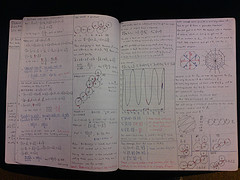
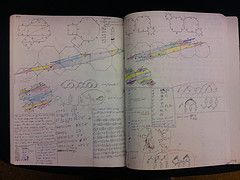
Some pages from Diana’s notebooks

All kinds of mathematicians study math and share it in so many ways. It’s like a never-ending math buffet!

Bon appetit!