Tag Archives: interview

MOVES, the Tower of Hanoi, and Mathigon

Welcome to this week’s Math Munch!

MOVESThe Math Munch team just wrapped up attending the first MOVES Conference, which was put on by the Museum of Math in NYC. MOVES is a recreational math conference and stands for Mathematics of Various Entertaining Subjects. Anna coordinated the Family Activities track at the conference and Paul gave a talk about his imbalance problems. I was just there as an attendee and had a blast soaking up wonderful math from some amazing people!
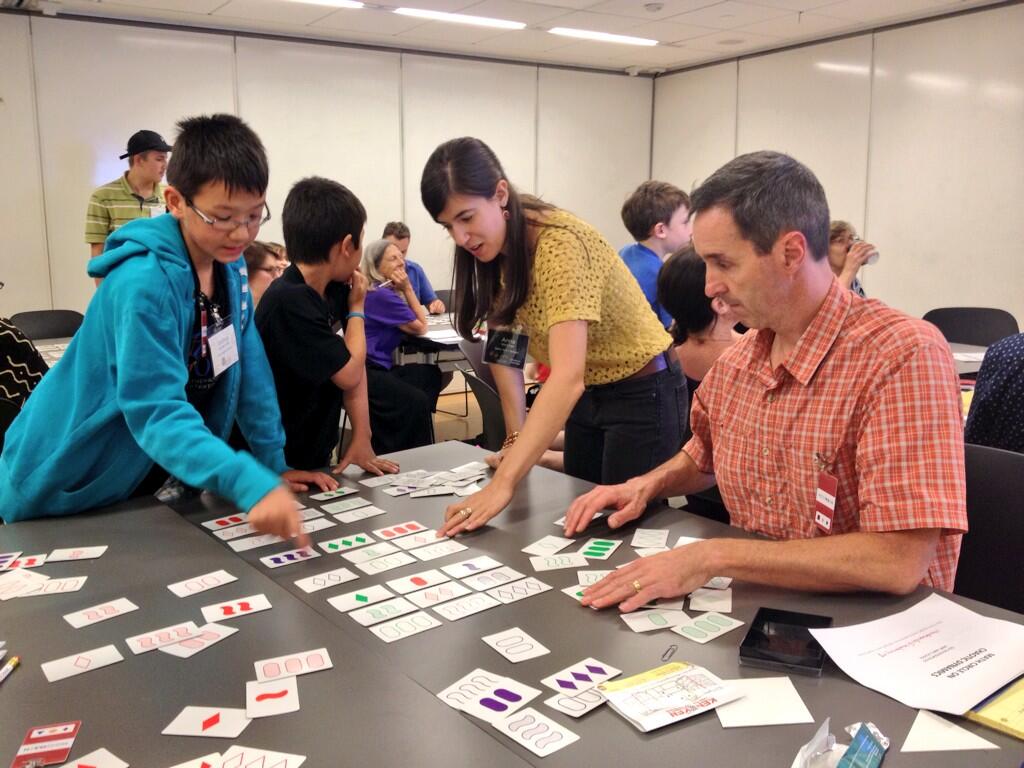
AnnaMOVES PaulMOVES JustinMOVES

Who all was there? Some of our math heroes—and familiar faces on Math Munch—like Erik Demaine, Tanya Khovanova, Tim and Tanya Chartier, and Henry Segerman, just to name just a few. I got to meet and learn from many new people, too! Even though I know it’s true, it still surprises me how big and varied the world of math and mathematicians is.
SuMOVES

Suzanne Dorée at MOVES.

One of my favorite talks at MOVES was given by Suzanne Dorée of Augsburg College. Su spoke about research she did with a former student—Danielle Arett—about the puzzle known as the Tower of Hanoi. You can try out this puzzle yourself with this online applet. The applet also includes some of the puzzle’s history and even some information about how the computer code for the applet was written.

danielle

Danielle Arett

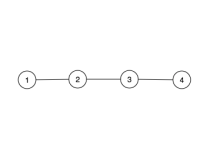
A pice of a Tower of Hanoi graph with three pegs and four disks.

A piece of a Tower of Hanoi graph with three pegs and four disks.

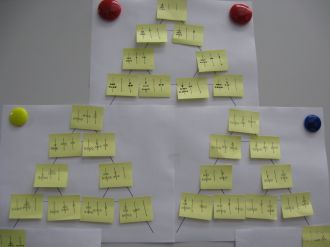
But back to Su and Danielle. If you think of the different Tower of Hanoi puzzle states as dots, and moving a disk as a line connecting two of these dots, then you can make a picture (or graph) of the whole “puzzle space”. Here are some photos of the puzzle space for playing the Tower of Hanoi with four disks. Of course, how big your puzzle space graph is depends on how many disks you use for your puzzle, and you can imagine changing the number of pegs as well. All of these different pictures are given the technical name of Tower of Hanoi graphs. Su and Danielle investigated these graphs and especially ways to color them: how many different colors are needed so that all neighboring dots are different colors?
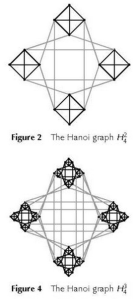
Images from Su and Danielle's paper. Towers of Hanoi graphs with four pegs.

Images from Su and Danielle’s paper. Tower of Hanoi graphs with four pegs.


Su and Danielle showed that even as the number of disks and pegs grows—and the puzzle graphs get very large and complicated—the number of colors required does not increase quickly. In fact, you only ever need as many colors as you have pegs! Su and Danielle wrote up their results and published them as an article in Mathematics Magazine in 2010.

Today Danielle lives in North Dakota and is an analyst at Hartford Funds. She uses math every day to help people to grow and manage their money. Su teaches at Ausburg College in Minnesota where she carries out her belief “that everyone can learn mathematics.”

Do you have a question for Su or Danielle—about their Tower of Hanoi research, about math more generally, or about their careers? If you do, send them to us in the form below for an upcoming Q&A!

UPDATE: We’re no longer accepting questions for Su and Danielle. Their interview will be posted soon! Ask questions of other math people here.

MathigonLast up, here’s a gorgeous website called Mathigon, which someone shared with me recently. It shares a colorful and sweeping view of different fields of mathematics, and there are some interactive parts of the site as well. There are features about graph theory—the field that Su and Danielle worked in—as well as combinatorics and polyhedra. There’s lots to explore!

Bon appetit!

Prime Gaps, Mad Maths, and Castles

Welcome to this week’s Math Munch!

It has been a thrilling last month in the world of mathematics. Several new proofs about number patterns have been announced. Just to get a flavor for what it’s all about, here are some examples.

I can make 15 by adding together three prime numbers: 3+5+7. I can do this with 49, too: 7+11+31. Can all odd numbers be written as three prime numbers added together? The Weak Goldbach Conjecture says that they can, as long as they’re bigger than five. (video)

11 and 13 are primes that are only two apart. So are 107 and 109. Can we find infinitely many such prime pairs? That’s called the Twin Prime Conjecture. And if we can’t, are there infinitely many prime pairs that are at most, say, 100 apart? (video, with a song!)

Harald Helfgott

Harald Helfgott

Yitang "Tom" Zhang

Yitang “Tom” Zhang

People have been wondering about these questions for hundreds of years. Last month, Harald Helfgott showed that the Weak Goldbach Conjecture is true! And Yitang “Tom” Zhang showed that there are infinitely many prime pairs that are at most 70,000,000 apart! You can find lots of details about these discoveries and links to even more in this roundup by Evelyn Lamb.

What’s been particularly fabulous about Tom’s result about gaps between primes is that other mathematicians have started to work together to make it even better. Tom originally showed that there are an infinite number of prime pairs that are at most 70,000,000 apart. Not nearly as cute as being just two apart—but as has been remarked, 70,000,000 is a lot closer to two than it is to infinity! That gap of 70,000,000 has slowly been getting smaller as mathematicians have made improvements to Tom’s argument. You can see the results of their efforts on the polymath project. As of this writing, they’ve got the gap size narrowed down to 12,006—you can track the decreasing values down the page in the H column. So there are infinitely many pairs of primes that are at most 12,006 apart! What amazing progress!

Two names that you’ll see in the list of contributors to the effort are Andrew Sutherland and Scott Morrison. Andrew is a computational number theorist at MIT and Scott has done research in knot theory and is at the Australian National University. They’ve improved arguments and sharpened figures to lower the prime gap value H. They’ve contributed by doing things like using a hybrid Schinzel/greedy (or “greedy-greedy”) sieve. Well, I know what a sieve is and what a greedy algorithm is, but believe me, this is very complicated stuff that’s way over my head. Even so, I love getting to watch the way that these mathematicians bounce ideas off each other, like on this thread.

Andrew Sutherland

Andrew Sutherland

Click through to see Andrew next to an amazing Zome creation!

Andrew. Click this!

Scott Morrison

Scott Morrison

Andrew and Scott have agreed to answer some of your questions about their involvement in this research about prime gaps and their lives as mathematicians. I know I have some questions I’m curious about! You can submit your questions in the form below:

I can think of only two times in my life where I was so captivated by mathematics in the making as I am by this prime gaps adventure. Andrew Wiles’s proof of Fermat’s Last Theorem was on the fringe of my awareness when it came out in 1993—its twentieth anniversary of his proof just happened, in fact. The result still felt very new and exciting when I read Fermat’s Enigma a couple of years later. Grigori Perelman’s proof of the Poincare Conjecture made headlines just after I moved to New York City seven years ago. I still remember reading a big article about it in the New York Times, complete with a picture of a rabbit with a grid on it.

This work on prime gaps is even more exciting to me than those, I think. Maybe it’s partly because I have more mathematical experience now, but I think it’s mostly because lots of people are helping the story to unfold and we can watch it happen!

fig110u2bNext up, I ran across a great site the other week when I was researching the idea of a “cut and slide” process. The site is called Mad Maths and the page I landed on was all about beautiful dissections of simple shapes, like circles and squares. I’ve picked out one that I find especially charming to feature here, but you might enjoy seeing them all. The site also contains all kinds of neat puzzles and problems to try out. I’m always a fan of congruent pieces problems, and these paper-folding puzzles are really tricky and original. (Or maybe, origaminal!) You’ll might especially like them if you liked Folds.

Christian's applet displaying the original four-room castle.

Christian’s applet displaying the original four-room castle.

Finally, we previously posted about Matt Parker’s great video problem about a princess hiding in a castle. Well, Christian Perfect of The Aperiodical has created an applet that will allow you to explore this problem—plus, it’ll let you build and try out other castles for the princess to hide in. Super cool! Will I ever be able to find the princess in this crazy star castle I designed?!

Crazy star castle!

My crazy star castle!

And as summer gets into full swing, the other kind of castle that’s on my mind is the sandcastle. Take a peek at these photos of geometric sandcastles by Calvin Seibert. What shapes can you find? Maybe Calvin’s creations will inspire your next beach creation!

Bon appetit!

167739151_ec142bbfe8 3342635687_f847918e0e 5945114420_c950231830

Solitons, Contours, and Thinking Sdrawkcab

Welcome to this week’s Math Munch!

Meet Nalini Joshi, a mathematician at the University of Sydney in Australia. I’ll let her introduce herself to you.

Nalini has an amazing story and amazing passion. What does her video make you think? To hear more from Nalini, you can watch this talk she gave last month at the Women in Mathematics conference at the Isaac Newton Institute in Cambridge, England. Her talk is called “Mathematics and life: a personal journey.” You might also enjoy reading this interview or others on her media page.

Nalini Joshi lecturing about solitons.

Nalini Joshi lecturing about solitons.

I’d like to share three clumps of ideas that might give you a flavor for the math that Nalini enjoys doing. Most of it is way over my head, but I’m reaching for it! You can, too, if you try.

Here’s clump number one. Two of the main objects that Nalini studies are dynamical systems and differential equations. You can think of a dynamical system as some objects that interact with each other and evolve over time. Think of the stars that Nalini described in the video, heading toward each other and tugging on each other. Differential equations are one way of describing these interactions in a mathematically precise way. They capture how tiny changes in one amount affect tiny changes in another amount.

Vlasov billiards.

Vlasov billiards.

To play around with some simple dynamical systems that can still produce some complex behaviors, check out dynamical-systems.org. Vlasov billiards was new to me. I think it’s really cool. The three-body problem is one of the oldest and most famous dynamical systems, and you can tinker around with examples of it here and here. There’s even a three-body problem game you can try playing. I’m not too crazy about it, but maybe you’ll enjoy it. It certainly gives you a sense for how chaotic the a three-body system can be!

Nalini doesn’t study just any old dynamical systems. She’s particularly interested in ones where the chaotic parts of the system cancel each other out. Remember in the video how she described the stars that go past each other and don’t destroy each other, that are “transparent to each other”? Places where this happens in dynamical systems are called soliton solutions. They’re like steady waves that can pass through each other. Check out these four videos on solitons, each of which gives a different perspective on them. If you’re feeling adventurous, you could try reading this article called What is a Soliton?

vid1

Making a water wave soliton in the Netherlands.

vid2

A computer animation of interacting solitons.

vid3

Japanese artist Takashi Suzuki tests a soliton to be used in a piece of performance art.

vid4

Students studying and building solitons in South Africa.

Level curves that are generalized Cassini curves. Also, kind of looks like a four-body problem. (click for video)

Level curves that are generalized Cassini curves.
Also, it kind of looks like a four-body problem.
(click for video)

The second idea that Nalini uses that I’d like to share is level curves, or contours. Instead of studying complicated differential equations directly, it’s possible to get at them geometrically by studying families of curves—contours—that are produced by related algebraic equations. They’re just like the lines on a topographic map that mark off areas of equal elevation.

Here’s a blog post by our friend Tim Chartier about colorful contour lines that arise from the differential equation governing heat flow. The temperature maps by Zachary Forest Johnson from a few weeks ago also used contour lines. And I found some great pieces of art that take contours as their inspiration. Click to check these out!

level_curves Utopia-70 Visual_Topography_of_a_Generation_Gap_Brooklyn_2

The last idea clump I’ll share involves integrable systems. In an integrable system, it’s possible to uniquely “undo” what has happened—the rules are such that there’s only one possible past that could lead to the present. Most systems don’t work this way—you can’t tell what was in your refrigerator a week ago by looking at it now! Nalini mentions on her research page that “ideas on integrable differential equations also extend to difference equations, and even to extended versions of cellular automata.” I enjoyed reading this article about reversible cellular automata, especially the section about Critters.

What move did Black just play? A puzzle by Raymond Smullyan.

What move did Black just play?
A puzzle by Raymond Smullyan.

And this made me think of a really nifty kind of chess puzzle called retrograde analysis—a fancy way of saying “thinking backwards”. Instead of trying to find the best chess move to play next, you instead have to figure out what move was made to get to the position in the puzzle. Most chess positions could be arrived at through multiple moves, but the positions in these puzzles are specially designed so that only one move will work. There’s a huge index of this kind of problem at The Retrograde Analysis Corner, and there are some great starter problems on this page.

Maurice Ashley

Maurice Ashley

And perhaps you’d like to hear a little bit about thinking backwards from one of the greatest teachers of chess, Grandmaster Maurice Ashley. Check out his TED video here.

I hope you’ve enjoyed finding out about Nalini Joshi and the mathematics that she loves. I asked Nalini if she would do a Q&A with us, and she said yes! Do you have a question you’d like to ask her? Send it to us below and we’ll include it in the interview, which I send to Nalini in about a week.

UPDATE: We’re no longer accepting questions for Nalini, because the interview has happened! Check it out!

Bon appetit!