Tag Archives: numbers

Demonstrations, a Number Tree, and Brainfilling Curves

Welcome to this week’s Math Munch!

Maybe you’re headed back to school this week. (We are!) Or maybe you’ve been back for a few weeks now. Or maybe you’ve been out of school for years. No matter which one it is, we hope that this new school year will bring many new mathematical delights your way!

A website that’s worth returning to again and again is the Wolfram Demonstrations Project (WDP). Since it was founded in 2007, users of the software package Mathematica have been uploading “demonstrations” to this website—amazing illuminations of some of the gems of mathematics and the sciences.

Each demonstration is an interactive applet. Some are very simple, like one that will factor any number up to 10000 for you. Others are complex, like this one that “plots orbits of the Hopalong map.”

Some demonstrations are great for visualizing facts about math, like these:
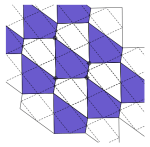
Any Quadrilateral Can Tile

A Proof of Euler’s Formula

Cube Net or Not?

There’s also a whole category of demonstrations that can be used as MArTH—mathematical art—tools, including these:

Rotate and Fold Back

Polygons Arranged in a Circle

Turtle Fractals

With over 8000 demonstrations to explore and new ones being added all the time, you can see why the Wolfram Demonstrations Project is worth returning to again and again!
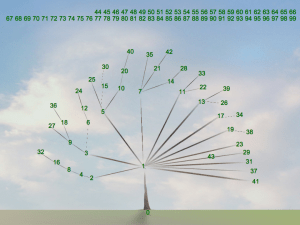
Jeffrey Ventrella’s Number Tree

Next up, check out this number tree. It was created by Jeffrey Ventrella, an innovator, artist, and computer programmer who lives in San Francisco. His number tree arranges the numbers from 1 to 100 according to their largest proper factors. For instance, the factors of 18 are 18, 9, 6, 3, 2, and 1. Once we toss out 18 itself as being “improper”—a.k.a. “uninteresting”—the largest factor of 18 is 9. This in turn has as its largest factor 3, and 3 goes down to 1. Chains of factors like this one make up Jeffrey’s tree. It has a wonderful accumulative feeling to it—it’s great to watch how patterns and complexity build up over time.

(On this theme, WDP also has a demonstrations about trees and about prime factorization graphs.)

Cloctal: “a fractal design that visualizes the passage of time”

There’s lots more math to explore on Jeffrey’s website. His piece Cloctal—a fractal clock—is one of my favorites. What I’d like to feature here, though, is the diverse and intricate work Jeffrey has done with plane-filling and space-filling curves.  You can find many examples at fractalcurves.com, Jeffrey’s website that’s chock full of great links.

Jeffrey recently completed a book called Brainfilling Curves. It’s “a visual math expedition, lead by a lifelong fractal explorer.” According to the description, the book picks up where Mandelbrot left off and develops an intuitive scheme for understanding an “infinite universe of fractal beauty.”
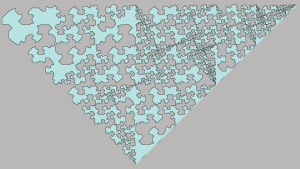
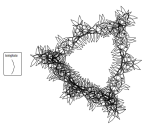
An example of a “brainfilling curve” from Jeffrey’s “root8” family

The title comes from the idea that nature uses space-filling curves quite often, to pack intestines into your gut or lots and lots of tissue into the brain you’re using to read this right now! Hopefully you’re finding all of this math quite brainfilling as well.

(And just one more example of why WDP is worth revisiting: here’s a demonstration that depicts the space-filling Hilbert and Moore curves. So much good stuff!)

Finally, here’s a video that Jeffrey made about brainfilling curves. You can find more on his YouTube channel.

Bon appetit!

Fractions, Sam Loyd, and a MArTH Journal

Welcome to this week’s Math Munch!

Check out this awesome graph:

What is it?  It’s a graph of the Farey Fractions, with the denominator of the (simplified) fraction on the vertical axis and the value of the fraction on the horizontal axis, made by mathematician and professor at Wheelock College Debra K. Borkovitz (previously).  Now, I’d never heard of Farey Fractions before I saw this image – but the graph was so cool that I wanted to learn all about them!

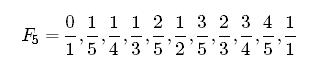
So, what are Farey Fractions, you ask?  Debra writes all about them and the cool visual patterns they make in this post.  To make a list of Farey Fractions you first pick a number – say, 5.  Then, you list all of the fractions between 0 and 1 whose denominators are less than or equal to the number you picked.  So, as Debra writes in her post, for 5 the list of Farey Fractions is:

As Debra writes, there are so many interesting patterns in Farey Fractions – many of which become much easier to see (literally) when you make a visualization of them.  Debra has made several awesome applets using the program GeoGebra, which she links to in her post.  (You can download GeoGebra and make applets of your own by visiting our Free Math Software page.)  These applets really show the power of using graphs and pictures to learn more about numbers.  To play with the applet that made the picture above, click here.  Check out her post to play with another applet, and to read more about the interesting patterns in Farey Fractions.

Next, check out this website devoted to the puzzles of puzzlemaster Sam Loyd.  Sam Loyd was a competitive chess player and professional puzzle-writer who lived at the end of the nineteenth century.  He wrote many puzzles that are still famous today – like the baffling Get Off the Earth puzzle.  Click the link to play an interactive version of the Get Off the Earth puzzle.

The site has links to numerous Sam Loyd puzzles.  Check out the Picture Puzzles, in which you have to figure out what object is described by the picture, or the Puzzleland Puzzles, which feature characters from the fictional place Puzzleland that Sam created.

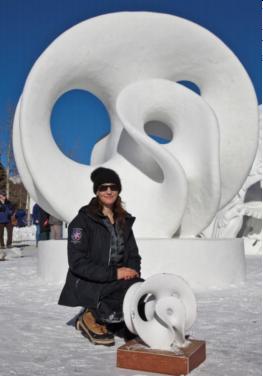
Snow MArTH, made by MArTHist Eva Hild and others at a snow sculpture event in Colorado. From the Spring, 2011 Hyperseeing.

Finally, take a look at some of the beautiful pictures and fascinating articles in this journal about mathematical art (a.k.a., MArTH) called Hyperseeing.  Hyperseeing is edited by mathematicians and artists Nat Friedman and Ergun Akleman.  Hyperseeing is published by the International Society of the Arts, Mathematics, and Architecture, which Nat founded to encourage education connecting the arts, architecture, and math – which we here at Math Munch love!  In one of his articles, Nat defines hyperseeing as, “Interdisciplinary education… concerned with seeing from multiple viewpoints in a very general sense.  Hyperseeing is a more complete way of seeing.”

There are so many beautiful images to look at and interesting articles to read in Hyperseeing.  Among other things, each edition of Hyperseeing features a mathematical comic by Ergun.  Here are some of my favorite Hyperseeings from the archives:

This edition of Hyperseeing features art made from Latin Squares and “organic geometry” art, among many other things.

This edition of Hyperseeing features crocheted hyperbolic surfaces (which we featured not long ago in this Math Munch!) and sculptures made with a 3-D printer, among many other things.

This is the first edition of Hyperseeing. In it, Nat describes the mission of Hyperseeing and the International Society of the Arts, Mathematics, and Architecture.

Bon appetit!

P.S. – You may have noticed a new thing to click off to the right, below the Favorite Munches.  This is our For Teachers section.  The Math Munch team has put together several pages to describe how we use Math Munch in our classes and give suggestions for how you might use it, too.  Teachers and non-teachers alike may want to check out our new Why Math Munch? page, which gives our mission statement.

P.P.S. – The Math Munch team is going to Bridges on Thursday!  Maybe we’ll see you there.

Math Cats, Frieze Music, and Numbers

Welcome to this week’s Math Munch!

I just ran across a website that’s chock full of cool math applets, links, and craft ideas – and perfect for fulfilling those summer math cravings!  Math Cats was created by teacher and parent Wendy Petti to, as she says on her site, “promote open-ended and playful explorations of important math concepts.”

Math Cats has a number of pages of interesting mathematical things to do, but my favorite is the Math Cats Explore the World page.  Here you’ll find links to cool math games and explorations made by Wendy, such as…

… the Crossing the River puzzle!  In this puzzle, you have to get a goat, a cabbage, and a wolf across a river without any of your passengers eating each other!  And…

… the Encyclogram!  Make beautiful images called harmonograms, spirographs, and lissajous figures with this cool applet.  Wendy explains some of the mathematics behind these images, too. And, one of my favorites…

Scaredy Cats!  If you’ve ever played the game NIM, this game will be very familiar.  Here you play against the computer to chase cats away – but don’t be left with the last cat, or you’ll lose!

These are only a few of the fun activities to try on Math Cats.  If you happen to be a teacher or parent, I recommend that you look at Wendy’s Idea Bank.  Here Wendy has put together a very comprehensive and impressive list of mathematics lessons, activities, and links contributed by many teachers.

Next, Vi Hart has a new video that showcases one of my favorite things in mathematics – the frieze.  A frieze is a pattern that repeats infinitely in one direction, like the footsteps of the person walking in a straight line above.  All frieze patterns have translation symmetry – or symmetry that slides or hops – but some friezes have additional symmetries.  The footsteps above also have glide reflection symmetry – a symmetry that flips along a horizontal line and then slides.  Frieze patterns frequently appear in architecture.  You can read more about frieze patterns here.

Reading about frieze patterns is all well and good – but what if you could listen to them?  What would a translation sound like?  A glide reflection?  The inverse of a frieze pattern?  Vi sings the sounds of frieze patterns in this video.

[youtube http://www.youtube.com/watch?v=Av_Us6xHkUc&feature=BFa&list=UUOGeU-1Fig3rrDjhm9Zs_wg]

Do you have your own take on frieze music?  Send us your musical compositions at MathMunchTeam@gmail.com .

Finally, if I were to ask you to name the number directly in the middle of 1 and 9, I bet you’d say 5.  But not everyone would.  What would these strange people say – and why would they also be correct?  Learn about this and some of the history, philosophy, and psychology of numbers – and hear some great stories – in this podcast from Radiolab.  It’s called Numbers.

Bon appetit!

P.S. – Paul made a new Yoshimoto video!  The Mega-Monster Mesh comes alive!  Ack!

[youtube https://www.youtube.com/watch?v=PMpr8pA5lJw&feature=player_embedded]

P.P.S. – Last week – June 28th, to be exact – was Tau Day.  For more information about Tau Day and tau, check out the last bit of this old Math Munch post.  In honor of the occasion, Vi Hart made this new tau video.  And there’s a remix.