Tag Archives: polyominoes

Polyominoes, Rubix, and Emmy Noether

Welcome to this week’s Math Munch!

Check out the Pentomino Project, a website devoted to all things about polyominoes by students and teachers from the K. S. O. Glorieux Ronse school in Belgium.

Their site is full of lots of useful information about polyominoes, such as what the different polyominoes look like and how they are formed.

In this puzzle, place the twelve pentominoes as "islands in a sea" so that the area of the sea is a small as possible. The pentominoes can't touch, even at corners. Here's a possible solution.

Even more awesome, though, is their collection of polyomino puzzles – about dissections, congruent pieces, tilings, and more!  They have a contest every year  – and people from around the world are encouraged to participate!  If you solve a puzzle, you can send them your solution and they might post it on their site.

Next, have you ever thought to yourself, “Gee, I wonder if I can make my own Rubix Cube?”  Well, sixth grader August did just that.  And, after several days of searching for patterns and working hard with paper, scissors, string, and tape, August succeeded!  His 2-by-2 Rubix Cube works just like any other, is fun to play with, and – even better – was fun to make.

Try it yourself:

Finally, ever heard of Emmy Noether?  It’s not surprising if you haven’t, because, according a New York Times article about her, “few can match in the depths of her perverse and unmerited obscurity….”  But, she was one of the most influential mathematicians and scientists of the 20th century – and was named by Albert Einstein the most “significant” and “creative” woman mathematician of all time.  You can read about Emmy’s influential theorem, and her struggles to become accepted in the mathematical community as a Jewish woman, in this article.

Want to learn more about women mathematicians throughout history?  Check out this site of biographies from Agnes Scott College.

Bon appetit!

Pentomino Puzzles, Knight’s Tours, and Decimal Maxing

Welcome to this week’s Math Munch!

Have a pentomino tiling problem that’s got you stumped?  Then perhaps the Pentominos Puzzle Solver will be right up your alley! Recently I’ve been thinking a lot about using computer programming and search algorithms to solve mathematical problems, and the Pentomino Puzzle Solver is a great example of the power of coding.  Written by David Eck, a professor of math and computer science at Brandeis University, the solver can find tilings of a variety of shapes.  Watch the application in slow-mo to see how it works; put it into high-gear to see the power of doing mathematics with computers!

Next, here’s a wonderful page about knight’s tours maintained by George Jelliss, a retiree from the UK.  He says on his introductory page, “I have been interested in questions related to the geometry of the knight’s move since the early 1970s.” George has investigated “leapers” or “generalized knights”—pieces that move in other L-shapes than the traditional 2×1—and he even published his own chess puzzle magazine for a number of years.  His webpage includes a great section about the history of knights tours, and I’m a fan of the beautiful catalog of “crosspatch” tours. Great stuff!

Multiplication, addition, division: which gives the biggest result?

Last but not “least”, to the left you’ll find a tiny chunk of a very large table that was constructed and colored by Debra Borkovitz, a math professor at Wheelock College.  Debra describes how, “Students often have poor number sense about multiplication and division with numbers less than one.”  She created an investigation where students decide, for any pair of decimals, which is biggest–multiplying them, adding them, or subtracting them.  For 1.0 and 1.0 the answer is easy–you should add them, so that you get 2.  .5 and 1 is trickier–adding yields 1.5, multiplying gives .5, but dividing 1 by .5 makes 2, since there are two halves in 1. Finding the biggest value possible given some restrictions is called “maximization” in mathematics, and it’s a very popular type of problem with many applications.

This investigation about makes me wonder: what other kinds of tables could I try to make?

Debra mentions that she got the inspiration for this problem from a newsletter put out by the Association of Women in Mathematics.  There’s lots to explore on their website, including an essay contest for middle schoolers, high schoolers, and undergraduates.

I hope you found something here to enjoy.  Bon appetit!

Circles, Geomagic, and Marble Calculators

Welcome to this week’s Math Munch!

We gave you a taste of some of Vi Hart’s math art last week with her balloon creations.  This week, we’re featuring some of Vi’s doodling in math class art – her Apollonian gaskets!  An Apollonian gasket is a fractal made by drawing a big circle, drawing two or three (or more!) smaller circles inside of it so that they fit snugly, and then filling all of the left-over empty space with smaller and smaller circles.  Here’s the video in which Vi tells how she draws Apollonian gaskets with circles and other shapes (and how she makes other awesome things like an infinitely long caravan of camels fading into the distance).  And here are some more Apollonian gaskets made by filling other shapes with circles from Math Freeze.

Next, you may have seen a magic square before, a number puzzle in which you fill a square grid with numbers so that each row, column, and diagonal have the same sum.  (Play with one here.)  But have you ever seen a geomagic square?

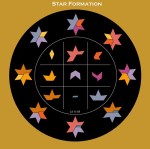
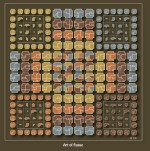
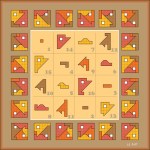
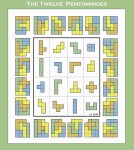
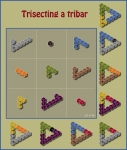
Magic squares have been around for thousands of years, but in 2001, Lee Sallows started thinking about them in a new way.  Lee realized that you could think of the numbers in the square as sticks of particular lengths, and the number being added to as an amount of space you were trying to fill with those sticks.  That led him to try to make magic squares out of things like pentominoes and other polyominoes, butterflies,  and many other shapes!  Aren’t they beautiful?

Finally, what do marbles, binary, and wooden levers have in common?  Mathematical artist, designer, and wood-worker Matthias Wandel built a binary adding machine that uses marbles and wooden gates!  Here’s a video demonstrating how it works:

Matthias doesn’t only build calculators.  Here’s a marble elevator and a machine that you can take apart and reassemble to make a new track.

Bon Appetit!