Tag Archives: primes

Demonstrations, a Number Tree, and Brainfilling Curves

Welcome to this week’s Math Munch!

Maybe you’re headed back to school this week. (We are!) Or maybe you’ve been back for a few weeks now. Or maybe you’ve been out of school for years. No matter which one it is, we hope that this new school year will bring many new mathematical delights your way!

A website that’s worth returning to again and again is the Wolfram Demonstrations Project (WDP). Since it was founded in 2007, users of the software package Mathematica have been uploading “demonstrations” to this website—amazing illuminations of some of the gems of mathematics and the sciences.

Each demonstration is an interactive applet. Some are very simple, like one that will factor any number up to 10000 for you. Others are complex, like this one that “plots orbits of the Hopalong map.”

Some demonstrations are great for visualizing facts about math, like these:
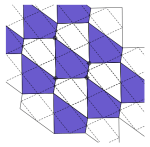
Any Quadrilateral Can Tile

A Proof of Euler’s Formula

Cube Net or Not?

There’s also a whole category of demonstrations that can be used as MArTH—mathematical art—tools, including these:

Rotate and Fold Back

Polygons Arranged in a Circle

Turtle Fractals

With over 8000 demonstrations to explore and new ones being added all the time, you can see why the Wolfram Demonstrations Project is worth returning to again and again!
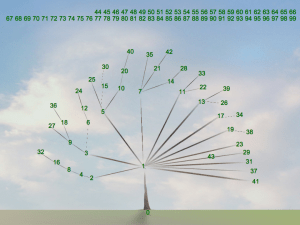
Jeffrey Ventrella’s Number Tree

Next up, check out this number tree. It was created by Jeffrey Ventrella, an innovator, artist, and computer programmer who lives in San Francisco. His number tree arranges the numbers from 1 to 100 according to their largest proper factors. For instance, the factors of 18 are 18, 9, 6, 3, 2, and 1. Once we toss out 18 itself as being “improper”—a.k.a. “uninteresting”—the largest factor of 18 is 9. This in turn has as its largest factor 3, and 3 goes down to 1. Chains of factors like this one make up Jeffrey’s tree. It has a wonderful accumulative feeling to it—it’s great to watch how patterns and complexity build up over time.

(On this theme, WDP also has a demonstrations about trees and about prime factorization graphs.)

Cloctal: “a fractal design that visualizes the passage of time”

There’s lots more math to explore on Jeffrey’s website. His piece Cloctal—a fractal clock—is one of my favorites. What I’d like to feature here, though, is the diverse and intricate work Jeffrey has done with plane-filling and space-filling curves.  You can find many examples at fractalcurves.com, Jeffrey’s website that’s chock full of great links.

Jeffrey recently completed a book called Brainfilling Curves. It’s “a visual math expedition, lead by a lifelong fractal explorer.” According to the description, the book picks up where Mandelbrot left off and develops an intuitive scheme for understanding an “infinite universe of fractal beauty.”
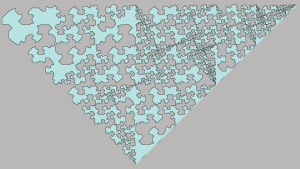
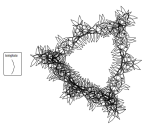
An example of a “brainfilling curve” from Jeffrey’s “root8” family

The title comes from the idea that nature uses space-filling curves quite often, to pack intestines into your gut or lots and lots of tissue into the brain you’re using to read this right now! Hopefully you’re finding all of this math quite brainfilling as well.

(And just one more example of why WDP is worth revisiting: here’s a demonstration that depicts the space-filling Hilbert and Moore curves. So much good stuff!)

Finally, here’s a video that Jeffrey made about brainfilling curves. You can find more on his YouTube channel.

Bon appetit!

Visualizations, Inspirations, and the Super Ultimate Graphing Challenge

Welcome to this week’s Math Munch!

Jason Davies

Meet Jason Davies, a freelance mathematician living in the UK. Growing up in Wales (one of the 4 countries of the United Kingdom) his classes were taught in Welsh. This makes Jason one of only about 611,000 people that speak the language, only 21.7% of the population of Wales! Imagine if only 1/5 of France spoke French!! These statistics are from a 2004 study, so the numbers may have changed a bit, but they still say something interesting don’t they?

Prime Seive

Jason is all about what numbers and pictures can tell us.  Since graduating from Cambridge, he’s been doing all sorts of data visualization and computer science on his own for various companies and IT firms. I originally found Jason through a link to his Prime Seive visualization, but take a look at his gallery and you’re bound to find something beautiful, interesting, interactive, and cool. I’ve linked to some of my favorites below.

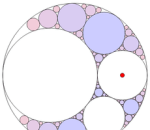
Interactive Apollonian Gasket

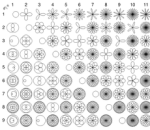
Rhodonea Curves

Set Partitions

I asked Jason a few questions about his interest in data visualization and math in general. Here’s a tasty little excerpt:

MM: What’s the most important trait for a mathematician to have? Is there one?

JD: Persistance is always useful in maths! I think the stereotype is to be analytical and logical, but in fact there are many other traits that are highly important, for instance communication skills. Mathematics is passed on from person to person, after all, so being able to communicate ideas effectively is dynamite.

MM: Do you have a message you’d like to give to young mathematicians?

JD: The world needs you!

Read the rest in our Q&A with Jason Davies, and you can see all of our interviews on the Q&A page we’ve just created.

Up next, a beautiful and inspiring video from Spain. The video is actually called Insprations, and it comes to us from Etérea Studios, the online home of animator Cristóbal Vila. In the intro he says, “I looked into that enormous and inexhaustible source of inspiration that is Escher and tried to imagine how it could be his workplace, what things would surround an artist like him, so deeply interested in science in general and mathematics in particular.”

I’d die to have an office like this!

It gets better.  Cristóbal added a page explaining all of the wonderful maths in the video. Click to read about Platonic solids, tilings, tangrams, and various works of art by M.C. Escher.

Finally, a nifty new game that explores the relationship between graphs and different kinds of motion. Super Ultimate Graphing Challenge is a game developed by Physics teacher Matthew Blackman to help his students understand the physics and mathematics of motion. You might not understand it all when you start, but keep playing and see what you can make of it. If you need a bit of help or have something to say, post it in our comments, and we’ll happily reply.

Bon appetit!

Music Box, FatFonts, and the Yoshimoto Cube

Welcome to this week’s Math Munch!

The Whitney Music Box

Jim Bumgardner

Solar Beat

With the transit of Venus just behind us and the summer solstice just ahead, I’ve got the planets and orbits on my mind. I can’t believe I haven’t yet shared with you all the Whitney Music Box. It’s the brainchild of Jim Bumgardner, a man of many talents and a “senior nerd” at Disney Interactive Labs. His music box is one of my favorite things ever–so simple, yet so mesmerizing.

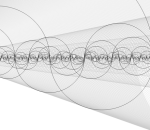
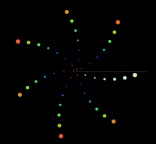
It’s actually a bunch of different music boxes–variations on a theme. Colored dots orbit in circles, each with a different frequency, and play a tone when they come back to their starting points. In Variation 0, for instance, within the time it takes for the largest dot to orbit the center once, the smallest dot orbits 48 times. There are so many patterns to see–and hear! There are 21 variations in all. Go nuts! In this one, only prime dots are shown. What do you notice?

You can find a more astronomical version of this idea at SolarBeat.

Above you’ll find a list of the numerals from 1 to 9. Or is it 0 to 9?

Where’s the 0 you ask? Well, the idea behind FatFonts is that the visual weight of a number is proportional to its numerical size. That would mean that 0 should be completely white!

FatFonts can also be nested. The first number below is 64. Can you figure out the second?

This is 64 in FatFonts.

What number is this?
Click to zoom!

FatFonts was developed by the team of Miguel NacentaUta Hinrichs, and Sheelagh Carpendale. You can see some uses that FatFonts has been put to on their Gallery page, and even download FatFonts to use in your word processor. Move over, Times New Roman!

This past week, Paul pointed me to this cool video by George Hart about interlocking complementary polyhedra that together form a cube. It reminded me of something I saw for the first time a few years ago that just blew me away. You have to see the Yoshimoto Cube to believe it:

In addition to its more obvious charms, something that delights me about the Yoshimoto Cube is how it was found so recently–only in 1971, by Naoki Yoshimoto.  (That other famous cube was invented in 1974 by Ernő Rubik.) How can it be that simple shapes can be so inexhaustible? If you’re feeling inspired, Make Magazine did a short post on the Yoshimoto Cube a couple of years that includes a template for making a Yoshimoto Cube out of paper. Edit: These template and instructions aren’t great. See below for better ones!

Since it’s always helpful to share your goals to help you stick to them, I’ll say that this week I’m going to make a Yoshimoto Cube of my own. Begone, back burner! Later in the week I’ll post some pictures below. If you decide to make one, share it in the comments or email us at

MathMunchTeam@gmail.com

We’d love to hear from you.

Bon appetit!

Update:

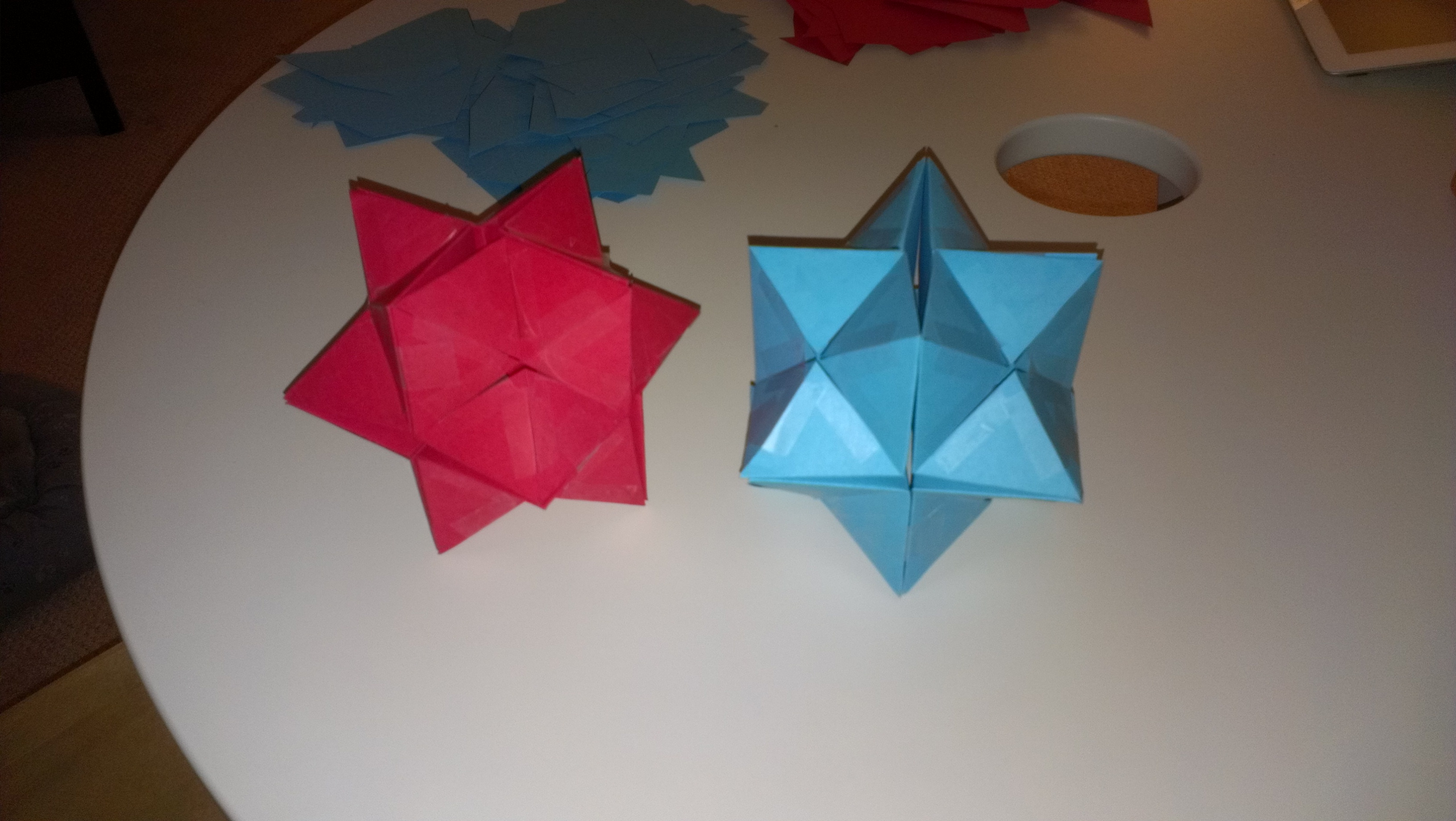
Here are the two stellated rhombic dodecahedra that make the Yoshimoto Cube that Paul and I made! Templates, instructions, and video to follow!

Here are two different templates for the Yoshimoto cubelet. You’ll need eight cubelets to make one star.

And here’s how you tape them together: