Tag Archives: Vi Hart

Maths Ninja, Folding Fractals, and Pi Fun

Welcome to this week’s Math Munch!

ninjaFirst up, have you ever been stuck on a gnarly math problem and wished that a math ninja would swoop in and solve the problem before it knew what hit it?  Have you ever wished that you had a math dojo who would impart wisdom to you in cryptic but, ultimately, extremely timely and useful ways?  Well, meet Colin Beverige, a math (or, as he would say, maths) tutor from England who writes a fun blog called Flying Colours Maths.  On his blog, he publishes a weekly series called, “Secrets of the Mathematical Ninja,” in which the mathematical ninja (maybe Colin himself?  He’s too stealthy to tell)  imparts nuggets of sneaky wisdom to help you take down your staunchest math opponent.

colin_bridgeFor example, you probably know the trick for multiplying by 9 using your fingers – but did you know that there’s a simple trick for dividing by 9, too?  Ever wondered how to express thirteenths as decimals, in your head?  (Probably not, but maybe you’re wondering now!)  Want to know how to simplify fractions like a ninja?  Well, the mathematical ninja has the answers – and some cute stories, too.  Check it out!
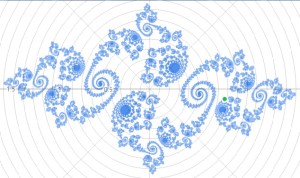
A picture of the Julia set.

A picture of a Julia set.

Next, I find fractals fascinating, but – I’ll admit it – I don’t know much about them.  I do know a little about the number line and graphing, though.  And that was enough to learn a lot more about fractals from this excellent post on the blog Hackery, Math, and Design by Steven Wittens.  In the post How to Fold a Julia Fractal, Steven describes how the key to understanding fractals is understanding complex numbers, which are the numbers we get when we combine our normal numbers with imaginary numbers.
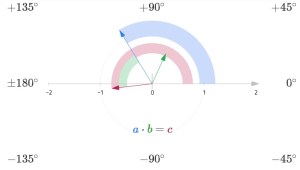
complex multiplicationNow, I think imaginary numbers are some of the most interesting numbers in mathematics – not only because they have the enticing name “imaginary,” but because they do really cool things and have some fascinating history behind them.  Steven does a really great job of telling their history and showing the cool things they do in this post.  One of the awesome things that imaginary numbers do is rotate.  Normal numbers can be drawn on a line – and multiplying by a negative number can be thought of as changing directions along the number line.  Steven uses pictures and videos to show how multiplying by an imaginary number can be thought of as rotating around a point on a plane.

here comes the julia set

A Julia set in the making.

The Julia set fractal is generated by taking complex number points and applying a function to them that squares each point and adds some number to it.  The fractal is the set of points that don’t get infinitely larger and larger as the function is applied again and again.  Steven shows how this works in a series of images.  You can watch the complex plane twist around on itself to make the cool curves and figures of the Julia set fractal.

Steven’s blog has many more interesting posts.  Check out another of my favorites, To Infinity… and Beyond! for an exploration of another fascinating, but confusing, topic – infinity.

Finally, a Pi Day doesn’t go by without the mathematicians and mathematical artists of the world putting out some new Pi Day videos!  Pi Day was last Thursday (3/14, of course).  Here’s a video from Numberphile in which Matt Parker calculates pi using pies!

In this video, also from Numberphile, shows how you only need 39 digits of pi to make really, really accurate measurements for the circumference of the observable universe:

Finally, it wouldn’t be Pi Day without a pi video from Vi Hart.  Here’s her contribution for this year:

Bon appetit!

Harmonious Sum, Continuous Life, and Pumpkins

Welcome to this week’s Math Munch!

We’ve posted a lot about pi on Math Munch – because it’s such a mathematically fascinating little number.  But here’s something remarkable about pi that we haven’t yet talked about. Did you know that pi is equal to four times this? Yup.  If you were to add and subtract fractions like this, for ever and ever, you’d get pi divided by 4.  This remarkable fact was uncovered by the great mathematician Gottfried Wilhelm Leibniz, who is most famous for developing the calculus.  Check out this interactive demonstration from the Wolfram Demonstrations Project to see how adding more and more terms moves the sum closer to pi divided by four.  (We’ve written about Wolfram before.)

I think this is amazing for a couple of reasons.  First of all, how can an infinite number of numbers add together to make something that isn’t infinite???  Infinitely long sums, or series, that add to a finite number have a special name in mathematics: convergent series.  Another famous convergent series is this one:

The second reason why I think this sum is amazing is that it adds to pi divided by four.  Pi is an irrational number – meaning it cannot be written as a fraction, with whole numbers in the numerator and denominator.  And yet, it’s the sum of an infinite number of rational numbers.

In this video, mathematician Keith Devlin talks about this amazing series and a group of mathematical musicians (or mathemusicians) puts the mathematics to music.

This video is part of a larger work called Harmonious Equations written by Keith and the vocal group Zambra.  Watch the rest of them, if you have the chance – they’re both interesting and beautiful.

Next up, Conway’s Game of Life is a cellular automaton created by mathematician John Conway.  (It’s pretty fun: check out this to download the game, and this Munch where we introduce it.)  It’s discrete – each little unit of life is represented by a tiny square.  What if the rules that determine whether a new cell is formed or the cell dies were applied to a continuous domain?  Then, it would look like this:

Looks like a bunch of cells under a microscope, doesn’t it?  Well, it’s also a cellular automaton, devised by mathematician Stephan Rafler from Nurnberg, Germany.  In this paper, Stephan describes the mathematics behind the model.  If you’re curious about how it works, check out these slides that compare the new continuous version to Conway’s model.

Finally, I just got a pumpkin.  What should I carve in it?  I spent some time browsing the web for great mathematical pumpkin carvings.  Here’s what I found.

A pumpkin carved with a portion of Escher’s Circle Limit.

A pumpkin tiled with a portion of Penrose tiling.

A dodecapumpkin from Vi Hart.

I’d love to hear any suggestions you have for how I should make my own mathematical pumpkin carving!  And, if you carve a pumpkin in a cool math-y way, send a picture over to MathMunchTeam@gmail.com!

Bon appetit!

Rectangles, Explosions, and Surreals

Welcome to this week’s Math Munch!

What is 3 x 4?   3 x 4 is 12.

Well, yes. That’s true. But something that’s wonderful about mathematics is that seemingly simple objects and problems can contain immense and surprising wonders.

How many squares can you find in this diagram?

As I’ve mentioned before, the part of mathematics that works on counting problems is called combinatorics. Here are a few examples for you to chew on: How many ways can you scramble up the letters of SILENT? (LISTEN?) How many ways can you place two rooks on a chessboard so that they don’t attack each other? And how many squares can you count in a 3×4 grid?

Here’s one combinatorics problem that I ran across a while ago that results in some wonderful images. Instead of asking about squares in a 3×4 grid, a team at the Dubberly Design Office in San Francisco investigated the question: how many of ways can a 3×4 grid can be partitioned—or broken up—into rectangles? Here are a few examples:

How many different ways to do this do you think there are? Here’s the poster that they designed to show the answer that they found! You can also check out this video of their solution.

In their explanation of their project, the team states that “Design tools are becoming more computation-based; designers are working more closely with programmers; and designers are taking up programming.” Designing the layout of a magazine or website requires both structural and creative thinking. It’s useful to have an idea of what all the possible layouts are so that you can pick just the right one—and math can help you to do it!

If you’d like to try creating a few 3×4 rectangle partitions of your own, you can check out www.3x4grid.com. [Sadly, this page no longer works. See an archive of it here. -JL, 10/2016]

Next up, explosions! I could tell you about the math of the game Minesweeper (you can play it here), or about exploding dice. But the kind of explosion I want to share with you today is what’s called a “combinatorial explosion.” Sometimes a problem that appears to be an only slightly harder variation of an easy problem turns out to be way, way harder. Just how BIG and complicated even simple combinatorics problems can get is the subject of this compelling and also somewhat haunting video.

Donald Knuth

Finally, all of this counting got me thinking about big numbers. Previously we’ve linked to Math Cats, and Wendy has a page where you can learn how to say some really big numbers. But thinking about counting also made me remember an experience I had in middle school where I found out just how big numbers could be! I was in seventh grade when I read this article from the December 1995 issue of Discover Magazine. It’s called “Infinity Plus One, and Other Surreal Numbers” and was written by Polly Shulman. I remember my mind being blown by all of the talk of infinitely-spined aliens and up-arrow notation for naming numbers. Here’s an excerpt:

Mathematicians and precocious five-year-olds have long been fascinated by the endlessness of numbers, and they’ve named the endlessness infinity. Infinity isn’t a number like 1, 2, or 3; it’s hard to say what it is, exactly. It’s even harder to imagine what would happen if you tried to manipulate it using the arithmetic operations that work on numbers. For example, what if you divide it in half? What if you multiply it by 2? Is 1 plus infinity greater than, less than, or the same size as infinity plus 1? What happens if you subtract 1 from it?

After I read this article, John Conway and Donald Knuth became heros of mine. (In college, I had the amazing fortune to have breakfast with Conway one day when he was visiting to give a lecture!) Knuth has a book about surreals that’s the friendliest introduction to the surreal numbers that I know of, and in this video, Vi Hart briefly touches on surreal numbers in discussing proofs that .9 = 1. Boy, would I love to see a great video or online resource that simply and beautifully lays out the surreal numbers in all their glory!

It was fun for me to remember that Discover article. I hope that you, too, run across some mathematics that leaves a seventeen-year impression on you!

Bon appetit!