Tag Archives: video

Circling, Squaring, and Triangulating

Welcome to this week’s Math Munch!

How good are you at drawing circles? To find out, try this circle drawing challenge. There are adorable cat pictures for prizes!

What’s the best score you can get? And hey—what’s the worst score you can get? And how is your score determined? Well, no matter how long the path you draw is, using that length to make a circle would surround the most area. How close your shape gets to that maximum area determines your score.

Do you think this is a good way to measure how circular a shape is? Can you think of a different way?

Dido, Founder and Queen of Carthage.

Dido, Founder and Queen of Carthage.

This idea that a circle is the shape that has the biggest area for a fixed perimeter reminds me of the story of Dido and her famous problem. You can find a retelling of it at Mathematica Ludibunda, a charming website that’s home to all sorts of mathematical stories and puzzles. The whole site is written in the voice of Rapunzel, but there’s a team of authors behind it all. Dido’s story in particular was written by a girl named Christa.

If you have any trouble drawing circles in the applet, you might try using pencil and paper or a chalkboard. I bet if you practice your circling and get good at it, you might even be able to challenge this fellow:

The simple perfect squared square of smallest order.

The simple perfect squared square
of smallest order.

Next up is squaring and the incredible Squaring.Net. The site is run by Stuart Anderson, who works at the Reserve Bank of Australia and lives in Sydney.

The site gathers together all of the research that’s been done about breaking up squares and rectangles into squares. It’s both a gallery and an encyclopedia. I love getting to look at the timelines of discovery—to see the progress that’s been made over time and how new things have been discovered even this year! Just within the last month or so, Stuart and Lorenz Milla used computers to show that there are 20566 simple perfect squared squares of order 30. Squaring.Net also has a wonderful links page that can connect you to more information about the history of squaring, as well as some of the delightful mathematical art that the subject has inspired.

trinity-glass2-small sqBox8 wp4f6b3871_0f

Delaunay triangulationLast up this week is triangulating. There are lots of ways to chop up a shape into triangles, and so I’ll focus on one particular way known as a Delaunay triangulation. To make one, scatter some points on the plane. Then connect them up into triangles so that each triangle fits snugly into a circle that contains none of the scattered points.

Fun Fact #1: Delaunay triangulations are named for the Soviet mathematician Boris Delaunay. What else is named for him? A mountain! That’s because Boris was a world-class mountain climber.

Fun Fact #2: The idea of Delaunay triangulations has been rediscovered many times and is useful in fields as diverse as computer animation and engineering.

Here are two uses of Delaunay triangulations I’d like to share with you. The first comes from the work of Zachary Forest Johnson, a cartographer who shares his work at indiemaps.com. You can check out a Delaunay triangulation applet that he made and read some background about this Delaunay idea here. To see how Zach uses these triangulations in his map-making, you’ve gotta check out the sequence of images on this page. It’s incredible how just a scattering of local temperature measurements can be extended to one of those full-color national temperature maps. So cool!

me

Zachary Forest Johnson

A Delaunay triangulation used to help create a weather map.

A Delaunay triangulation used to help create a weather map.

Finally, take a look at these images that Jonathan Puckey created. Jonathan is a graphic artist who lives in Amsterdam and shares his work on his website. In 2008 he invented a graphical process that uses Delaunay triangulations and color averaging to create abstractions of images. You can see more of Jonathan’s Delaunay images here.

 armandmevis-1  fox

I hope you find something to enjoy in these circles, squares, and triangles. Bon appetit!
“Happy Birthday, Euler!”, Project Euler, and Pants

Welcome to this week’s Math Munch!

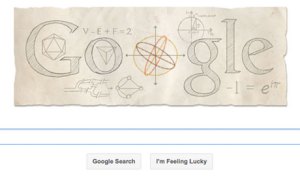
Did you see the Google doodle on Monday?

Leonhard Euler Google doodleThis medley of Platonic solids, graphs, and imaginary numbers honors the birthday of mathematician and physicist Leonhard Euler. (His last name is pronounced “Oiler.” Confusing because the mathematician Euclid‘s name is not pronounced “Oiclid.”) Many mathematicians would say that Euler was the greatest mathematician of all time – if you look at almost any branch of mathematics, you’ll find a significant contribution made by Euler.

480px-Leonhard_Euler_2Euler was born on April 15, 1707, and he spent much of his life working as a mathematician for one of the most powerful monarchs ever, Frederick the Great of Prussia. In Euler’s time, the kings and queens of Europe had resident mathematicians, philosophers, and scientists to make their countries more prestigious.  The monarchs could be moody, so mathematicians like Euler had to be careful to keep their benefactors happy. (Which, sadly, Euler did not. After almost 20 years, Frederick the Great’s interests changed and he sent Euler away.) But, the academies helped mathematicians to work together and make wonderful discoveries.

Want to read some of Euler’s original papers? Check out the Euler Archive. Here’s a little bit of an essay called, “Discovery of a Most Extraordinary Law of Numbers, Relating to the Sum of Their Divisors,” which you can find under the subject “Number Theory”:

Mathematicians have searched so far in vain to discover some order in the progression of prime numbers, and we have reason to believe that it is a mystery which the human mind will never be able to penetrate… This situation is all the more surprising since arithmetic gives us unfailing rules, by means of which we can continue the progression of these numbers as far as we wish, without however leaving us the slightest trace of any order.

Mathematicians still find this baffling today! If you’re interested in dipping your toes into Euler’s writings, I’d suggest checking out other articles in “Number Theory,” such as “On Amicable Numbers,” or some articles in “Combinatorics and Probability,” like “Investigations on a New Type of Magic Square.”

pe_banner_lightWant to work, like Euler did, on important math problems that will stretch you to make connections and discoveries? Check out Project Euler, an online set of math and computer programming problems. You can join the site and, as you work on the problems, talk to other problem-solvers, contribute your solutions, and track your progress. The problems aren’t easy – the first one on the list is, “Find the sum of all the multiples of 3 and 5 below 1000” – but they build on one another (and are pretty fun).

pants200-8bb43915cd34ea1718d8fe4716cf33c5e60a5a2d-s3

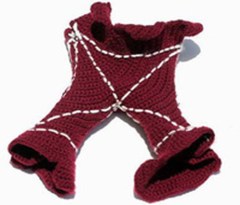
Pants made from a crocheted model of the hyperbolic plane, by Daina Taimina.

Finally, if someone asked you what a pair of pants is, you probably wouldn’t say, “a sphere with three open disks removed.” But maybe you also didn’t know that pants are important mathematical objects!

I ran into a math problem involving pants on Math Overflow (previously). Math Overflow is a site on which mathematicians can ask and answer each other’s questions. The question I’m talking about was asked by Tony Huynh. He knew it was possible to turn pants inside-out if your feet are tied together. (Check out the video below to see it done!) Tony was wondering if it’s possible to turn your pants around, so that you’re wearing them backwards, if your feet are tied together.

Is this possible? Another mathematician answered Tony’s question – but maybe you want to try it yourself before reading about the solution. Answering questions like this about transformations of surfaces with holes in them is part of a branch of mathematics called topology – which Euler is partly credited with starting. A more mathematical way of stating this problem is: is it possible to turn a torus (or donut) with a single hole in it inside-out? Here’s another video, by James Tanton, about turning things inside-out mathematically.

Bon appetit!

MMteam-240x240P.S. – The Math Munch team will be speaking next weekend, on April 27th, at TEDxNYED! We’re really excited to get to tell the story of Math Munch on the big stage. Thank you for being such enthusiastic and curious readers and allowing us to share our love of math with you. Maybe we’ll see some of you there!

We Use Math, Integermania, and Best-of-Seven

Welcome to this week’s Math Munch!

astronaut“When will I use math?” Have you ever asked this question? Well, then you are in for a treat, because the good people of We Use Math have some answers for you! This site was created by the Math Department at Brigham Young University to help share information about career paths that are opened up by studying mathematics. Here’s their introductory video:

The We Use Math site shares write-ups about a wide range of career opportunities that involve doing mathematics. I was glad to learn more about less-familiar mathy careers like technical writing and cost estimation. Also, my brother has studied some operations management in college, so it was great to read the overview of that line of work. In addition, the We Use Math site has pages about recent math discoveries and about unsolved math problems. Check them out!

Next up is one of my long-time favorite websites: Integermania!

Perhaps you’ve heard of the four 4’s problem before. Using four 4’s and some arithmetic operations, can you make the numbers from 1 to 20? Or even higher? Some numbers are easy to make, like 16. It’s 4+4+4+4. Some are sneakier, like 1. One way it can be created is (4+4)/(4+4). But what about 7? Or 19? This is a very common type of problem in mathematics—which math objects of a certain type can be built with limited tools?

swilson21-e1315080873212

Steven J. Wilson

Integermania is a website where people from around the world have submitted number creations made of four small numbers and operations. It’s run by Steven J. Wilson, a math professor at Johnson County Community College in Kansas. (Steven has even more great math resources at his website Milefoot.com)

There are many challenges at Integermania: four 4’s, the first four prime numbers, the first four odds, and even the digits of Ramanujan’s famous taxicab number (1729).

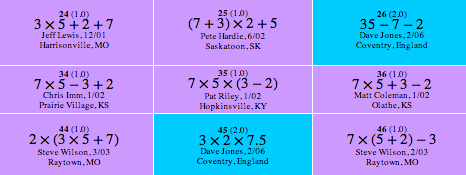
Here are some number creations made of the first four prime numbers. Can you make some of your own?

Here are some number creations made of the first four prime numbers.
Can you make some of your own?

One of my favorite aspects of Integermania is the way it rates number creations by “exquisiteness level“. If a number creation is made using only simple operations—like addition or multiplication—then it’s regarded as more exquisite than if it uses operations like square roots or percentages. I also love how Integermania provides an opportunity for anyone to make their mark in the big world of mathematical research—it’s like scrawling a mathematical “I wuz here!” After years of visiting the site, I just submitted for the first time some number creations of my own. I’ll let you know how it goes, and I’d love to hear about it if you decide to submit, too.

Here are recaps of all the World Series since 1903 from MLB.com

Here are recaps of all the World Series since 1903 from MLB.com

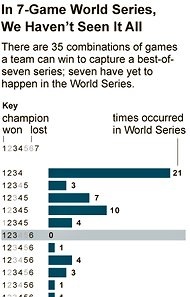
Now coming to the plate: my final link of the week! Monday was the first day of the new Major League Baseball season. I want to share with you a New York Times article from last December. It’s called Keeping Score: Over in Four About a Fifth of the Time. The article digs into the outcomes of all of the World Series championships—not so much who won as how they won. It takes four victories to win a seven-game series, and there are 35 different ways that a best-of-seven series can play out, put in terms of wins and losses for the overall winner. For instance, a clean sweep would go WWWW, while another sequence would be WWLLWW. The article examines which of these win-loss sequences have been the most common in the World Series.

(Can you figure out why there are 35 possible win-loss sequences in a seven-game series? What about for a best-of-five series? And what if we tried to model the outcome of a series by assuming each team has a fixed chance of winning each game?)

worldseriesstats

A clip of the stats that are displayed in the Times article. Click through to see it all.

I was curious to know if the same results held true in other competitions. Are certain win-loss sequences rare across different sports? Are “sweeps” the most common outcome? After sifting through Wikipedia for a while, I was able to compile the statistics about win-loss sequences for hockey’s Stanley Cup Finals. This has been a best-of-seven series since 1939, and it has been played 73 times since then. (It didn’t happen in 2005 because of a lockout.) You can see the results of my research in this document. Two takeaways: sweeps are also the most common result in hockey, but baseball more frequently requires the full seven games to determine a winner.

It could be a fun project to look at other best-of-seven series, like the MLB’s League Championship Series or basketball’s NBA Finals. If you pull that data together, let us know in the comments!

Batter up, and bon appetit!

******

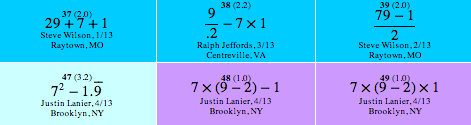
UPDATE (4/4/13): My first set of five number creations was accepted and are now posted on the Ramanujan challenge page. Here are the three small ones! Can you find a more exquisite way of writing 47 than I did?

myintegermania