Author Archives: Anna Weltman

Mathematical Impressions, Modular Origami, and the Tenth Dimension

Welcome to this week’s Math Munch!

First up, check out the latest video in George Hart‘s series called “Mathematical Impressions.”  George has been making videos for “Mathematical Impressions,” which is sponsored by the Simons Foundation, since summer, when he made his video debut – so there are many videos to watch!  Here’s his newest video, called, “Attesting to Atoms,” about how the geometric structure of crystals gives clues to the existence of atoms.  (Click on the picture below to watch the video.)
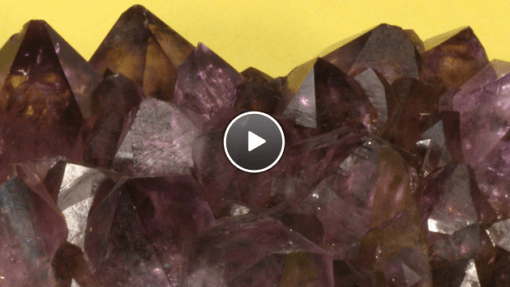
Atoms video

I love how this video shows a real way in which knowledge of mathematics – which can seem very abstract at times – can help us to understand the structure of the world, which is very concrete.  In this second video, one of my favorites, George talks about the reverse of that – allowing our knowledge of something concrete to help us understand abstract mathematics.  This video is called, “Knot Possible.”  (Again, click on the picture to watch the video!)

Knot video

I could have used these words of wisdom from George when I was thinking about the problem he poses in this video: “Don’t let your knowledge of mathematics artificially limit what you think is physically possible.  Quite to the contrary!  Mathematics is a tool which can empower us to do amazing things that no one has ever done before.”  Well said, George!

sierpinski-tetrahedron-tri-2Speaking of using mathematics to do and make amazing things, check out this website of modular origami models and patterns!

This site was put together by Michal Kosmulski, who lives in Poland and works in information technology.  In addition, however, he folds these amazing modular origami polyhedra, fractals, and other awesome mathematical objects!  Michal’s site is full of pictures of his modular origami creations and links to patterns for how to make them yourself as well as information about the mathematics behind the objects.  He has also included some useful tips on how to make the more challenging shapes.
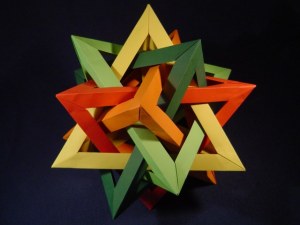
fit-five-intersecting-tetrahedra-60deg-2One of my favorites is the object to the left, “Five Intersecting Tetrahedra.”  I think that this structure is both beautiful and very interesting.  It can be made by intersecting five tetrahedra, or triangular-based pyramids, as shown, or by making a stellation of an icosahedron.  What does that mean?  Well, an icosahedron is a polyhedron with twenty equilateral triangular faces.  To stellate a polyhedron, you extend some element of the polyhedron – such as the faces or edges – in a symmetric way until they meet to form a new polyhedron.  There are 59 possible stellations of the icosahedron!  Michal has models of several of them, including the Five Intersecting Tetrahedra and the great stellated icosahedron shown below on the left.  The figure on the right is called “Cube.”

spiked-dodecahedron-ssitcube-oxi

Finally, all the talking about dimensions that we’ve been doing for the past few weeks reminded me of my favorite video about higher dimensions.  It’s called, “Imagining the Tenth Dimension,” and it shows a way of thinking about dimensions, from the zero dimension all the way up to the tenth.  I can watch this video again and again and still find it mind-blowing and fascinating.

Bon appetit!
A Closet Full of Puzzles, Sphereland, and Math Doodles

Welcome to this week’s Math Munch!

After a few weeks off, we’re back with some exciting things to share.  First up is Futility Closet, a blog featuring “an idler’s miscellany of compendious amusements.”  The blog is full of big-worded phrases like that, but I most love the puzzles they often post – everything from chess to numbers, codes, and devilish word play.  I also love that the name of the person who wrote each puzzle accompanies it.  Take a look at the few I’ve posted below and click here for the full list of puzzles.

2012-12-30-swine-wave-1
Here’s a puzzle called Swine Wave, by Lewis Carroll. The puzzle: Lace 24 pigs in these sties so that, no matter how many times one circles the sties, he always find that the number in each sty is closer to 10 than the number in the previous one. Want to know the solution? Click on the image above to visit Futility Closet.
2012-12-31-project-management-1
This puzzle is called Project Management, by Paul Vaderlind. The question: If a blacksmith requires five minutes to put on a horseshoe, can eight blacksmiths shoe 10 horses in less than half an hour? The catch: A horse can stand on three legs, but not on two. Click on the image to visit Futility Closet for the solution!

Next, have you ever wondered what it would be like to visit another dimension?   In 1884, Edwin A. Abbott wrote about life in the second dimension, in a nice little book called Flatland: A Romance of Many Dimesnions.  (Fun fact: the “A” in Edwin’s name stands for Abbott.  So his name is Edwin Abbott Abbott.)  Click on that link and you can read the whole book, if you like.  The book is about a world of flat beings who have no idea that the third dimension exists.  In the book, the main character, A Square, is visited by a sphere from the unknown world “above” him.  Kind of makes me wonder whether we’re just like the characters in Flatland, three-dimensional creatures ignorant of the fourth dimension that exists “above” us…

spherelandWell, the recently released movie Flatland 2: Sphereland deals with precisely that issue.  The Math Munch team had the opportunity to preview this movie, and we loved it.  In Sphereland, the granddaughter of the Square from Flatland, Hex, and her friend Puncto try to understand some mysterious triangles that Puncto thinks will cause the disastrous end of a space exploration mission and go on an adventure to help their three-dimensional friend Spherius with a problem he brought back from the fourth dimension.

portfolio-TorusHigher dimensions can be very difficult to wrap your head around.  This movie does a great job of helping the movie-watcher to understand how higher and lower dimensions relate to each other through the plot twists and challenges that the characters face.  You can really learn a lot about dimensions and the shape of space by watching this movie.  Plus, the characters are engaging and the images are fun.  Sphereland features the voices of a number of really great actors, including Kristen Bell, Danny Pudi, Michael York, and Danica McKellar.

Want to learn more about Sphereland?  Check out the trailer:

And, here’s an interview with Danny Pudi, the voice of Puncto, and Tony Hale, who does a fantastic job as the King of Pointland:

By the way, the makers of Sphereland also made a movie of Flatland!  The Math Munch team loved that one, too.  Here’s a link to the trailer.

tumblr_mgw2ainZDX1s0payeo1_1280Finally, check out this beautiful blog of mathematical doodles by high school math student and artist Chloé Worthington!  Chloé started mathematically doodling a few years ago in… well, in class.  When she doodles in class, Chloé is better able to focus on what’s going on and makes beautiful art.   (We at Math Munch encourage you to pay attention in class while you doodle.)

Chloé does all of her doodles by hand with ink pens.  She does a lot of work with triangles, as shown here.  One of her signature doodles is this nested puzzle piece doodle:

tumblr_mfjypuxlqs1s0payeo1_1280

Doodling mathematically is one of the ways that Chloé does math and shares what she loves about it with the world.  She’s a trigonometry student, too.  How do you share what you love about math – or any other subject?

Bon appetit!

The Museum of Math, Shapes That Roll, and Mime-matics

Welcome to this week’s Math Munch!  We have so many exciting things to share with you this week – so let’s get started!

Something very exciting to math lovers all over the world happened on Saturday.  The Museum of Mathematics opened its doors to the public!

MoMath entranceThe Museum of Mathematics (affectionately called MoMath – and that’s certainly what you’ll get if you go there) is in the Math Munch team’s hometown, New York City.

human treeThere are so many awesome exhibits that I hardly know where to start.  But if you go, be sure to check out one of my favorite exhibits, Twist ‘n Roll.  In this exhibit, you roll some very interestingly shaped objects along a slanted table – and investigate the twisty paths that they take.  And you can’t leave without seeing the Human Tree, where you turn yourself into a fractal tree.

coaster rollersOr going for a ride on Coaster Rollers, one of the most surprising exhibits of all.  In this exhibit, you ride in a cart over a track covered with shapes that MoMath calls “acorns.”  The “acorns” aren’t spheres – and yet your ride over them is completely smooth!  That’s because these acorns, like spheres, are surfaces of constant width.  That means that if you pick two points on opposite ends of the acorn – with “opposite” meaning points that you could hold between your hands while your hands are parallel to each other – the distance between those points is the same regardless of the points you choose.  See some surfaces of constant width in action in this video:

Rouleaux_triangle_AnimationOne such surface of constant width is the shape swept out by rotating a shape called a Reuleaux triangle about one of its axes of symmetry.  Much as an acorn is similar to a sphere, a Reuleaux triangle is similar to a circle.  It has constant diameter, and therefore rolls nicely inside of a square.  The cart that you ride in on Coaster Rollers has the shape of a Reuleaux triangle – so you can spin around as you coast over the rollers!

Maybe you don’t live in New York, so you won’t be able to visit the museum anytime soon.  Or maybe you want a little sneak-peek of what you’ll see when you get there.  In any case, watch this video made by mathematician, artist, and video-maker George Hart on his first visit to the museum.  George also worked on planning and designing the exhibits in the museum.

We got the chance to interview Emily Vanderpol, the Outreach Exhibits coordinator for MoMath, and Melissa Budinic, the Assistant Exhibit Designer for MoMath.  As Cindy Lawrence, the Associate Director for MoMath says, “MoMath would not be open today if it were not for the efforts” of Emily and Melissa.  Check out Melissa and Emily‘s interviews to read about their favorite exhibits, how they use math in their jobs for MoMath, and what they’re most excited about now that the museum is open!

mimematicsLogo (1)Finally, meet Tim and Tanya Chartier.  Tim is a math professor at Davidson College in North Carolina, and Tanya is a language and literacy educator.  Even better, Tim and Tanya have combined their passion for math and teaching with their love of mime to create the art of Mime-matics!  Tim and Tanya have developed a mime show in which they mime about some important concepts in mathematics.  Tim says about their mime-matics, “Mime and math are a natural combination.  Many mathematical ideas fold into the arts like shape and space.  Further, other ideas in math are abstract themselves.  Mime visualizes the invisible world of math which is why I think math professor can sit next to a child and both get excited!”

One of my favorite skits, in which the mime really does help you to visualize the invisible world of math, is the Infinite Rope.  Check it out:

slinkyIn another of my favorite skits, Tanya interacts with a giant tube that twists itself in interesting topological ways.  Watch these videos and maybe you’ll see, as Tanya says, how a short time “of positive experiences with math, playing with abstract concepts, or seeing real live application of math in our world (like Google, soccer, music, NASCAR, or the movies)  can change the attitude of an audience member who previously identified him/herself as a “math-hater.””  You can also check out Tim’s blog, Math Movement.

Tim and Tanya kindly answered some questions we asked them about their mime-matics.  Check out their interview by following this link, or visit the Q&A page.

Bon appetit!