Author Archives: Justin Lanier

Demonstrations, a Number Tree, and Brainfilling Curves

Welcome to this week’s Math Munch!

Maybe you’re headed back to school this week. (We are!) Or maybe you’ve been back for a few weeks now. Or maybe you’ve been out of school for years. No matter which one it is, we hope that this new school year will bring many new mathematical delights your way!

A website that’s worth returning to again and again is the Wolfram Demonstrations Project (WDP). Since it was founded in 2007, users of the software package Mathematica have been uploading “demonstrations” to this website—amazing illuminations of some of the gems of mathematics and the sciences.

Each demonstration is an interactive applet. Some are very simple, like one that will factor any number up to 10000 for you. Others are complex, like this one that “plots orbits of the Hopalong map.”

Some demonstrations are great for visualizing facts about math, like these:
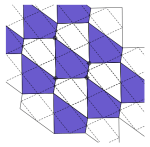
Any Quadrilateral Can Tile

A Proof of Euler’s Formula

Cube Net or Not?

There’s also a whole category of demonstrations that can be used as MArTH—mathematical art—tools, including these:

Rotate and Fold Back

Polygons Arranged in a Circle

Turtle Fractals

With over 8000 demonstrations to explore and new ones being added all the time, you can see why the Wolfram Demonstrations Project is worth returning to again and again!
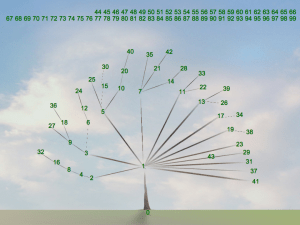
Jeffrey Ventrella’s Number Tree

Next up, check out this number tree. It was created by Jeffrey Ventrella, an innovator, artist, and computer programmer who lives in San Francisco. His number tree arranges the numbers from 1 to 100 according to their largest proper factors. For instance, the factors of 18 are 18, 9, 6, 3, 2, and 1. Once we toss out 18 itself as being “improper”—a.k.a. “uninteresting”—the largest factor of 18 is 9. This in turn has as its largest factor 3, and 3 goes down to 1. Chains of factors like this one make up Jeffrey’s tree. It has a wonderful accumulative feeling to it—it’s great to watch how patterns and complexity build up over time.

(On this theme, WDP also has a demonstrations about trees and about prime factorization graphs.)

Cloctal: “a fractal design that visualizes the passage of time”

There’s lots more math to explore on Jeffrey’s website. His piece Cloctal—a fractal clock—is one of my favorites. What I’d like to feature here, though, is the diverse and intricate work Jeffrey has done with plane-filling and space-filling curves.  You can find many examples at fractalcurves.com, Jeffrey’s website that’s chock full of great links.

Jeffrey recently completed a book called Brainfilling Curves. It’s “a visual math expedition, lead by a lifelong fractal explorer.” According to the description, the book picks up where Mandelbrot left off and develops an intuitive scheme for understanding an “infinite universe of fractal beauty.”
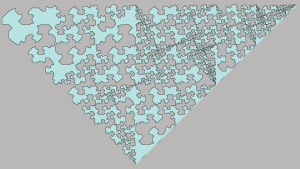
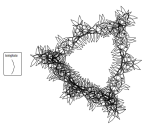
An example of a “brainfilling curve” from Jeffrey’s “root8” family

The title comes from the idea that nature uses space-filling curves quite often, to pack intestines into your gut or lots and lots of tissue into the brain you’re using to read this right now! Hopefully you’re finding all of this math quite brainfilling as well.

(And just one more example of why WDP is worth revisiting: here’s a demonstration that depicts the space-filling Hilbert and Moore curves. So much good stuff!)

Finally, here’s a video that Jeffrey made about brainfilling curves. You can find more on his YouTube channel.

Bon appetit!

Newroz, a Math Factory, and Flexagons

Welcome to this week’s Math Munch!

You’ve probably seen Venn diagrams before. They’re a great way of picturing the relationships among different sets of objects.

But I bet you’ve never seen a Venn diagram like this one!

Frank Ruskey

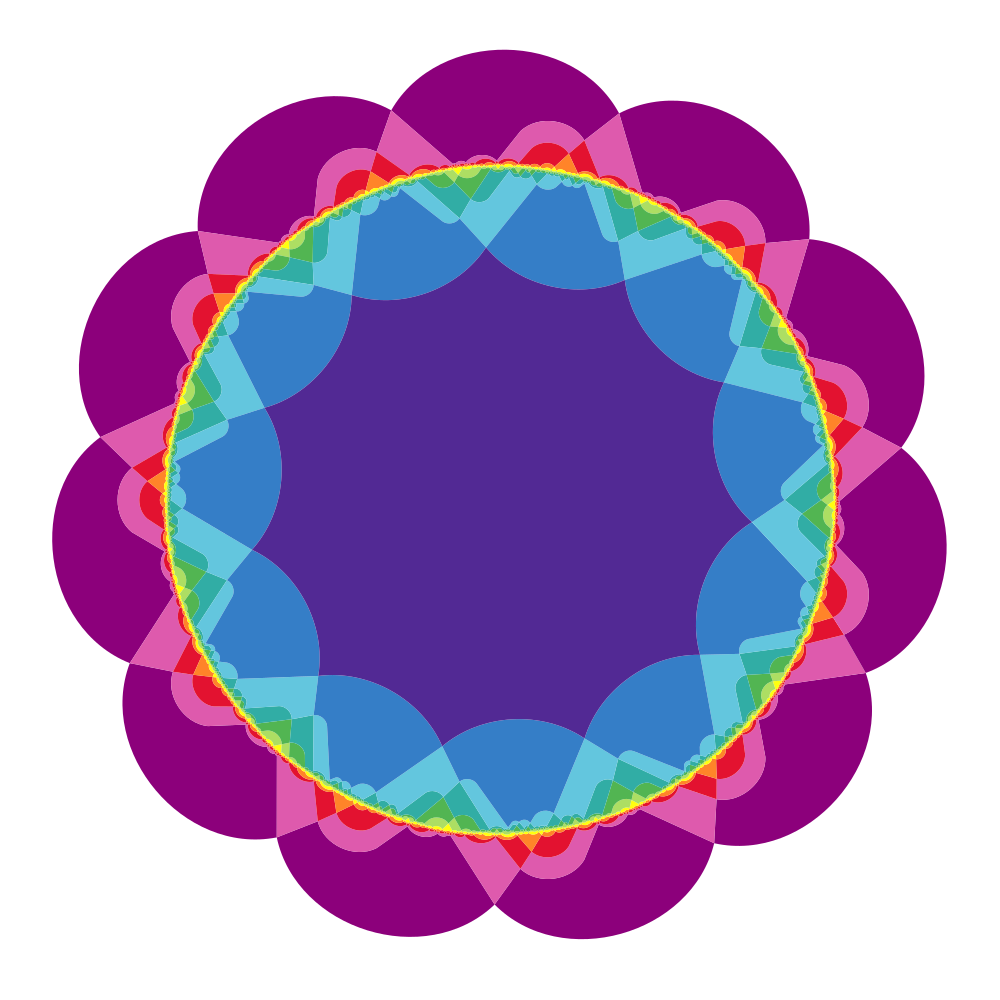
That’s because its discovery was announced only a few weeks ago by Frank Ruskey and Khalegh Mamakani of the University of Victoria in Canada. The Venn diagrams at the top of the post are each made of two circles that carve out three regions—four if you include the outside. Frank and Khalegh’s new diagram is made of eleven curves, all identical and symmetrically arranged. In addition—and this is the new wrinkle—the curves only cross in pairs, not three or more at a time. All together their diagram contains 2047 individual regions—or 2048 (that’s 2^11) if you count the outside.

Frank and Khalegh named this Venn diagram “Newroz”, from the Kurdish word for “new day” or “new sun”. Khalegh was born in Iran and taught at the University of Kurdistan before moving to Canada to pursue his Ph.D. under Frank’s direction.

Khalegh Mamakani

“Newroz” to those who speak English sounds like “new rose”, and the diagram does have a nice floral look, don’t you think?

When I asked Frank what it was like to discover Newroz, he said, “It was quite exciting when Khalegh told me that he had found Newroz. Other researchers, some of my grad students and I had previously looked for it, and I had even spent some time trying to prove that it didn’t exist!”

Khalegh concurred. “It was quite exciting. When I first ran the program and got the first result in less than a second I didn’t believe it. I checked it many times to make sure that there was no mistake.”

You can click these links to read more of my interviews with Frank and Khalegh.

I enjoyed reading about the discovery of Newroz in these articles at New Scientist and Physics Central. And check out this gallery of images that build up to Newroz’s discovery. Finally, Frank and Khalegh’s original paper—with its wonderful diagrams and descriptions—can be found here.

A single closed curve—or “petal”— of Newroz. Eleven of these make up the complete diagram.

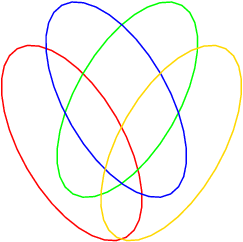
A Venn diagram made of four identical ellipses. It was discovered by John Venn himself!

For even more wonderful images and facts about Venn diagrams, a whole world awaits you at Frank’s Survey of Venn Diagrams.

On Frank’s website you can also find his Amazing Mathematical Object Factory! Frank has created applets that will build combinatorial objects to your specifications. “Combinatorial” here means that there are some discrete pieces that are combined in interesting ways. Want an example of a 5×5 magic square? Done! Want to pose your own pentomino puzzle and see a solution to it? No problem! Check out the rubber ducky it helped me to make!

A pentomino rubber ducky!

Finally, Frank mentioned that one of his early mathematical experiences was building hexaflexagons with his father. This led me to browse around for information about these fun objects, and to re-discover the work of Linda van Breemen. Here’s a flexagon video that she made.

And here’s Linda’s page with instructions for how to make one. Online, Linda calls herself dutchpapergirl and has both a website and a YouTube channel. Both are chock-full of intricate and fabulous creations made of paper. Some are origami, while others use scissors and glue.

I can’t wait to try making some of these paper miracles myself!

Bon appetit!

Bridges, Meander Patterns, and Water Sports

This past week the Math Munch team got to attend the Bridges 2012. Bridges is a mathematical art conference, the largest one in the world. This year it was held at Towson University outside of Baltimore, Maryland. The idea of the conference is to build bridges between math and the arts.

Participants gave lectures about their artwork and the math that inspired or informed it. There were workshop sessions about mathematical poetry and chances to make baskets and bead bracelets involving intricate patterns. There was even a dance workshop about imagining negative-dimensional space! There were also some performances, including two music nights (which included a piece that explored a Fibonacci-like sequence called Narayana’s Cows) and a short film festival (here are last year’s films). Vi Hart and George Hart talked about the videos they make and world-premiered some new ones. And at the center of it all was an art exhibition with pieces from around the world.

The Zen of the Z-Pentomino by Margaret Kepner

Does this piece by Bernhard Rietzl
remind you of a certain sweater?

5 Rhombic Screens by Alexandru Usineviciu

Pythagorean Proof by Donna Loraine

To see more, you should really just browse the Bridges online gallery.

A shot of the gallery exhibition

I know that Paul, Anna, and I will be sharing things with you that we picked up at Bridges for months to come. It was so much fun!

David Chappell

One person whose work and presentation I loved at Bridges is David Chappell. David is a professor of astronomy at the University of La Verne in California.

David shared some thinking and artwork that involve meander patterns. “Meander” means to wander around and is used to describe how rivers squiggle and flow across a landscape. David uses some simple and elegant math to create curve patterns.

Instead of saying where curves sit in the plane using x and y coordinates, David describes them using more natural coordinates, where the direction that the curve is headed in depends on how far along the curve you’ve gone. This relationship is encoded in what’s called a Whewell equation. For example, as you walk along a circle at a steady rate, the direction that you face changes at a contant rate, too. That means the Whewell equation of a circle might look like angle=distance. A smaller circle, where the turning happens faster, could be written down as angle=2(distance).

Look at how the Cauto River “meanders” across the Cuban landscape.

In his artwork, David explores curves whose equations are more complicated—ones that involve multiple sine functions. The interactions of the components of his equations allow for complex but rhythmic behavior. You can create meander patterns of your own by tinkering with an applet that David designed. You can find both the applet and more information about the math of meander patterns on David’s website.

David Chappell’s Meander #6
Make your own here!

When I asked David about how being a scientist affects his approach to making art, and vice versa, he said:

My research focuses on nonlinear dynamics and pattern formation in fluid systems. That is, I study the spatial patterns that arise when fluids are agitated (i.e. shaken or stirred). I think I was attracted to this area because of my interest in the visual arts. I’ve always been interested in patterns. The science allows me to study the underlying physical systems that generate the patterns, and the art allows me to think about how and why we respond to different patterns the way we do.  Is there a connection between how we respond to a visual image and the underlying “rules” that produced the image?  Why to some patterns look interesting, but others not so much?

For more of my Q&A with David, click here. In addition, David will be answering questions in the comments below, so ask away!

Since bridges and meandering rivers are both water-related, I thought I’d round out this post with a couple of interesting links about water sports and the Olympics. My springboard was a site called Maths and Sport: Countdown to the Games.

No wiggle rigs

Arrangements of rowers that are “wiggle-less”

Here’s an article that explores different arrangements of rowers in a boat, focusing on finding ones where the boat doesn’t “wiggle” as the rowers row. It’s called Rowing has its Moments.

Next, here’s an article about the swimming arena at the 2008 Beijing games, titled Swimming in Mathematics.


Paul used to be a competitive diver, and he says there’s an interesting code for the way dives are numbered.  For example, the “Forward 1 ½ Somersaults in Tuck Position” is dive number 103C.  How does that work?  You can read all about it here.  (Degree of difficulty is explained as well.)

Finally, enjoy these geometric patterns inspired by synchronized swimming!

Stay cool, and bon appetit!