Recently I’ve been running across tons of neat, slick math applets. I feel like they all go together. What do they have in common? Maybe you’ll be able to tell me.
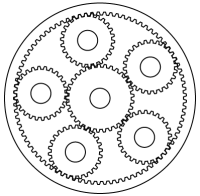
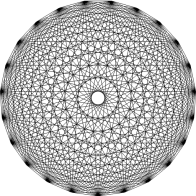
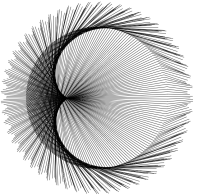
Ready for some more? Because with these sorts of visualizations, Dan Anderson has been on fire lately. Dan is a high school math teacher in New York state. He and his students had fifteen minutes of fame last year when they investigated whether or not Double Stuf Oreos really have double the stuf.
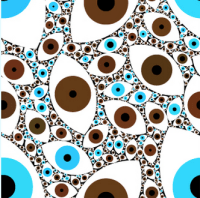
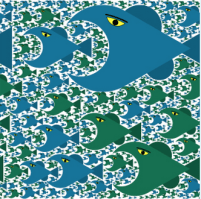
Here is Dan’s page on OpenProcessing. (Processing is the computer language in which Dan programs his applets.) And check out the images and gifs on Dan’s Tumblr. Here’s a sampling!
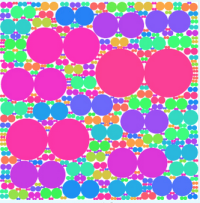
That’s a chunk of math to chew on already, but we’re just getting started! Next up, check out the space-filling artwork of John Shier.
John’s artwork places onto the canvas shapes of smaller and smaller sizes. Notice that the circles below fill in gaps, but they don’t touch each other, they way circles do in an Apollonian gasket.
You can learn more about John’s space-filling shapes on this page and find further details in this paper.
Thanks for making us this sweet banner, John!
Last up this week, head to this site to watch an awesome trailer of a film about Julia Robinson. The short clip focuses on Julia’s work on Hilbert’s tenth problem. It includes interviews with a number of people who knew Julia, including her sister Constance Reid. Constance wrote extensively about mathematics and mathematicians. I’ve read her biography of Hilbert and can highly recommend it. You can read more about Julia and Constance here and here.
Julia Robinson
Julia’s sister, Constance Reid
Julia and Constance as young girls.
You might enjoy visiting the site of the Julia Robinson Mathematics Festival. Check to see if a festival will be hosted in your area sometime soon, or find out how you can run one yourself!
With May wrapped up and June getting started, I hope you have a lot of math to look forward to this summer. Bon appetit!
All of our munches this week come from the recent tweets of mathematician, author, and friend of the blog Steven Strogatz. Steve works at Cornell University as an applied mathematician, tackling questions like “If people shared taxis with strangers, how much money could be saved?” and “What caused London’s Millennium Bridge to wobble on its opening day?”
On top of his research, Steve is great at sharing math with others. (This week I learned one great piece of math from him, and then another, and suddenly there was a very clear theme to my post!) Steve has written for the New York Times and was recently awarded the Lewis Thomas Prize as someone “whose voice and vision can tell us about science’s aesthetic and philosophical dimensions, providing not merely new information but cause for reflection, even revelation.”
This Saturday, Steve will be presenting at the first-ever National Math Festival. The free and fun main event is at the Smithsonian in Washington, DC, and there are related math events all around the country this weekend. Check and see if there’s one near you!
Here are a few pieces of math that Steve liked recently. I liked them as well, and I hope you will, too.
First up, check out this lovely image:
It appeared on Numberplay and was created by Hamid Naderi Yeganeh, a student at University of Qom in Iran. Look at the way the smaller and smaller tiles fit together to make the design. It’s sort of like a rep-tile, or this scaly spiral. And do those shapes look familiar? Hamid was inspired by the shapes of the continents of Africa and South America (if you catch my continental drift). Maybe you can create your own Pangaea-inspired tiling.
If you think that’s cool, you should definitely check out Numberplay, where there’s a new math puzzle to enjoy each week!
Next, up check out the Math Explorers’ Club, a collection of great math activities for people of all ages. The Club is a project of Cornell University’s math department, where Steve teaches.
The first item every sold on the auction site eBay. Click through for the story!
One of the bits of math that jumped out to me was this page about auctions. There’s so much strategy and scheming that’s involved in auctions! I remember being blown away when I first learned about Vickrey auctions, where the winner pays not what they bid but what the second-highest bidder did!
And finally this week: have you ever wondered “What will I ever use math for?” Well, SIAM—the Society for Industrial and Applied Mathematics—has just the video for you. They asked people attending one of their meetings to finish the sentence, “I use math for…”. Here are 32 of their answers in just 60 seconds.
Thanks for sharing all this great math, Steve! And bon appetit, everyone!
Painting by Renée Othot for Simon Plouffe’s birthday.
Welcome to this week’s Math Munch!
It’s here—the Pi Day of the Century happens on Saturday: 3-14-15!
How will you celebrate? You might check to see if there are any festivities happening in your area. There might be an event at a library, museum, school, or university near you.
John Conway at the pi recitation contest in Princeton.
There’s a huge celebration here in Princeton—in part because Pi Day is also Albert Einstein’s birthday, and Albert lived in Princeton for the last 22 years of his life. One event involves kids reciting digits of pi and and is hosted by John Conway and his son, a two-time winner of the contest. I’m looking forward to attending! But as has been noted, memorizing digits of pi isn’t the most mathematical of activities. As Evelyn Lamb relays,
I do feel compelled to point out that besides base 10 being an arbitrary way of representing pi, one of the reasons I’m not fond of digit reciting contests is that, to steal an analogy I read somewhere, memorizing digits of pi is to math as memorizing the order of letters in Robert Frost’s poems is to literature. It’s not an intellectually meaningful activity.
I haven’t memorized very many digits of pi, but I have memorized a digit of pi that no one else has. Ever. In the history of the world. Probably no one has ever even thought about this digit of pi.
And you can have your own secret digit, too—all thanks to Simon Plouffe‘s amazing formula.
Simon’s formula shows that pi can be calculated chunk by chunk in base 16 (or hexadecimal). A single digit of pi can be plucked out of the number without calculating the ones that come before it.
The discovery of this formula came as a surprise. For centuries it had been assumed that there was no way to compute the nth digit of π without calculating all of the preceding n − 1 digits.
Check out some of Simon’s math art!
Simon is a mathematician who was born in Quebec. In addition to his work on the digits of irrational numbers, he also helped Neil Sloane with his Encyclopedia of Integer Sequences, which soon online and became the OEIS (previously). Simon is currently a Trustee of the OEIS Foundation.
There is a wonderful article by Simon and his colleagues David Bailey, Jonathan Borwein, and Peter Borwein called The Quest for Pi. They describe the history of the computation of digits of pi, as well as a description of the discovery of their digit-plucking formula.
According to the Guinness Book of World Records, the most digits that someone has memorized and recited is 67,890. Unofficial records go up to 100,000 digit. So just to be safe, I’ve used an algorithm by Fabrice Bellard based on Simon’s formula to calculate the 314159th digit of pi. (Details here and here.) No one in the world has this digit of pi memorized except for me.
Ready to hear my secret digit of pi? Lean in and I’ll whisper it to you.
The 314159th digit of pi is…7. But let’s keep that just between you and me!
And just to be sure, I used this website to verify the 314159th digit. You can use the site to try to find any digit sequence in the first 200 million digits of pi.
Aziz & Peter’s patterns.
Next up: we met Aziz Inan in last week’s post. This week, in honor of Pi Day, check out some of the numerical coincidences Aziz has discovered in the early digits in pi. Aziz and his colleague Peter Osterberg wrote an article about their findings. By themselves, these observations are nifty little patterns. Maybe you’ll find some more of your own. (This kind of thing reminds me of the Strong Law of Small Numbers.) As Aziz and Peter note at the end of the article, perhaps the study of such little patterns will one day help to show that pi is a normal number.
And last up this week, to get your jam on as Saturday approaches, here’s the brand new Pi Day Anthem by the recently featured John Sims and the inimitable Vi Hart.




 You can learn more about John’s space-filling shapes on this page and find further details in this paper.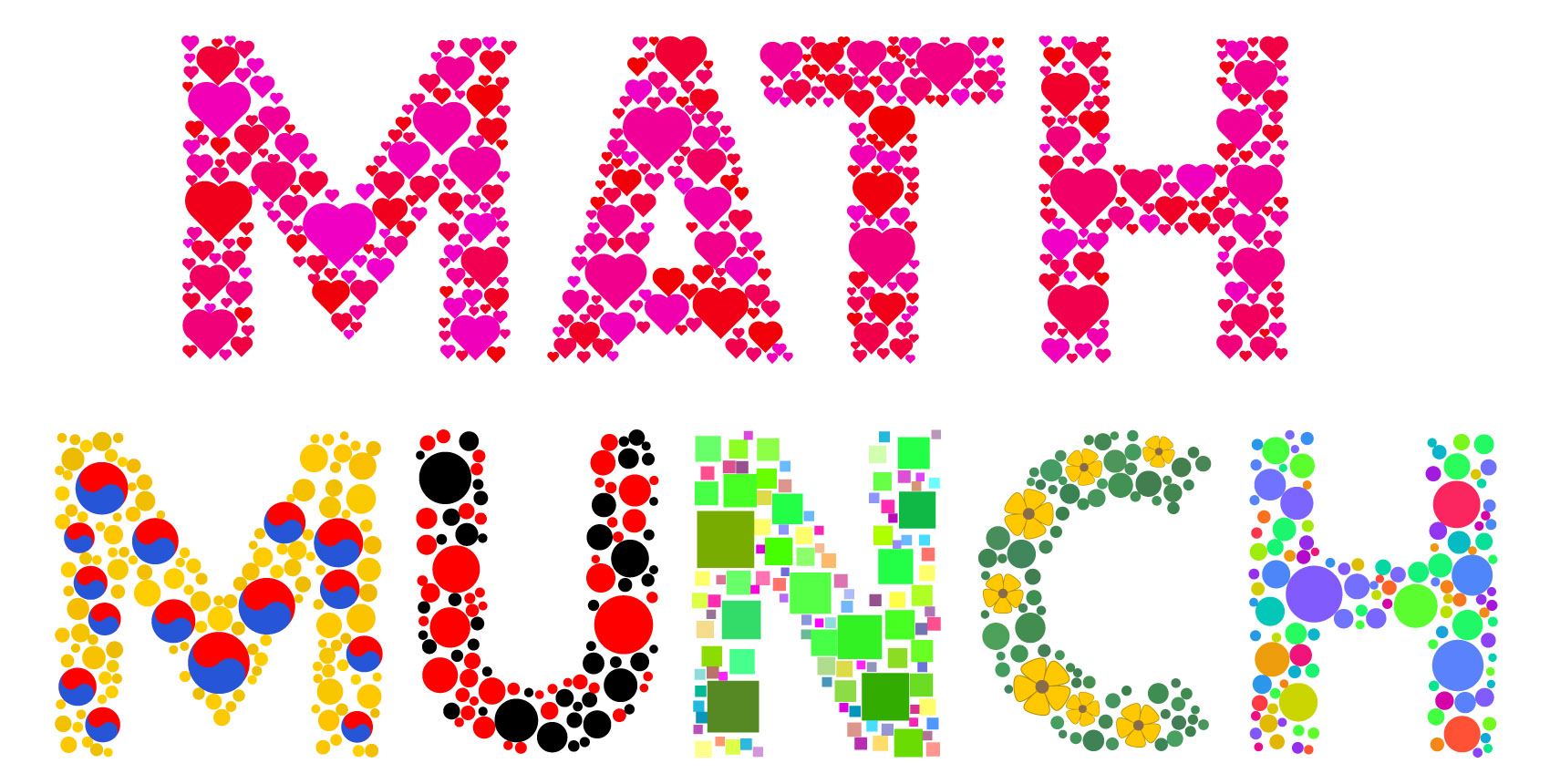








 Math Munch