Author Archives: Paul Salomon

Visualizations, Inspirations, and the Super Ultimate Graphing Challenge

Welcome to this week’s Math Munch!

Jason Davies

Meet Jason Davies, a freelance mathematician living in the UK. Growing up in Wales (one of the 4 countries of the United Kingdom) his classes were taught in Welsh. This makes Jason one of only about 611,000 people that speak the language, only 21.7% of the population of Wales! Imagine if only 1/5 of France spoke French!! These statistics are from a 2004 study, so the numbers may have changed a bit, but they still say something interesting don’t they?
Prime Seive

Jason is all about what numbers and pictures can tell us.  Since graduating from Cambridge, he’s been doing all sorts of data visualization and computer science on his own for various companies and IT firms. I originally found Jason through a link to his Prime Seive visualization, but take a look at his gallery and you’re bound to find something beautiful, interesting, interactive, and cool. I’ve linked to some of my favorites below.
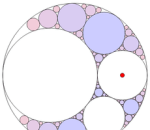
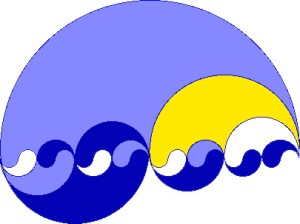
Interactive Apollonian Gasket

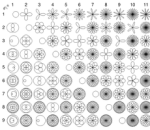
Rhodonea Curves

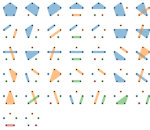
Set Partitions

I asked Jason a few questions about his interest in data visualization and math in general. Here’s a tasty little excerpt:

MM: What’s the most important trait for a mathematician to have? Is there one?

JD: Persistance is always useful in maths! I think the stereotype is to be analytical and logical, but in fact there are many other traits that are highly important, for instance communication skills. Mathematics is passed on from person to person, after all, so being able to communicate ideas effectively is dynamite.

MM: Do you have a message you’d like to give to young mathematicians?

JD: The world needs you!

Read the rest in our Q&A with Jason Davies, and you can see all of our interviews on the Q&A page we’ve just created.

Up next, a beautiful and inspiring video from Spain. The video is actually called Insprations, and it comes to us from Etérea Studios, the online home of animator Cristóbal Vila. In the intro he says, “I looked into that enormous and inexhaustible source of inspiration that is Escher and tried to imagine how it could be his workplace, what things would surround an artist like him, so deeply interested in science in general and mathematics in particular.”

I’d die to have an office like this!

It gets better.  Cristóbal added a page explaining all of the wonderful maths in the video. Click to read about Platonic solids, tilings, tangrams, and various works of art by M.C. Escher.

Finally, a nifty new game that explores the relationship between graphs and different kinds of motion. Super Ultimate Graphing Challenge is a game developed by Physics teacher Matthew Blackman to help his students understand the physics and mathematics of motion. You might not understand it all when you start, but keep playing and see what you can make of it. If you need a bit of help or have something to say, post it in our comments, and we’ll happily reply.

Bon appetit!
Mike Naylor, Math Magic, and Mazes

Mathematical artist, Mike Naylor juggling 5 balls.

Welcome to this week’s Math Munch!

Last week, Justin told you about our time at Bridges 2012, the world’s largest conference of mathematics and art, and I must reiterate: this was one of the coolest things I’ve ever been a part of. The art was gorgeous. The people were great. I’m pretty sure I was beaming with excitement. At dinner we met, Mike Naylor, a mathematical artist and generally fantastic guy living in Norway. You can read his full artist’s statement and artwork from the Bridges exhibition, but here’s an excerpt:

“Much of my artwork focuses on the use of the human body to represent geometric concepts, but I also enjoy creating abstract works that capture mathematical ideas in ways that are pleasing, surprising and invite further reflection.”

Meeting Mike was especially exciting for me, because just days earlier, I’d fallen in love with Mike’s math blog. This week, I’ll be sharing some of the gems I’ve found there:

I didn’t even mention abacaba.org, yet another amazing Mike Naylor project.  It’s a site devoted entirely to one pattern: A, aBa, abaCaba, abacabaDabacaba,…

Since Justin introduced mathematical poetry last week, check out one of Mike’s mathematical poems called “Decision Tree.” What a clever idea! Like Mike, I’m a juggler, so I absolutely loved his Fractal Juggler animation, which shows a juggler juggling jugglers juggling jugglers… Clever idea #2! And for a third clever idea, check out the Knight Maze he designed. Wow!

“Decision Tree”

“Fractal Juggler”

“Knight Maze”

The most squares of whole area that will fit in a square of area 17.

Speaking of mazes, I found a whole bunch of cool ones when I was poking around the Math Magic site hosted by Stetson University. Each month Math Magic poses a math question for readers to work on and then submit their solutions. This month’s question is about packing squares in squares. (Click to see the submissions so far.)  At the bottom of the page you can find links to many more cool math sites, but as promised, I’ll share some of the mazes I found.

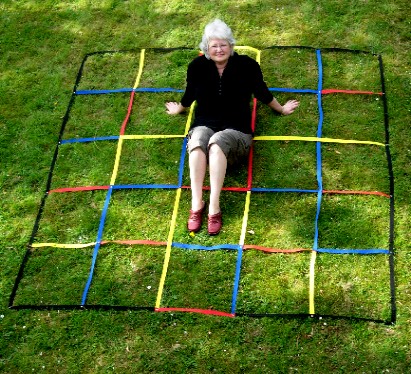
A puzzle designer for over 40 years, here Andrea Gilbert lays across one of her step-over sequence mazes.

First there’s Andrea Gilbert’s site, Click Mazes, which has all sorts of online mazes and puzzles.  In the picture you can see Andrea laying in one of her step-over sequence mazes.  How do you figure they work?

Then there’s Logic Mazes, a website of mazes by Robert Abbott. I don’t know much about Robert, but his site caught my eye because it begins with Five Easy Mazes: 1 2 3 4 5, but there are better mazes after that. I really liked the number mazes. Play around, think your way through, and have some fun!

Bon appetit!

Number Mazes

Eyeball Mazes

Alice Mazes

Partitions, Riddles, and Escher Videos

Welcome to this week’s Math Munch!

Meet James Tanton, one of my very favorite mathematicians. According to his bio, James is “deeply interested in bridging the gap between the mathematics experienced by school students and the creative mathematics practiced and explored by mathematicians.” Me too! Dr. Tanton is an author and math teacher, but I know him best through his internet videos. Some of them cover some pretty advanced mathematics, but this video on partitions and the Fibonacci numbers is very clear and WAY COOL!

o o oo ooo ooooo

Up next, check out Steve Miller’s Math Riddles, a website full of fantastic (you guessed it) math riddles collected by Steve Miller. Steve’s a math professor at Williams College, and according to him, these riddles, “have two very desirable properties: they have an elegant solution, and that solution doesn’t involve advanced mathematics… What you do need is some patience, and a willingness to explore. Don’t be afraid to try something — see where it leads!”

With that in mind, why not give some a try? You can sort the riddles by topic or difficulty, but here a few possible starters:

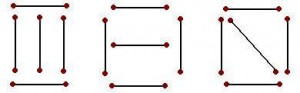
There are fifteen sticks. Remove six sticks and be left with ten.

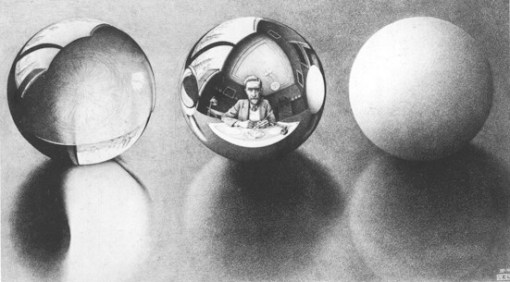
Finally, some relaxing videos I’ve found to showcase once again the fantastic artwork of Dutch graphic artist, M.C. Escher. We’ve featured his work before, but I can never get enough.

3 Spheres II by M.C. Escher

“Mathematicians know their subject is beautiful. Escher shows us that it’s beautiful.” That’s a lovely little quote from mathematician Ian Stewart in this short little clip called, The Mathematical Art of M.C. Escher. If you’re up for something more substantial, here’s an hour-long documentary called Metamorphose, which features video of Escher himself hard at work, something I had never seen before! If you end up watching, leave us a comment and let us know what you think.

We’ve also put together a YouTube playlist of every video ever featured on Math Munch, which we will continue to update. If you want to find the coolest math vids on the internet, I’d say that’s a good place to start.

Bon appetit!