Category Archives: Math Munch

Factorization Dance, Vanishing, and Storm Infographics

Welcome to this week’s Math Munch!

Think fast!  How many dots are there in this picture?

This beautiful picture comes to you from Brent Yorgey and Stephen Von Worley.  If you counted the dots, you probably didn’t count them one at a time.  (And, if you did, can you think of another way to count them?)  If you counted them like I did, you noticed that the dots are arranged in rings of five.  Then maybe you noticed that the rings of five are themselves arranged in rings of five.  And then, finally, you may have noticed that those rings are also arranged in rings of five!  How many dots is that?  5x5x5 = 125!

In this blog post, Brent describes how he wrote the computer program that creates these pictures.  The program factors numbers into primes.  Then, starting with the smallest prime factor, the program arranges dots into regular polygons of the appropriate size with dots (or polygons of dots) at the vertices of the polygon.

Here’s how that works for 90.  90’s prime factorization is 2x3x3x5:

As Brent writes in his post, this counting gets much harder to do with numbers that have large prime factors.  For example, here is 183:

From this picture, I can tell that 183 has 3 as a prime factor.  But how many times does 3 go into 183?  It isn’t immediately clear.

When Stephen saw Brent’s creation, he decided the diagrams would be even more awesome if they danced.  And so he created what he calls the Factor Conga.  If you only click on one link today, click that one.  The Factor Conga is beautiful and totally mesmerizing.

For more factor diagrams, check out this post from the Aperiodical.  There’s a link to the factor diagram by Jason Davies that we posted about over the summer.

Next up, a few months ago we posted about the puzzles of Sam Loyd – one of which was a puzzle called Get Off the Earth.  In this puzzle, the Earth spins and – impossibly – one of the men seems to vanish.  This puzzle is a type of illusion called a geometrical vanish.  In a geometrical vanish, an image is chopped into pieces and the pieces are rearranged to make a new image that takes up the same amount of space as the original, but is missing something.

Here’s a video of another geometrical vanish:

No matter the picture, these illusions are baffling for the same reason.  Rearranging the pieces of an image shouldn’t change the image’s area.  And, yet, in these illusions, that’s exactly what seems to happen.

Check out some of these other links to geometrical vanishes.  Print out your own here.  And think about this: Are these illusions math – and, if it so, how?  I came across geometrical vanishes because a friend asked if I thought the Get Off the Earth puzzle was mathematical.  He isn’t convinced.  If you have any ideas that you think can convince him either way, leave them in the comments section!

Finally, the Math Munch team’s home, New York City, (and this writer’s other home, New Jersey) was hit by a hurricane this week.  The city and surrounding areas are still recovering from the storm.  Sandy left millions of people without power and many without homes.  One way people have tried to communicate the magnitude of what happened is to make infographics of the data.  Making a good infographic requires a blend of mathematics, art, and persuasion.  Here some of the most interesting infographics about the storm that I’ve found.  Check out how they use size, placement, and color to communicate information and make comparisons.
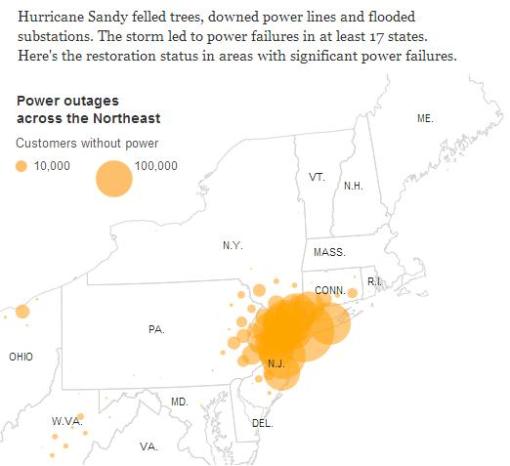
This infographic from the New York Times shows the number of power outages in the northeast and their locations in different states. The size of the circle indicates the number of people without power. Why would the makers of this infographic choose circles? Why do you think they chose to place them on a map? What do you think of the overlapping?

This is part of an infographic from the Huffington Post that compares hurricanes Sandy and Katrina. Click on the image to see the rest of the infographic. What conclusions can you draw about the hurricanes from the information?
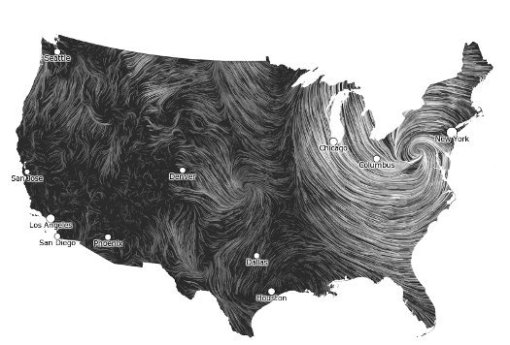
This is a wind map of the country captured at 10:30 in the morning on October 30th, the day hurricane Sandy hit. The infographic was made by scientist-artists Fernanda Viegas and Martin Wattenberg. It shows how wind is flowing around the United States in real-time. Check out their site (click on this image) to see what the wind is doing right now in your part of the country!

To those in places affected by Hurricane Sandy, be safe.  To all our readers, bon appetit!

Pentago, Geometry Daily, and The OEIS

Welcome to this week’s Math Munch!

Pentago Board

Hurricane Sandy is currently slamming the East coast, but the Math Munch Team is safe and sound, so the math must go on.  First up, if you’ve visited our games page lately, you may have noticed a recent addition.  Pentago is a 2-player strategy with simple rules and an enticing twist.

  • Rules: Take turns playing stones.  The first person to get 5 in a row wins.  (5 is the “pent” part.)
  • Twist: After you place a stone you must spin one of the 4 blocks.  This makes things very interesting.

Why don’t you play a few games before you read on?  You can play the computer on their website, play with a friend by email, or download the Pentago iPhone app.  But if you’re ready, let’s dig into some Pentago strategy and analysis.

Mindtwister CEO, Monica Lucas

Mindtwister (the company that sells Pentago) put out a free strategy guide that names 4 different kinds of winning lines and rates their relative strengths.  The weakest strategy is called Monica’s Five, and it’s named after Mindtwister CEO and Pentago lover, Monica Lucas.  You can read our Q&A for more expert game strategies and insights.  We also had a chance to speak with Tomas Floden, the inventor of Pentago, so it’s a double Q&A week.

As you play, you start to build your own strategy guide, so let me share three basic rules from mine.  I call them the first 3 Pentago Theorems.  (A theorem is a proven math fact.)

  1. If you have a move to win, take it!  This one is obvious, but you’ll see why I include it.
  2. If your opponent is only missing one stone from a line of 5 you must play there.  It seems like you could play somewhere else and spin the line apart, but your opponent can play the stone and spin back!  The only exception to this rule is rule 1.  If you can win, just do that!
  3. 4 in a row, with both ends open will (almost always) win.  This is a classic double trap.  Either end will finish the winning line, so by rule 2 both must be filled, but this is impossible.  The exceptions of course will come when your opponent is able to win right away, so you still have to pay close attention.

Up next, check out the beautiful math art of Geometry Daily.

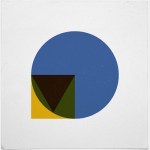
#288 Fundamental

#132 Eight Squares

#259 Dudeney’s Dissection

#296 Downpour

#236 Nova

#124 Cuboctahedron

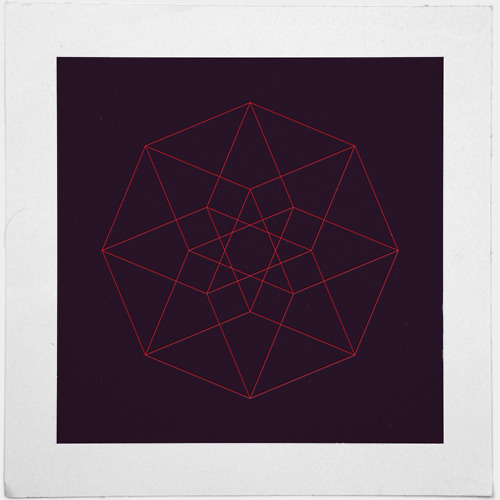
#136 Tesseract

#26 Pentaflower

#92 Circular Spring

The site is the playground for the geometrical ideas of Tilman Zitzmann, a German designer and teacher, who’s been creating a new image every day for almost a year now!  He also took some time to write about his creative process, so if you’re interested, have a read.  Visit the Geometry Daily archives to view all the images.

Finally, an amazing resource – the On-Line Encyclopedia of Integer Sequences.  What’s the pattern here?  1, 3, 6, 10, 15, 21, …  Any idea?  Do you know what the 50th number would be?  Well if you type this sequence into the OEIS, it’ll tell you every known sequence that matches.  Here’s what you get in this case.  These are the “triangular numbers,” also the number of edges in a complete graph.  It also tells you formula for the sequence:

  • a(n) = C(n+1,2) = n(n+1)/2 = 0+1+2+…+n.

If you make n=1, then you get 1.  If n=2, then you get 3.  If n=5, you get the 5th number, so to get the 50th number in the sequence, we just make n=50 in the formula.  n(n+1)/2 becomes 50(50+1)/2 = 1275.  Nifty.  Who’s got a pattern that needs investigating?

Have a great week, and bon appetit!

Pixel Art, Gothic Circle Patterns, and First Past the Post

Welcome to this week’s Math Munch!

Guess what? Today is Math Munch’s one-year anniversary!

We’re so grateful to everyone who has made this year so much fun: our students and readers; everyone who has spread the word about Math Munch; and especially all the people who do and make the cool mathy things that we so love to find and share.

Speaking of which…

Mathematicians have studied the popular puzzle called Sudoku in numerous ways. They’ve counted the number of solutions. They’ve investigated how few given numbers are required to force a unique solution. But Tiffany C. Inglis came at this puzzle craze from another angle—as a way to encode pixel art!

Tiffany studies computer graphics at the University of Waterloo in Ontario, Canada. She’s a PhD candidate at the Computer Graphics Lab (which seems like an amazing place to work and study—would you check out these mazes!?)

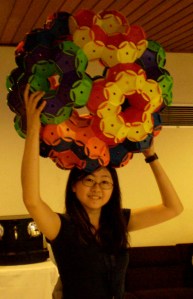
Tiffany C. Inglis, hoisting a buckyball

Tiffany tried to find shading schemes for Sudoku puzzles so that pictures would emerge—like the classic mushroom pictured above. Sudoku puzzles are a pretty restrictive structure, but Tiffany and her collaborators had some success—and even more when they loosened the rules a bit. You can read about (and see!) some of their results on this rad poster and in their paper.

Thinking about making pictures with Sudoku puzzles got Tiffany interested in pixel art more generally. “I did some research on how to create pixel art from generic images such as photographs and realized that it’s an unexplored area of research, which was very exciting!” Soon she started building computer programs—algorithms—to automatically convert smooth line art into blockier pixel art without losing the flavor of the original. You can read more about Tiffany’s pixelization research on this page of her website. You should definitely check out another incredible poster Tiffany made about this research!

To read more of my interview with Tiffany, you can click here.

Cartoon Tiffany explains what makes a good pixelization. Check out the full comic!

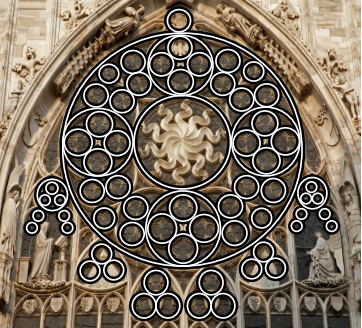
I met Tiffany this past summer at Bridges, where she both exhibited her artwork and gave an awesome talk about circle patterns in Gothic architecture. You may be familiar with Apollonian gaskets; Gothic circle patterns have a similar circle-packing feel to them, but they have some different restrictions. Circles don’t just squeeze in one at a time, but come in rings. It’s especially nice when all of the tangencies—the places where the circles touch—coincide throughout the different layers of the pattern. Tiffany worked on the problem of when this happens and discovered that only a small family has this property. Even so, the less regular circle patterns can still produce pleasing effects. She wrote about this and more in her paper on Gothic circle patterns.

I’m really inspired by how Tiffany finds new ideas in so many place, and how she pursues them and then shares them in amazing ways. I hope you’re inspired, too!

A rose window at the Milan Cathedral, with circle designs highlighted.

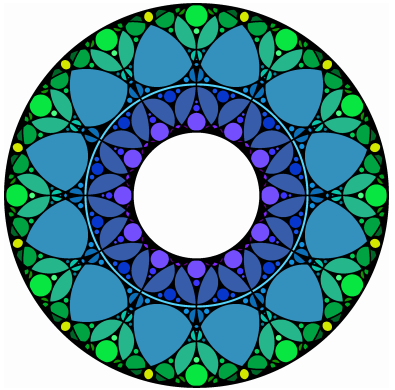
A mathematical model similar to the window, which Tiffany created.

An original design by Tiffany. All of these images are from her paper.

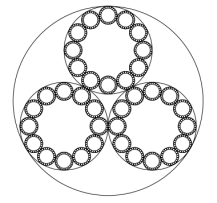
Here’s another of Tiffany’s designs. Now try making one of your own!

Using the Mathematica code that Tiffany wrote to build her diagrams, I made an applet where you can try making some circle designs of your own. Check it out! If you make one you really like—and maybe color it in—we’d love to see it! You can send it to us at MathMunchTeam@gmail.com.

(You’ll may have to download a plug-in to view the applet; it’s the same plug-in required to use the Wolfram Demonstrations Project.)

Finally, with Election Day right around the corner, how about a dose of the mathematics of voting?

I’m a fan of this series of videos about voting theory by C.G.P. Grey. Who could resist the charm of learning about the alternative vote from a wallaby, or about gerrymandering from a weasel? Below you’ll find the first video in his series, entitled “The Problems with First Past the Post Voting Explained.” Majority rule isn’t as simple of a concept as you might think, and math can help to explain why. As can jungle animals, of course.

Thanks again for being a part of our Math Munch fun this past year. Here’s to a great second course! Bon appetit!


PS I linked to a bunch of papers in this post. After all, that’s the traditional first anniversary gift!