Category Archives: Math Munch

Line Fractals, Knitting, and 3-D Design

Welcome to this week’s Math Munch!

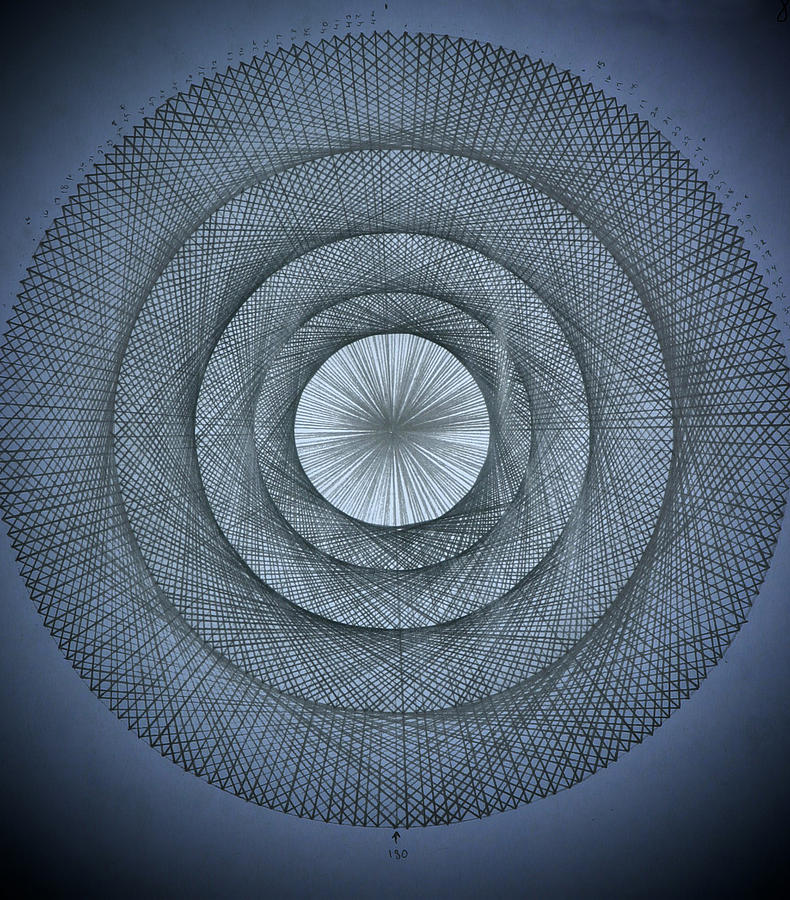
Take a look at this beautiful line drawing:

Jason Padgett

This is called, “Towards Pi 3.141552779 Hand-Drawn,” and it’s by mathematician and artist Jason Padgett.  Jason wasn’t always a mathematician or an artist.  In fact, it was only after a severe head injury that Jason suddenly found that he “saw” fractals and other geometric images in mathematical and scientific ideas.  Jason is interested in limits.  The picture above, for example, is Jason’s artistic interpretation of a limit that approaches pi.  If you draw a circle with radius 1 and make polygons inside of it using secants for their sides, the areas of the polygons get closer and closer to pi as the number of sides increases – but always stay less than pi.  If you take that same circle and make polygons around it using tangents for their sides, the areas of the polygons also get closer and closer to pi as the number of sides increases – but always stay larger than pi.  Jason tried to draw the way that those sequences “trap pi” in this picture.

I think it’s really amazing that Jason draws these by hand.  Here’s some more of Jason’s artwork, and a video of Jason drawing “Towards Pi 3.141552779 Hand-Drawn.”
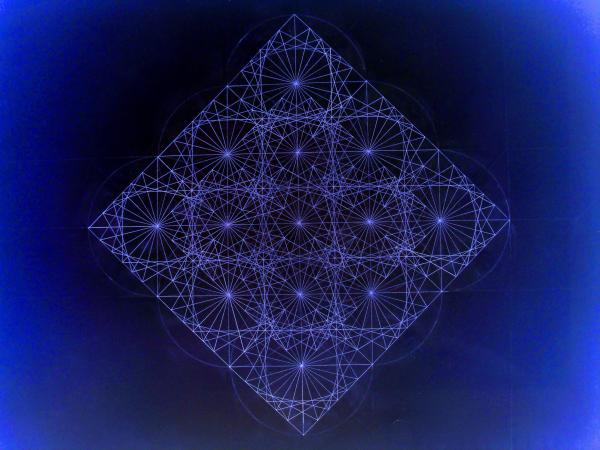
Space Time Sine Cosine and Tangent Waves

The Power of Pi

Wave Particle Duality

[youtube http://www.youtube.com/watch?v=uHqRTtnU8Wg&feature=fvwrel]

Next, did you like Sondra Eklund’s sweater from last week?  Did it inspire you to do some mathematical knitting of your own?  If so, check out the website Woolly Thoughts.

Woolly Thoughts is run by “mathekniticians” Pat Ashforth and Steve Plummer who love to do, teach, and share math with others through their knitting.  They’ve designed many beautiful and mathematical afghan and pillow patterns, and some patterns for interesting math toys.  Here are some of my favorites:

The “Finite Field” afghan is a color-coded addition table using binary.

The “Fibo-Optic” afghan is made to look like a flying cube using side-lengths based on the Fibonacci sequence.

Finally, one of the programs featured in the new Math Art Tools link is TinkerCAD.  TinkerCAD is a program you can use to make 3D designs – just because, or to print out with a 3D printer!

TinkerCAD has three parts: Discover, Learn, and Design.  In the Discover section, you can browse things that other tinkerers have made and download them to print yourself.  There are some really cool things out there, like this Father’s Day mug made by Fabricatis and this sail boat made by Klyver Boys.

Next, in the Learn section, you can play different “quests” to hone your TinkerCAD skills.  Finally, in the Design section, you can make your own thing!  TinkerCAD is really intuitive to use.  The TinkerCAD tutorial video is really helpful if you want to learn how to use TinkerCAD – as are the quests.

Stay tuned for pictures of some TinkerCAD things made by friends of Math Munch!

Bon appetit!

A Sweater, Paper Projects, and Math Art Tools

Sondra Eklund and her Prime Factorization Sweater

Welcome to this week’s Math Munch!

Check out Sondra Eklund and her awesome prime factorization sweater! Sondra is a librarian and a writer who writes a blog where she reviews books. She also is a knitter and a lover of math!

Each number from two to one hundred is represented in order on the front of Sondra’s sweater. Each prime number is a square that’s a different color; each composite number has a rectangle for each of the primes in its prime factorization. This number of columns that the numbers are arranged into draws attention to different patterns of color. For instance, you can see a column that has a lot of yellow in it on the front of the sweater–these are all number that contain five as a factor.

You can read more about Sondra and her sweater on her blog. Also, here’s a response and variation to Sondra’s sweater by John Graham-Cumming.

Next up, do you like making origami and other constructions out of paper? Then you’ll love the site made by Laszlo Bardos called CutOutFoldUp.

Laszlo Bardos

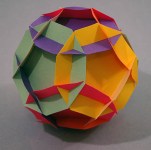
A Rhombic Spirallohedron

A decagon slide-together

Laszlo is a high school math teacher and has enjoyed making mathematical models since he was a kid. On CutOutFoldUp you’ll find gobs of projects to try out, including printable templates. I’ve made some slide-togethers before, but I’m really excited to try making the rhombic spirallohedron pictured above! What is your favorite model on the site?

Last up, Paul recently discovered a great mathematical art applet called Recursive Drawing. The tools are extremely simple. You can make circles and squares. You can stretch these around. But most importantly, you can insert a copy of one of your drawings into itself. And of course then that copy has a copy inside of it, and on and on. With a very simple interface and very simple tools, incredible complexity and beauty can be created.

Recursive Drawing was created by Toby Schachman, an artist and programmer who graduated from MIT and now lives in New York City and attends NYU.  You can watch a demo video below.

Recursive Drawing is one of the first applets on our new Math Art Tools page. We’ll be adding more soon. Any suggestions? Leave them in the comments!

Bon appetit!

Scott Kim, Puzzles, and Games

Welcome to this week’s Math Munch!

Scott Kim

Meet Scott Kim.  He’s loved puzzles ever since he was a kid, so these days he designs puzzles for a living.  He’s been writing puzzles for Discover Magazine for years in a monthly column called “The Boggler.”  Click that link to look through some of his Boggler archives.  Here’s a cool one he wrote in 2002 about hypercubes and the 4th dimension.

Ambigram

In his 11-minute TED talk, Scott tells the story of his career and shares some of his favorite puzzles, games, and ambigrams.  It’s also completely clear how much he really loves what he does (as do I.)

Knights on Horseback – M.C. Escher

I’ve always loved “figure/ground” images, where the leftover space from one shape creates another recognizable shape.  M.C. Escher created some of the most famous and well-known examples of figure/ground art, but Scott Kim took the idea a step further – making an interactive puzzle game based on the ideas.  Naturally, the game is called “Figure Ground,” and it’s delightfully tricky.  You can even create your own levels.  Scott has a whole page of web games.  Go play!

Symmetrical Alphabet – Ambigram by Scott Kim

Still hungry for more Scott Kim?  He gave a presentation for the Museum of Math‘s lecture series, Math Encounters.  You can watch the full-length video here.  You can also watch an interview he did with Vi Hart by clicking here.

Finally, after you read a Math Munch (or right in the middle) do you ever have a question you wish someone could answer or something you want explained?  Or do you ever wish we could help you find more of something you liked in the post?  Well we can do that!  Just leave a comment on the bottom of the page, and the Math Munch team will be very happy to answer.  We’d love to hear from our readers.

Bon appetit!