Category Archives: Math Munch

Triangles, Triangles, Triangles!

Welcome to this week’s Math Munch!

Inspired by Vi Hart’s most recent doodling video “Triangle Party!”, this week’s post is all about triangles.

Connie Liu

One of the most amazing things about mathematics is that there are always new discoveries to be made about even the simplest of objects–even triangles!  Check out this article about Connie Liu, a Hawaiian teenager who just last year discovered some new formulas that relate special points of triangles to each other.  Connie has found some new, simple, and interesting ways of describing the triangle inequality – just by sticking with her questions and digging into a particular part of mathematics a little deeper than anyone had before.

Next up, here are some visual perspectives on Pascal’s triangle.  Even folks who are well acquainted with this numerical cascade are likely to find something new to see in these blog posts by Tao Wang.  Tao is a math and computer teacher in NYC.  My favorite visualization is the video that depicts the entries of Pascal’s triangle as blocks that are as tall as their numerical value.

Hat tip to Patrick Honner, a math teacher from Brooklyn, for the Pascal’s triangle visualizations.  Patrick writes a sweet mathematical blog, including a running series of photographs about the math that he sees in the world.  Check out his posts about which of these isosceles triangles is “more equilateral.”

Zooming in on the corner of a Koch snowflake.

Finally, Vi mentions and doodles a Koch snowflake in her video.  This seems timely, what with snowfalls likely just around the corner.  Here are some great images of generalizations of the Koch snowflake by Phil Keenan that he made using computers.

Wow, what a great crop of other blogs for you to explore!

Here is a list of them all:

Math Laoshi by Tao Wang

Math Appreciation by Patrick Honner

Meandering Through Mathematics by Phil Keenan

and of course Vi Hart’s Blog

Stay tuned for more winter-inspired mathematics next week!

Bon appetit!

Alphametics, Hyperbolic Crochet, and a Puzzle Contest

Welcome to the first Math Munch of December!


Did you know that SEND + MORE = MONEY?  Or that DOUBLE + DOUBLE + TOIL = TROUBLE?  It does if you replace the letters with the appropriate digits!  These very clever puzzles, where the digits in numbers of addition, subtraction, or multiplication problems are replaced by letters in words, are called alphametics (or sometimes cryptarithms).  Mathematician, software engineer, and writer Mike Keith calls them the “most elegant of puzzles” on his page devoted to some alphametics he’s found and created.  Check out the “doubly-true” alphametics – puzzles where the words are numbers – and Mike’s alphametic poetry.  In this poem, written in what Mike calls “Strict Alphametish,” the last word in each line is the sum of the previous words in that line!  Wow!

Next, take a look at these cool objects!

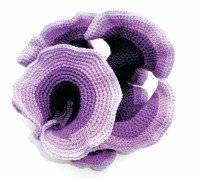
Purple hyperbolic plane

If you draw a line on a hyperbolic plane and a point not on that line, you can make an infinite number of lines parallel to the first line through the point.

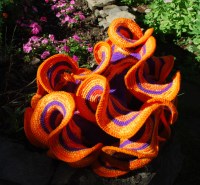
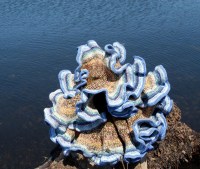
These are models of hyperbolic planes crocheted by Cornell University mathematician and artist Daina Taimina.  A hyperbolic plane is a surface that is kind of like the opposite of a sphere: on a sphere, the surface always curves in towards itself, but on a hyperbolic plane, the surface always curves away from itself.

Before Daina figured out how to crochet a hyperbolic plane, mathematicians had no durable, easy-to-use models of this very important geometric object!  But now, anyone with a little crocheting skill (or a willingness to learn!) can make a hyperbolic plane!  Here are instructions on how to crochet your very own hyperbolic plane, and here’s a link to Daina’s blog.

By the way, our favorite mathematical doodler Vi Hart also makes models of hyperbolic planes out of balloons.

Finally, do you like to play with Rubik’s Cubes, stacking puzzles, or other physical math puzzles?  Think you could make one of your own?   These are some of the entries in the 2011 Nob Yoshigahara Puzzle Design Competition.  Here are the winners!  The designer of the first-place puzzle won this cool trophy!

Bon Appetit!

Number Gossip, Travels, and Topology

Thanksgiving was great, but I hope you saved room for this week’s Math Munch!

First up, meet Tanya Khovonova, a mathematician and blogger who works at MIT.  Number Gossip is a website of hers where you can find the mysterious facts behind your favorite numbers.  For instance, did you know that the opposite sides of a die add to 7, or that 7 is the only prime number followed by a cube (8=23)? Speaking of 7, I also found this cool test for divisibility by 7 on Tanya’s website.

Tanya Khovonova

Is that divisible by 7? Let's take a walk.

Read about how to use it here, but basically you follow that diagram a certain way, and if you land back at the white dot, then you’re number is divisible by 7. I’m amazed and trying to figure out how it works!

Infographic - Holiday Travel Patterns

Next up, I wanted to share this incredible picture I found today.  It’s an infographic showing travel patterns in the US during the holiday season.  The picture must represent millions of little pieces of data, so I’ve spent a lot of time staring and analyzing it.  Did you notice the bumps in the bottom?  Why is that happening?  Why are the blue lines different from the white lines? There are so many good things to be seen.

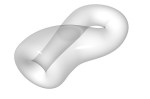
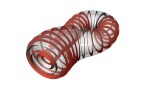
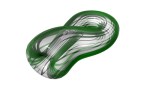
Finally, take a look at these pictures!  They’re from Kenneth Baker’s Sketches of Topology blog.  Kenneth makes images demonstrating ideas in topology, one of the most visually appealing branches of mathematics.  Some of it is tough to understand, but the pictures certainly are fascinating.

On a related point, have you taken a look at the Math Munch page of math games? (You can always find the link at the top of the column to the right.)  I just added a topology game, the Four Color Game, and I’m kind of loving it.  It’s based on a famous math result about only needing 4 colors to nicely color any flat map.  This is called the Four Color Theorem, and it’s a part of topology.

Bon appetit!