Category Archives: Math Munch

SET, Ptolemy, and Malin Christersson

Welcome to this week’s Math Munch!

To set up the punchline: if you haven’t played the card game SET before, do yourself a favor and go try it out now!

(Or if you prefer, here’s a video tutorial.)
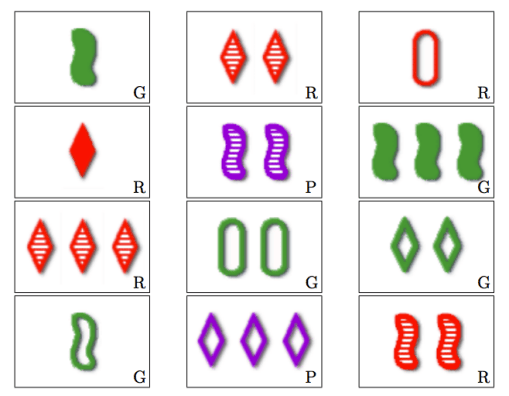
ThereAreNoSetsHere

Are there any sets to be found here?

(And even if you have played before, go ahead and indulge yourself with a round. You deserve a SET break. 🙂 )

Now, we’ve shared about SET before, but recently there has been some very big SET-related news. Although things have been quieter around Georgia Tech since summer has started, there has been a buzz both here and around the internet about a big breakthrough by Vsevolod Lev, PĂ©ter Pál Pach, and Georgia Tech professor Ernie Croot. Together they have discovered a new approach to estimate how big a SET-less collection of SET cards can be.

In SET there are a total of 81 cards, since each card expresses one combination of four different characteristics (shape, color, filling, number) for which there are three possibilities each. That makes 3^4=81 combinations of characteristics. Of these 81 cards, what do you think is the most cards we could lay out without a SET appearing? This is not an easy problem, but it turns out the answer is 20. An even harder problem, though, is asking the same question but for bigger decks where there are five or ten or seventy characteristics—and so 3^5 or 3^10 or 3^70 cards. Finding the exact answer to these larger problems would be very, very hard, and so it would be nice if we could at least estimate how big of a collection of SET-less cards we could make in each case. This is called the cap set problem, and Vsevolod, Péter, and Ernie found a much, much better way to estimate the answers than what was previously known.

To find out more on the background of the cap set problem, check out this “low threshold, high ceiling” article by Michigan grad student Charlotte Chan. And I definitely encourage you to check out this article by Erica Klarreich in Quanta Magazine for more details about the breakthrough and for reactions from the mathematical community. Here’s a choice quote:

Now, however, mathematicians have solved the cap set problem using an entirely different method — and in only a few pages of fairly elementary mathematics. “One of the delightful aspects of the whole story to me is that I could just sit down, and in half an hour I had understood the proof,” Gowers said.

(For further wonderful math articles, you’ll want to visit Erica’s website.)

 Vsevolod  Peter  Ernie
 Charlotte  Erica  Marsha

These are photos of Vsevolod, Péter, Ernie, Charlotte, Erica, and the creator of SET, geneticist Marsha Jean Falco.

Ready for more? Earlier this week, I ran across this animation:

tumblr_o0k7mkhNSN1uk13a5o1_500

It shows two ways of modeling the motions of the sun and the planets in the sky. On the left is a heliocentric model, which means the sun is at the center. On the right is a geocentric model, which means the earth is at the center.
suntriangle

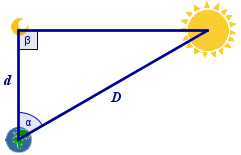
Around 250 BC, Aristarchus calculated the size of the sun, and decided it was too big to revolve around the earth!

Now, I’m sure you’ve heard that the sun is at the center of the solar system, and that the earth and the planets revolve around the sun. (After all, we call it a “solar system”, don’t we?) But it took a long time for human beings to decide that this is so.

I have to confess: I have a soft spot for the geocentric model. I ran across the animation in a Facebook group of some graduates of St. John’s College, where I studied as an undergrad. We spent a semester or so reading Ptolemy’s Almagest—literally, the “Great Work”—on the geocentric model of the heavens. It is an incredible work of mathematics and of natural science. Ptolemy calculated the most accurate table of chords—a variation on a table of the sine function—that existed in his time and also proved intricate facts about circular motion. For example, here’s a video that shows that the eccentric and epicyclic models of solar motion are equivalent. What’s really remarkable is that not only does Ptolemy’s system account for the motions of the heavenly bodies, it actually gave better predictions of the locations of the planets than Copernicus’s heliocentric system when the latter first debuted in the 1500s. Not bad for something that was “wrong”!

Here are Ptolemy and Copernicus’s ways of explaining how Mars appears to move in the sky:
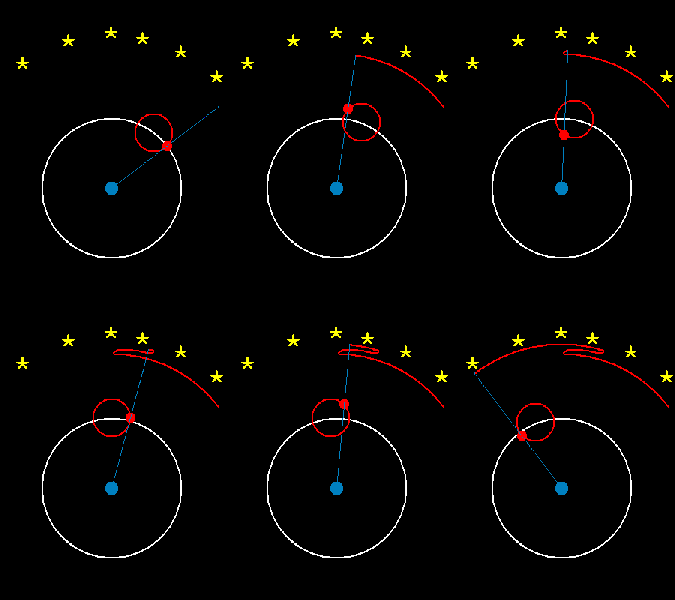
ptolemy Copernicus_Mars

Maybe you would like to learn more about the history of models of the cosmos? Or maybe you would like tinker with a world-system of your own? You might notice that the circles-on-circles of Ptolemy’s model are just like a spirograph or a roulette. I wonder what would happen if we made the orbit circles in much different proportions?
Malin

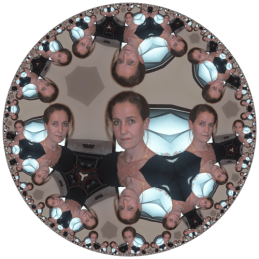
Malin, tiled hyperbolically.

Now, I was very glad to take this stroll down memory lane back to my college studies, but little did I know that I was taking a second stroll as well: the person who created this great animation, I had run across several other pieces of her work before! Her name is Malin Christersson and she’s a PhD student in math education in Sweden. She is also a computer scientist who previously taught high school and also teaches many people about creating math in GeoGebra. You can try out her many GeoGebra applets here. Malin also has a Tumblr where she posts gifs from the applets she creates.

About a year ago I happened across an applet that lets you create art in the style of artist (and superellipse creator) Piet Mondrian. But it also inverts your art—reflects it across a circle—so that you can view your own work from a totally different perspective. Then just a few months later I delighted in finding another applet where you can tile the hyperbolic plane with an image of your choice. (I used one tiling I produced as my Twitter photo for a while.)

Mondrian

Mondrainverted.

tiling (4)

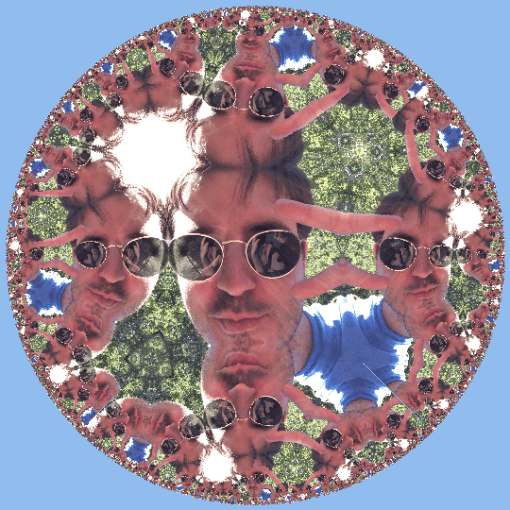
Me, tiled hyperbolically.

And now come to find out these were both made by Malin, just like the astronomy animation above! And Malin doesn’t stop there, no, no. You should see her fractal applets depicting Julia sets. And her Rolling Hypocycloids and Epicycloids are can’t-miss. (Echoes of Ptolemy there, yes?!)

And please don’t miss out on Malin’s porfolio of applets made in the programming language Processing.

It’s a good feeling to finally put the pieces together and to have a new mathematician, artist, and teacher who inspires me!

I hope you’ll find some inspiration, too. Bon appetit!

Wordless Videos, isthisprime, and Fan Chung Graham

Welcome to this week’s Math Munch! For the final Thursday of May, we’ll be looking back at some of this month’s posts from our Facebook page. We’ll see some wordless videos by The Global Math Project, look at a prime number quiz game, and meet Fan Chung Graham, one of the world’s leading mathematicians.

I don’t know much about The Global Math Project, but I know James Tanton is involved, and that is always a good thing. (Remember his Exploding Dots?) Well, they’ve posted a couple of wonderful videos featuring Tanton’s “math without words.” Need I say more? See for yourself.

If you like those, here are some more math without words from Tanton’s website.

Up next is a neat little thing by Christian Lawson-Perfect from The Aperiodical. Christian bought isthisprime.com and set up a little quiz game. Click over and see for yourself how it goes… I’ll wait… click below…

Screen Shot 2016-05-25 at 8.52.14 PM

It’s good practice for divisibility tests and getting your prime recognition up, but I suppose it’s not all that mathematical, is it? But Christian did something interesting. He recorded data from all the games played, and he wrote a summary of the results. I love all the charts and graphs in there. The one below shows how likely a number is to be missed by players.

Screen Shot 2016-05-25 at 9.01.48 PM

Finally, I hadn’t heard of Fan Chung-Graham until I found an interview of her posted on Facebook. She is one of the world’s leading mathematicians in several fields, and though she recently retired, she still conducts some research. The interview is a little academic, but it’s still nice to get to know such a talented mathematician.

fan1

Well that wraps up the week and month. I hope you’ve found some tasty math.  Have a great week and bon appetite!

Forest Fires, Scrubbing Calculator, and Bongard Problems

Welcome to this week’s Math Munch!

Last summer where I live, in California, there were a lot of forest fires. We’re having a big drought, and that made fires started for lots accidental of reasons– lightning, downed power lines, things like that– get much bigger than usual. I thought I’d learn a little about forest fires so that I can be a more responsible resident of my state.

And I found this great website with an awesome computer simulation that you can manipulate to experiment with the factors that lead to forest fires!

Forest fire.png

My forest fire, just starting to burn. Click on this picture to play with the simulation! (Note: It doesn’t work as well in certain browsers. I recommend Firefox.)


This site was built by Nicky Case, who studies things that mathematicians and scientists call complex systems. Basically, a complex system is some phenomenon that has a simple set of causes but unpredictable results. An environment with forest fires is a good example– a simple lightning strike in a drought-ridden forest can cause a wildfire to spread in patterns that firefighters struggle to predict. It turns out that simulations are perfect for modeling complex systems. With just a few simple program rules we can create a huge number of situations to study. Even better, we can change the rules to see what will happen if, say, the weather changes or people are more careful about where and when they set fires.

Forest fire what if

What do you think? Click the picture to see Nicky’s simulation.

You can use Nicky’s program to change the probability that trees grow, a burning tree sets its neighbors on fire, and many other factors. You can even invent your own and model them with emojis. What if there were two kinds of trees and one was more flammable than the other? What if trees grew quickly but lightning was common? As Nicky shows, simulations are useful for exploring what-if questions in complex systems. Use your imagination and explore!

Next up, have you ever heard of a scrubbing calculator? No, it’s not a calculator that doubles as a sponge. It’s a calculator that helps you solve for unknowns in equations by “scrubbing,” or approximating, the answer until you find a number that works.

Scrubbing calculator equation

Here’s how it works: Say you’re trying to solve for an unknown, like the x in the equation above (maybe for some practical reason or just because you’re doing your homework). You could do some pretty complicated algebraic manipulations so that the x alone equals some number. But what if you could make a guess and change it until the equation worked?

Scrubbing calculator

Click on this image to see a scrubbing calculator in action!

If your guess was too big, you’d know because the expression wouldn’t equal 768 anymore– it would equal something larger. And if you had a calculator that instantly told you the solution based on your guess, you could do this guessing and checking pretty quickly.

Well, lucky for you I found a scrubbing calculator that you can use online! It’s very simple– just type in your equation and your guess, and click on the number you want to change (most likely the guess) to make it larger or smaller. It’s useful for solving equations, like I said. But I actually find it most interesting to watch how the whole expression changes as you change one of the numbers in it. For instance, check out the Pythagorean triple calculator I built. What do you notice as you gradually change one of the numbers in the expression?

https://www.cruncher.io/?/embed/xiY1IjwUJS

Finally, I’m excited to share with you one of my favorite kinds of puzzles– Bongard problems!
Bongard 1A Bongard problem has two sets of pictures, with six pictures in each set. All of the pictures on the left have something in common that the pictures on the right do not. The challenge is to figure out what distinguishes the two groups of pictures.

Bongard 2

This problem was made by Douglas Hofstadter, who introduced Bongard problems to the U.S. I haven’t figured it out yet. Can you?

I got the Bongard problems shown above from a collection of problems put together by cognitive scientist Harry Foundalis. He has almost 300 of them, some made by Mikhail Bongard himself, who developed these problems while studying how to train computers to recognize patterns.

Harry also has guidelines for how to develop your own Bongard problems. He encourages people to send their problems to him and says he might even put them up on his site!

Bon appetit!