Tag Archives: arithmetic

Alphametics, Hyperbolic Crochet, and a Puzzle Contest

Welcome to the first Math Munch of December!


Did you know that SEND + MORE = MONEY?  Or that DOUBLE + DOUBLE + TOIL = TROUBLE?  It does if you replace the letters with the appropriate digits!  These very clever puzzles, where the digits in numbers of addition, subtraction, or multiplication problems are replaced by letters in words, are called alphametics (or sometimes cryptarithms).  Mathematician, software engineer, and writer Mike Keith calls them the “most elegant of puzzles” on his page devoted to some alphametics he’s found and created.  Check out the “doubly-true” alphametics – puzzles where the words are numbers – and Mike’s alphametic poetry.  In this poem, written in what Mike calls “Strict Alphametish,” the last word in each line is the sum of the previous words in that line!  Wow!

Next, take a look at these cool objects!

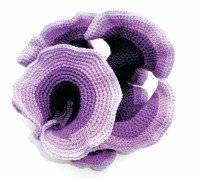
Purple hyperbolic plane

If you draw a line on a hyperbolic plane and a point not on that line, you can make an infinite number of lines parallel to the first line through the point.

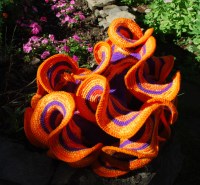
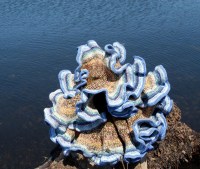
These are models of hyperbolic planes crocheted by Cornell University mathematician and artist Daina Taimina.  A hyperbolic plane is a surface that is kind of like the opposite of a sphere: on a sphere, the surface always curves in towards itself, but on a hyperbolic plane, the surface always curves away from itself.

Before Daina figured out how to crochet a hyperbolic plane, mathematicians had no durable, easy-to-use models of this very important geometric object!  But now, anyone with a little crocheting skill (or a willingness to learn!) can make a hyperbolic plane!  Here are instructions on how to crochet your very own hyperbolic plane, and here’s a link to Daina’s blog.

By the way, our favorite mathematical doodler Vi Hart also makes models of hyperbolic planes out of balloons.

Finally, do you like to play with Rubik’s Cubes, stacking puzzles, or other physical math puzzles?  Think you could make one of your own?   These are some of the entries in the 2011 Nob Yoshigahara Puzzle Design Competition.  Here are the winners!  The designer of the first-place puzzle won this cool trophy!

Bon Appetit!

Number Gossip, Travels, and Topology

Thanksgiving was great, but I hope you saved room for this week’s Math Munch!

First up, meet Tanya Khovonova, a mathematician and blogger who works at MIT.  Number Gossip is a website of hers where you can find the mysterious facts behind your favorite numbers.  For instance, did you know that the opposite sides of a die add to 7, or that 7 is the only prime number followed by a cube (8=23)? Speaking of 7, I also found this cool test for divisibility by 7 on Tanya’s website.

Tanya Khovonova

Is that divisible by 7? Let's take a walk.

Read about how to use it here, but basically you follow that diagram a certain way, and if you land back at the white dot, then you’re number is divisible by 7. I’m amazed and trying to figure out how it works!

Infographic - Holiday Travel Patterns

Next up, I wanted to share this incredible picture I found today.  It’s an infographic showing travel patterns in the US during the holiday season.  The picture must represent millions of little pieces of data, so I’ve spent a lot of time staring and analyzing it.  Did you notice the bumps in the bottom?  Why is that happening?  Why are the blue lines different from the white lines? There are so many good things to be seen.

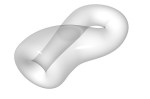
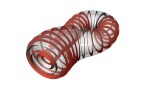
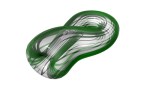
Finally, take a look at these pictures!  They’re from Kenneth Baker’s Sketches of Topology blog.  Kenneth makes images demonstrating ideas in topology, one of the most visually appealing branches of mathematics.  Some of it is tough to understand, but the pictures certainly are fascinating.

On a related point, have you taken a look at the Math Munch page of math games? (You can always find the link at the top of the column to the right.)  I just added a topology game, the Four Color Game, and I’m kind of loving it.  It’s based on a famous math result about only needing 4 colors to nicely color any flat map.  This is called the Four Color Theorem, and it’s a part of topology.

Bon appetit!

Circles, Geomagic, and Marble Calculators

Welcome to this week’s Math Munch!

We gave you a taste of some of Vi Hart’s math art last week with her balloon creations.  This week, we’re featuring some of Vi’s doodling in math class art – her Apollonian gaskets!  An Apollonian gasket is a fractal made by drawing a big circle, drawing two or three (or more!) smaller circles inside of it so that they fit snugly, and then filling all of the left-over empty space with smaller and smaller circles.  Here’s the video in which Vi tells how she draws Apollonian gaskets with circles and other shapes (and how she makes other awesome things like an infinitely long caravan of camels fading into the distance).  And here are some more Apollonian gaskets made by filling other shapes with circles from Math Freeze.

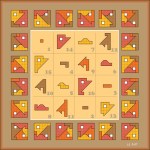
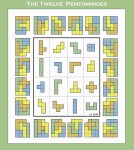
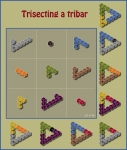
Next, you may have seen a magic square before, a number puzzle in which you fill a square grid with numbers so that each row, column, and diagonal have the same sum.  (Play with one here.)  But have you ever seen a geomagic square?

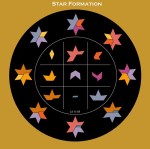
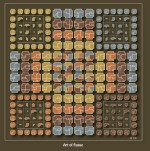
Magic squares have been around for thousands of years, but in 2001, Lee Sallows started thinking about them in a new way.  Lee realized that you could think of the numbers in the square as sticks of particular lengths, and the number being added to as an amount of space you were trying to fill with those sticks.  That led him to try to make magic squares out of things like pentominoes and other polyominoes, butterflies,  and many other shapes!  Aren’t they beautiful?

Finally, what do marbles, binary, and wooden levers have in common?  Mathematical artist, designer, and wood-worker Matthias Wandel built a binary adding machine that uses marbles and wooden gates!  Here’s a video demonstrating how it works:

Matthias doesn’t only build calculators.  Here’s a marble elevator and a machine that you can take apart and reassemble to make a new track.

Bon Appetit!