Tag Archives: binary

Fullerenes, Fibonacci Walks, and a Fourier Toy

Welcome to this week’s Math Munch!
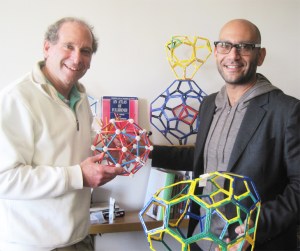
Stan and James

Stan and James

Earlier this month, neuroscientists Stan Schein and James Gayed announced the discovery of a new class of polyhedra. We’ve often posted about Platonic solids here on Math Munch. The shapes that Stan and James found have the same symmetries as the icosahedron and dodecahedron, and they also have all equal edge lengths.

One of Stan and James's shapes, made of equilateral pentagons and hexagons.

One of Stan and James’s shapes, made of equilateral pentagons and hexagons.

These new shapes are examples of fullerenes, a kind of shape named after the geometer, architect, and thinker Buckminster Fuller. In the 1980s, chemists discovered that molecules made of carbon can occur in polyhedral shapes, both in the lab and in nature. Stan and James’s new fullerenes are modifications of some existing shapes first described in 1937 by Michael Goldberg. The faces of Goldberg’s shapes were warped, not flat, and Stan and James showed that flattening can be achieved—thus turning Goldberg’s shapes into true polyhedra—while also having all equal edge lengths. There’s great coverage of Stan and James’s discovery in this article at Science News and a fascinating survey of the media’s coverage of the discovery by Adam Lore on his blog. Adam’s post includes an interview with Stan!

Next up—how much fun is it to find a fractal that’s new to you? That happened to me recently when I ran across the Fibonacci word fractal.
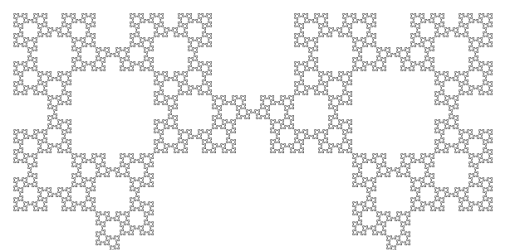
A portion of a Fibonacci word curve.

A portion of a Fibonacci word curve.

Fibonacci “words”—really just strings of 0’s and 1’s—are constructed kind of like the numbers in the Fibonacci sequence. Instead of adding numbers previous numbers to get new ones, we link up—or “concatenate”—previous words. The first few Fibonacci words are 1, 0, 01, 010, 01001, and 01001010. Do you see how new words are made out of the two previous ones?

Here’s a variety of images of Fibonacci word fractals, and you can find more details about the fractal in this article. The infinite Fibonacci word has an entry at the OEIS, and you can find a Fibonacci word necklace on Etsy. Dale Gerdemann, a linguist at the University of Tübingen, has a whole series of videos that show off patterns created out of Fibonacci words. Here is one of my favorites:

Last but not least this week, check out this groovy applet!

Lucas's applet showing the relationship between epicycles and Fourier series

Lucas’s applet showing the relationship between epicycles and Fourier series

A basic layout of Ptolemy's model, including epicycles.

A basic layout of Ptolemy’s model, including epicycles.

Sometime around the year 200 AD, the astronomer Ptolemy proposed a way to describe the motion of the sun, moon, and planets. Here’s a video about his ideas. Ptolemy relied on many years of observations, a new geometrical tool we call “trigonometry”, and a lot of ingenuity. He said that the sun, moon, and planets move around the earth in circles that moved around on other circles—not just cycles, but epicycles. Ptolemy’s model of the universe was incredibly accurate and was state-of-the-art for centuries.
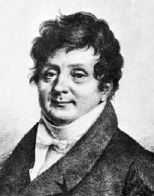
Joseph Fourier

Joseph Fourier

In 1807, Joseph Fourier turned the mathematical world on its head. He showed that periodic functions—curves with a repeated pattern—can be built by adding together a very simple class of curves. Not only this, but he showed that curves created in this way could have breaks and gaps even though they are built out of continuous curves called “sine” and “cosine”. (Sine and cosine are a part of the same trigonometry that Ptolemy helped to found.) Fourier series soon became a powerful tool in mathematics and physics.
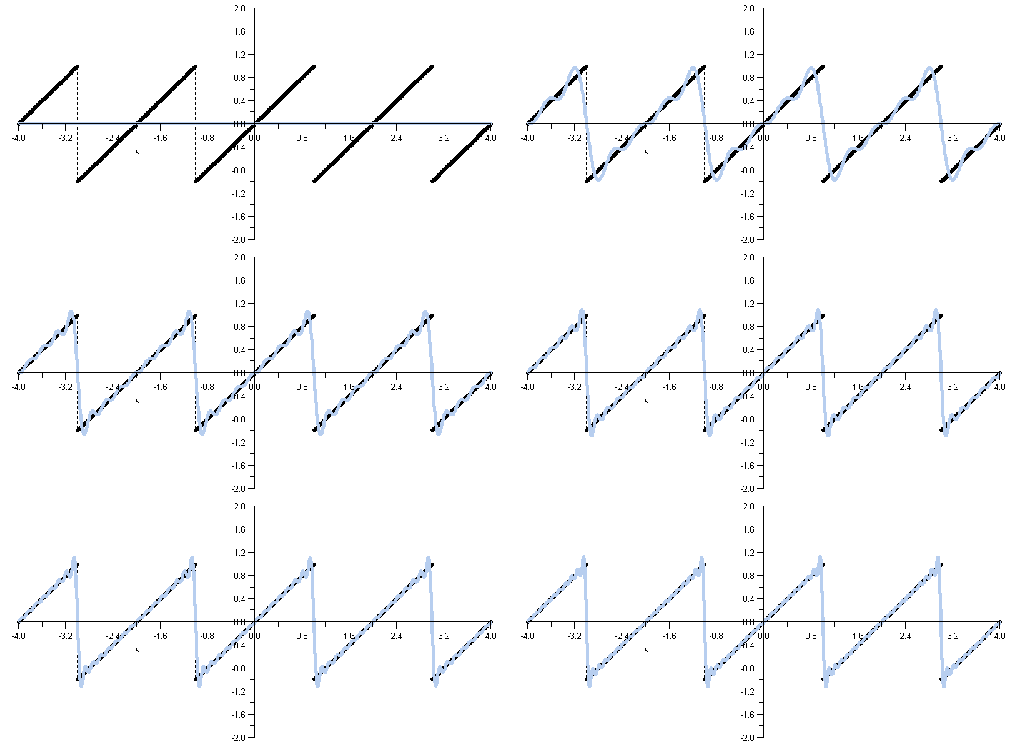
A Fourier series that converges to a discontinuous function.

A Fourier series that converges to a discontinuous function.

And then in the early 21st century Lucas Vieira created an applet that combines and sets side-by-side the ideas of Ptolemy and Fourier. And it’s a toy, so you can play with it! What cool designs can you create? We’ve featured some of Lucas’s work in the past. Here is Lucas’s short post about his Fourier toy, including some details about how to use it.

Bon appetit!

Talk Like a Computer, Infinite Hotel, and Video Contest

01010111 01100101 01101100 01100011 01101111 01101101 01100101 00100000 01110100 01101111 00100000 01110100 01101000 01101001 01110011 00100000 01110111 01100101 01100101 01101011 00100111 01110011 00100000 01001101 01100001 01110100 01101000 00100000 01001101 01110101 01101110 01100011 01101000 00100001

Or, if you don’t speak binary, welcome to this week’s Math Munch!

Looking at that really, really long string of 0s and 1s, you might think that binary is a really inefficient way to encode letters, numbers, and symbols. I mean, the single line of text, “Welcome to this week’s Math Munch!” turns into six lines of digits that make you dizzy to look at. But, suppose you were a computer. You wouldn’t be able to talk, listen, or write. But you would be made up of lots of little electric signals that can be either on or off. To communicate, you’d want to use the power of being able to turn signals on and off. So, the best way to communicate would be to use a code that associated patterns of on and off signals with important pieces of information– like letters, numbers, and other symbols.

That’s how binary works to encode information. Computer scientists have developed a code called ASCII, which stands for American Standard Code for Information Interchange, that matches important symbols and typing communication commands (like tab and backspace) with numbers.

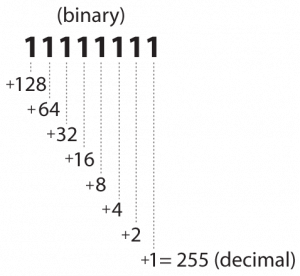
To use in computing, those numbers are converted into binary. How do you do that? Well, as you probably already know, the numbers we regularly use are written using place-value in base 10. That means that each digit in a number has a different value based on its spot in the number, and the places get 10 times larger as you move to the left in the number. In binary, however, the places have different values. Instead of growing 10 times larger, each place in a binary number is twice as large as the one to its right. The only digits you can use in binary are 0 and 1– which correspond to turning a signal on or leaving it off.

But if you want to write in binary, you don’t have to do all the conversions yourself. Just use this handy translator, and you’ll be writing in binary 01101001 01101110 00100000 01101110 01101111 00100000 01110100 01101001 01101101 01100101 00101110

Next up, check out this video about a classic number problem: the Infinite Hotel Paradox. If you find infinity baffling, as many mathematicians do, this video may help you understand it a little better. (Or add to the bafflingness– which is just how infinity works, I guess.)

I especially like how despite how many more people get rooms at the hotel (so long as the number of people is countable!), the hotel manager doesn’t make more money…

Speaking of videos, how about a math video contest? MATHCOUNTS is hosting a video contest for 6th-8th grade students. To participate, teams of four students and their teacher coach choose a problem from the MATHCOUNTS School Handbook and write a screenplay based on that problem. Then, make a video and post it to the contest website. The winning video is selected by a combination of students and adult judges– and each member of the winning team receives a college scholarship!

Here’s last year’s first place video.

01000010 01101111 01101110 00100000 01100001 01110000 01110000 01100101 01110100 01101001 01110100 00100001  (That means, Bon appetit!)

Mayans, Calendars, and Ramanujan

Welcome to this week’s Math Munch!

There’s been a lot of fuss recently about the Mayan calendar and the “end of the world.” You’ll be relieved to hear that the world continues to hang in there. In fact, no less an authority than NASA put out a video to help clear up the misinformation surrounding the rolling over of the Mayan calendar.

mayanAll of the doomsday talk did get me researching the Mayan calendar and number system. Check out this page that discusses Mayan numerals and will even count and skip-count for you. Once you’ve got the knack of how to count in the Mayan system, maybe you’ll want to try to decipher the numbers on a Mayan ballcourt marker in this interactive applet.

A cool fact that I learned from that first page is that the Mayans also had another and fancier way of writing down numbers: face glyphs. I found a really comprehensive article by Mark Pitts that describes both face glyphs and the ordinary system, too.

glyphs

The Mayan face glyphs for 0, 1, 2, and 3:
mih, jun, cha’, and ux.

There are many interesting kinds of calendars that human being have developed over the centuries, all with different styles, different mathematical patterns, and different connections to the natural and human worlds. We’ve featured the Cloctal before, but how about some links to some other fun mathy calendars as the new year approaches?

Thursday-January-1

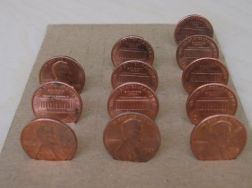
Thursday, January 1—in pennies.

I’m always amazed by what the internet produces when I dream up a search term like “binary calendar.” Perhaps you’ve seen a binary clock before—if not, check out this one—but I was delighted to find several different takes on a binary calendar served up by Google. Juan Osborne designed a binary calendar with all of the dates written out it a big colorful loop. Next, can you figure out the secret to this wooden binary calendar by Ken and Bobbie Ralphs? (It’s a lot like a marble calculator.) And third, here’s a binary calendar that you can make using just twelve pennies, courtesy of exploringbinary.com!

aztec-calendar-wheels

The Aztec tonalpohualli calendar.

There are many more amazing calendars to explore. Maybe you’ll check out Aztec calendar wheels, or find out about anniversaries of mathematicians from this calendar. (Isaac Newton was born on Christmas!) There are even more great calendars to explore at the Calendar Wiki, including some new calendars that have been proposed to “fix” our calendar—the Gregorian calendar—to get rid of traits like uneven months and leap years.

RamanujanSpeaking of anniversaries, this past Saturday was the 125th anniversary of the birth of the great Indian mathematician Srinivasa Ramanujan. Google celebrated the occasion with this doodle on the Indian Google homepage.

srinivasa_ramanujans_125th_birthday-992007-hp

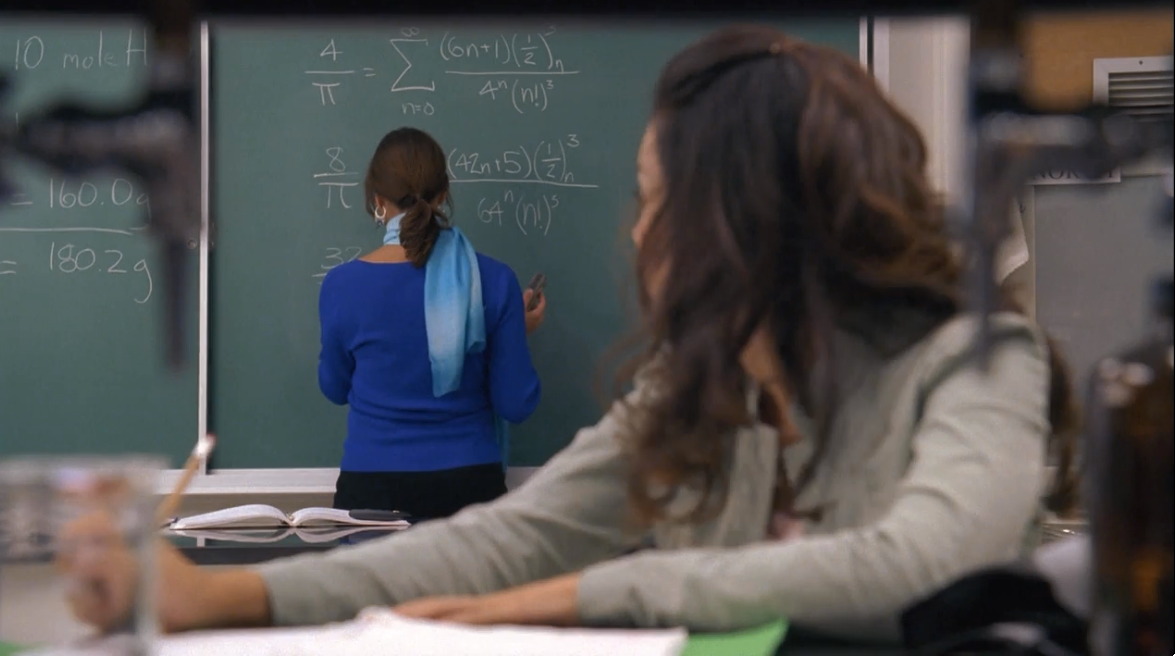
Ramanujan’s story is inspiring and also in some ways tragic. There’s plenty of information about Ramanujan on the web, but you might particularly enjoy reading this recent tribute to him by Dilip D’Souza. One surprising fact I ran across is that one of Ramanujan’s formulas involving pi appeared in (of all places) the movie High School Musical.

formula

One of Ramanujan’s infinite series, which made an appearance in High School Musical.

Ramanujan’s 125th birthday this year became the occasion for India’s first National Mathematics Day. What a cool holiday! Here is a clip from Indian television that shows some Indian students honoring Ramanujan and doing some math.

https://www.youtube.com/watch?v=zgw8VwCIOpw

I can’t understand everything that’s happening in the video, but it’s simply amazing to catch a glimpse of students on the other side of the world being excited about math. Also, you might notice that some of the students are figuring out cube roots of large numbers, while some others are shown figuring out what day of the week certain dates fell on. That’s a neat calendar-related feat that you can read more about here.

And just because it made me giggle, here’s a little bonus video.

Bon appetit!