Tag Archives: building

Partial Cubes, Open Cubes, and Spidrons

Welcome to this week’s Math Munch!

Recently the videos that Paul and I made about the Yoshimoto Cube got shared around a bit on the web. That got me to thinking again about splitting cubes apart, because the Yoshimoto Cube is made up of two pieces that are each half of a cube.

A part of Wall Drawing #601 by Sol LeWitt

A part of Wall Drawing #601
by Sol LeWitt

A friend of mine once shared with me some drawings of cubes by the artist Sol LeWitt. The cubes were drawn as solid objects, but parts of them were cut away and removed. It was fun trying to figure out what fraction of a cube remained.

On the web, I found a beautiful image that Sol made called Wall Drawing #601. In the clipping of it to the left, I see 7/8 of a cube and 3/4 of a cube. Do you? You can view the whole of this piece by Sol on the website of the Greater Des Moines Public Art Foundation.

The Cube Vinco by Vaclav Obsivac.

The Cube Vinco by Vaclav Obsivac.

There are other kinds of objects that break a cube into pieces in this way, like this tricky puzzle by Vaclav Obsivac and this “shaved” Rubik’s cube modification. Maybe you’ll design a cube dissection of your own!

As I further researched Sol LeWitt’s art, I found that he had investigated partial cubes in other ways, too. My favorite of Sol’s tinkerings is the sculpture installation called “Variations of Incomplete Cubes“. You can check out this piece of artwork on the SFMOMA site, as well as in the video below.

In the video, a diagram appears that Sol made of all of the incomplete open cubes. He carefully listed out and arranged these pictures to make sure that he had found them all—a very mathematical task. It reminds me of the list of rectangle subdivisions I wrote about in this post.
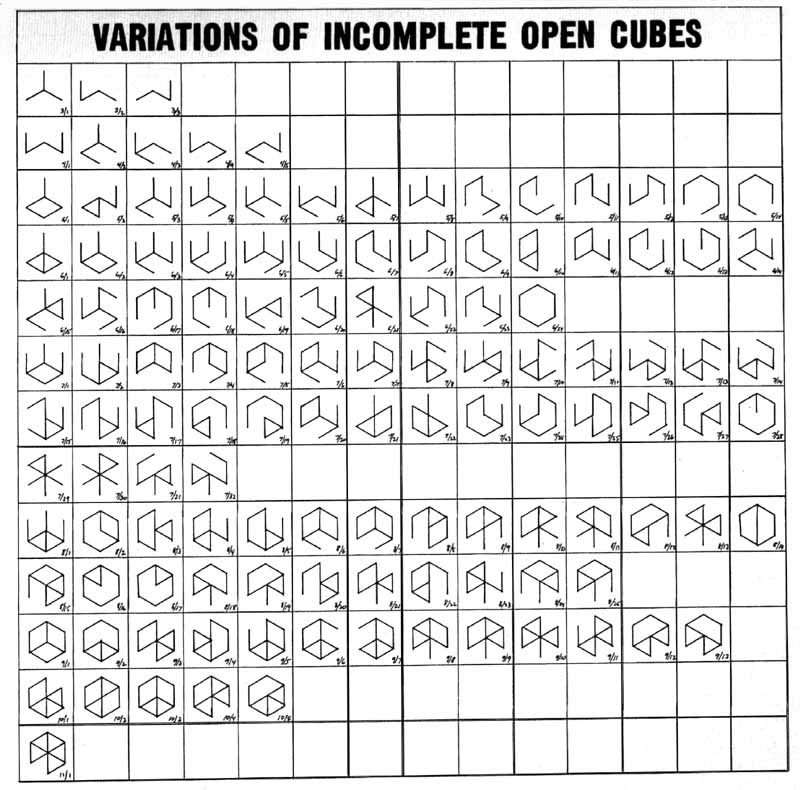
sollewitt_variationsonincompleteopencubes_1974

Sol’s diagram got me to thinking and making: what other shapes might have interesting “incomplete open” variations? I started working on tetrahedra. I think I might try to find and make them all. How about you?
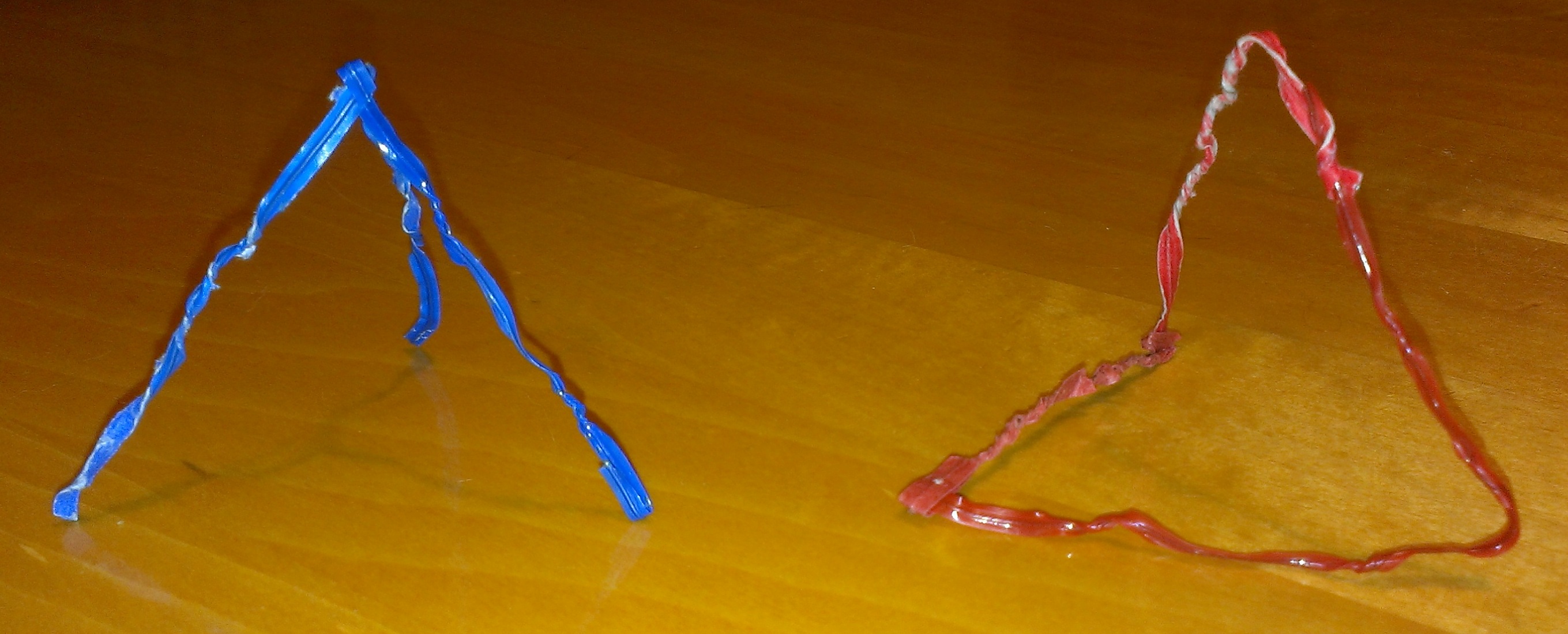
Two open tetrahedra I made. Can you find some more?

Two open tetrahedra I made. Can you find some more?

Finally, as I browsed Google Images for “half cube”, one image in particular jumped out at me.

half-cube-newnweb

What are those?!?!

Dániel's original spidron from 1979

Dániel’s original spidron from 1979

These lovely rose-shaped objects are called spidrons—or more precisely, they appear to be half-cubes built out of fold-up spidrons. What are spidrons? I had never heard of them, but there’s one pictured to the right and they have their own Wikipedia article.

The first person who modeled a spidron was Dániel Erdély, a Hungarian designer and artist. Dániel started to work with spidrons as a part of a homework assignment from Ernő Rubik—that’s right, the man who invented the Rubik’s cube.

A cube with spidron faces.

A cube with spidron faces.

Two halves of an icosahedron.

Two halves of an icosahedron.

A hornflake.

A hornflake.

Here are two how-to videos that can help you to make a 3D spidron—the first step to making lovely shapes like those pictured above. The first video shows how to get set up with a template, and the second is brought to you by Dániel himself! Watching these folded spidrons spiral and spring is amazing. There’s more to see and read about spidrons in this Science News article and on Dániel’s website.

And how about a sphidron? Or a hornflake—perhaps a cousin to the flowsnake? So many cool shapes!

To my delight, I found that Dániel has created a video called Yoshimoto Spidronised—bringing my cube splitting adventure back around full circle. You’ll find it below. Bon appetit!

Reflection Sheet – Partial Cubes, Open Cubes, and Spidrons

MoMA, Pop-Up Books, and A Game of Numbers

Welcome to this week’s Math Munch!

Thank you so much to everyone who participated in our Math Munch “share campaign” over the past two weeks. Over 200 shares were reported and we know that even more sharing happened “under the radar”. Thanks for being our partners in sharing great math experiences and curating the mathematical internet.

Of course, we know that the sharing will continue, even without a “campaign”. Thanks for that, too.

All right, time to share some math. On to the post!

N_JoshiTo kick things off, you might like to check out our brand-new Q&A with Nalini Joshi. A choice quote from Nalini:

In contrast, doing math was entirely different. After trying it for a while, I realized that I could take my time, try alternative beginnings, do one step after another, and get to glimpse all kinds of possibilities along the way.

By Philippe Decrauzat.

By Philippe Decrauzat.

I hope the math munches I share with you this week will help you to “glimpse all kinds of possibilities,” too!

Recently I went to the Museum of Modern Art (MoMA) in New York City. (Warning: don’t confuse MoMA with MoMath!) On display was an exhibit called Abstract Generation. You can view the pieces of art in the exhibit online.

As I browsed the galley, the sculptures by Tauba Auerbach particularly caught my eye. Here are two of the sculptures she had on display at MoMA:

CRI_244599 CRI_244605

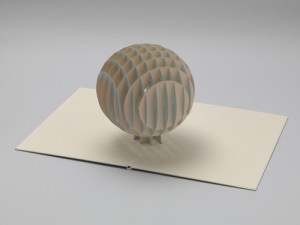
Just looking at them, these sculptures are definitely cool. However, they become even cooler when you realize that they are pop-up sculptures! Can you see how the platforms that the sculptures sit on are actually the covers of a book? Neat!

Here’s a video that showcases all of Tauba’s pop-ups in their unfolding glory. Why do you think this series of sculptures is called [2,3]?

This idea of pop-up book math intrigued me, so I started searching around for some more examples. Below you’ll find a video that shows off some incredible geometric pop-ups in action. To see how you can make a pop-up sculpture of your own, check out this how-to video. Both of these videos were created by paper engineer Peter Dahmen.

Taura Auerbach.

Tauba Auerbach.

Tauba got me thinking about math and pop-up books, but there’s even more to see and enjoy on her website! Tauba’s art gives me new ways to connect with and reimagine familiar structures. Remember our post about the six dimensions of color? Tauba created a book that’s a color space atlas! The way that Tauba plays with words in these pieces reminds me both of the word art of Scott Kim and the word puzzles of Douglas Hofstadter. Some of Tauba’s ink-on-paper designs remind me of the work of Chloé Worthington. And Tauba’s piece Componants, Numbers gives me some new insight into Brandon Todd Wilson’s numbers project.

0108 MM MM-Tauba-Auerbach-large

This piece by Tauba is a Math Munch fave!

For me, both math and art are all about playing with patterns, images, structures, and ideas. Maybe that’s why math and art make such a great combo—because they “play” well together!

Speaking of playing, I’d like to wrap up this week’s post by sharing a game about numbers I ran across recently. It’s called . . . A Game of Numbers! I really like how it combines the structure of arithmetic operations with the strategy of an escape game. A Game of Numbers was designed by a software developer named Joseph Michels for a “rapid” game competition called Ludum Dare. Here’s a Q&A Joseph did about the game.

A Game of Numbers.

A Game of Numbers.

If you enjoy A Game of Numbers, maybe you’ll leave Joseph a comment on his post about the game’s release or drop him an email. And if you enjoy A Game of Numbers, then you’d probably enjoy checking out some of the other games on our games page.

Bon appetit!

PS Tauba also created a musical instrument called an auerglass that requires two people to play. Whooooooa!

Reflection Sheet – MoMA, Pop-Up Books, and A Game of Numbers

Coasts, Clueless Puzzles, and Beach Math Art

summerAh, summertime. If it’s as hot where you are as it is here in New York, I bet this beach looks great to you, too. A huge expanse of beach all to myself sounds wonderful… And that makes me wonder – how much coastline is there in the whole world?

Interestingly, the length of the world’s coastline is very much up for debate. Just check out this Wikipedia page on coastlines, and you’ll notice that while the CIA calculates the total coastline of the world to be 356,000 kilometers, the World Resources Institute measures it to be 1,634,701! What???

Measuring the length of a coastline isn’t as simple as it might seem, because of something called the Coastline Paradox. This paradox states that as the ruler you use to measure a coastline gets shorter, the length of the coastline gets longer – so that if you used very, very tiny ruler, a coastline could be infinitely long! This excellent video by Veritasium explains the problem very well:

2000px-KochFlakeAs Vertitasium says, many coastlines are fractals, like the Koch snowflake shown at left – never-ending, infinitely complex patterns that are created by repeating a simple process over and over again. In this case, that simple process is the waves crashing against the shore and wearing away the sand and rock. If coastlines can be infinitely long when you measure them with the tiniest of rulers, how to geographers measure coastline? By choosing a unit of measurement, making some approximations, and deciding what is worth ignoring! And, sometimes, agreeing to disagree.

Need something to read at the beach, and maybe something puzzle-y to ponder? Check out this interesting article by four mathematicians and computer scientists, including James Henle, a professor in Massachusetts. They’ve invented a Sudoku-like puzzle they call a “Clueless Puzzle,” because, unlike Sudoku, their puzzle never gives any number clues.

Clueless puzzleHow does this work? These puzzles use shapes instead of numbers to provide clues. Here’s an example from the paper: Place the numbers 1 through 6 in the cells of the figure at right so that no digit appears more than once in a row or column AND so that the numbers in each region add to the same sum. The paper not only walks you through the solution to this problem, but also talks about how the mathematicians came up with the idea for the puzzles and studied them mathematically. It’s very interesting – I recommend you read it!

Finally, if you’re not much of a beach reader, maybe you’d like to make some geometrically-inspired beach art! Check out this land art by artist Andy Goldsworthy:

Andy Goldsworthy 1
Andy Goldsworthy 2

Or make one of these!

Happy summer, and bon appetit!