Tag Archives: diversity

Numenko, Turning Square, and Toilet Paper

Welcome to this week’s Math Munch!

Have you ever played Scrabble or Bananagrams? Can you imagine versions of these games that would use numbers instead of letters?

Meet Tom Lennett, who imagined them and then made them!
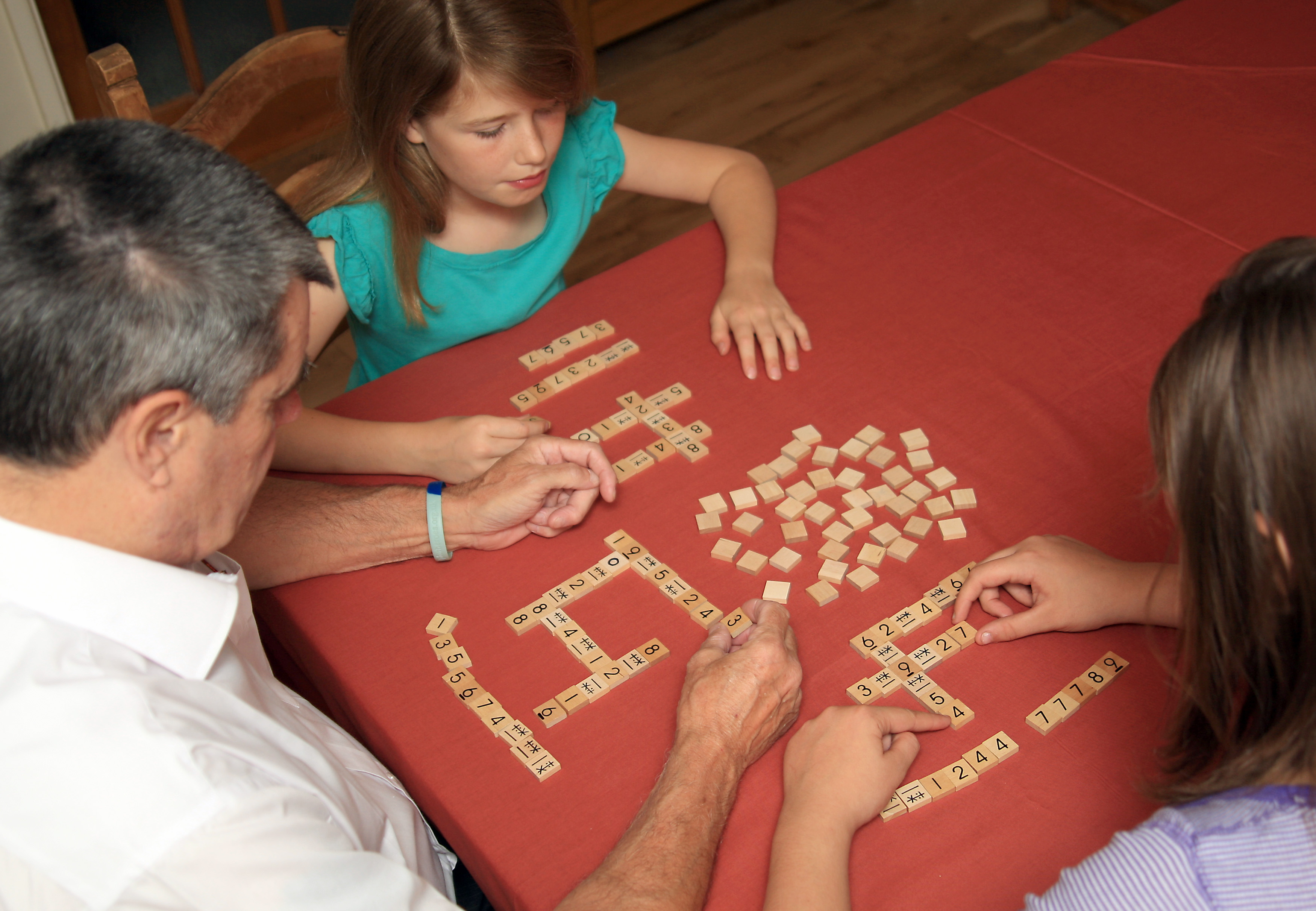
Tom playing Numenko with his grandkids.

Tom playing Numenko with his grandkids.

Numemko is a crossnumber game. Players build up number sentences, like 4×3+8=20, that cross each other like in a crossword puzzle. There is both a board game version of Numenko (like Scrabble) and a bag game version (like Banagrams). Tom invented the board game years ago to help his daughter get over her fear of math. He more recently invented the bag game for his grandkids because they wanted a game to play where they didn’t have to wait their turn!
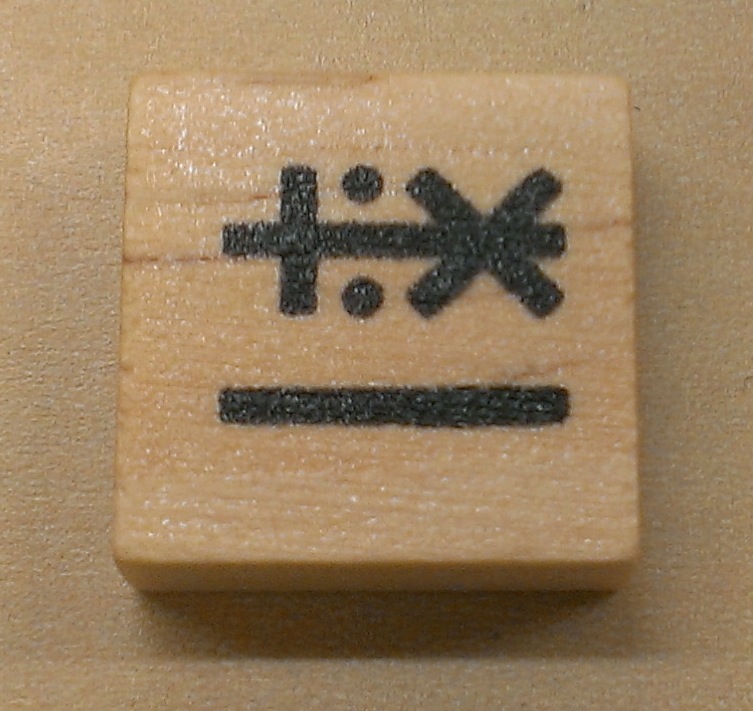
The Multichoice tile.

The Multichoice tile.

One important feature of Numenko is the Multichoice tile. Can you see how it can represent addition, subtraction, multiplication, division, or equality?

How would you like to have a Numenko set of your own? Well, guess what—Tom holds weekly Numenko puzzle competitions with prizes! You can see the current puzzle on this page, as well as the rules. Here’s the puzzle at the time of this post—the week of November 3, 2013.

Can you replace the Multichoice tiles to create a true number sentence?

Challenge: replace the Multichoice tiles to create a true number sentence.

I can assure you that it’s possible to win Tom’s competitions, because one of my students and I won Competition 3! I played my first games of Numenko today and really enjoyed them. I also tried making some Numenko puzzles of my own; see the sheet at the bottom of this post to see some of them.

Tom in 1972.

Tom in 1972.

In emailing with Tom I’ve found that he’s had a really interesting life. He grew up in Scotland and left school before he turned 15. He’s been a football-stitcher, a barber, a soldier, a distribution manager, a paintball site operator, a horticulturist, a property developer, and more. And, of course, also a game developer!

Do you have a question you’d like to ask Tom? Send it in through the form below, and we’ll try to include it in our upcoming Q&A!

leveledit

The level editor.

Say, do you like Bloxorz? I sure do—it’s one of my favorite games! So imagine my delight when I discovered that a fan of the game—who goes by the handle Jz Pan—created an extension of it where you can make your own levels. Awesome, right? It’s called Turning Square, and you can download it here.

(You’ll need to uncompress the file after downloading, then open TurningSquare.exe. This is a little more involved than what’s usual here on Math Munch, but I promise it’s worth it! Also, Turning Square has only been developed for PC. Sorry, Mac fans.)
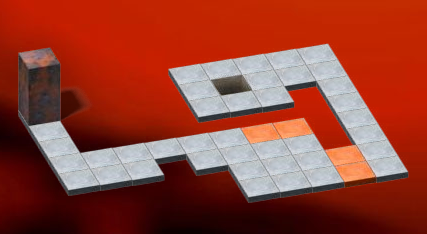
The level!

The level I made!

But wait, there’s more! Turning Square also introduces new elements to Bloxorz, like slippery ice and pyramids you can trip over. It has a random level generator that can challenge you with different levels of difficulty. Finally, Turning Square includes a level solver—it can determine whether a level that you create is possible or not and how many steps it takes to complete.

Jz Pan is from China and is now a graduate student at the Chinese Academy of Sciences, majoring in mathematics and studying number theory. Jz Pan made Turning Square in high school, back in 2008.

Jz Pan has agreed to answer some of your questions! Use the form below to send us some.

If you make a level in Turning Square that you really like, email us the .box file and we can share it with everyone through our new Readers’ Gallery! Here is my level from above, if you want to try it out.

Jz Pan has also worked on an even more ambitious extension of Bloxorz called Turning Polyhedron. The goal is the same, but like the game Dublox, the shape that you maneuver around is different. Turning Polyhderon features several different shapes. Check out this video of it being played with a u-polyhedron!

And if you think that’s wild, check out this video with multiple moving blocks!

Last up this week, have you ever heard that it’s impossible to fold a piece of paper in half more than eight times? Or maybe it’s seven…? Either way, it’s a “fact” that seems to be common knowledge, and it sure seems like it’s true when you try to fold up a standard sheet of paper—or even a jumbo sheet of paper. The stack sure gets thick quickly!
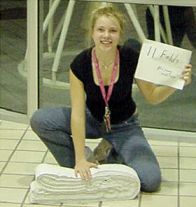
Britney Gallivan and her 11th fold.

Britney and her 11th fold.

Well, here’s a great story about a teenager who decided to debunk this “fact” with the help of some math and some VERY big rolls of toilet paper. Her name is Britney Gallivan. Back in 2001, when she was a junior in high school, Britney figured out a formula for how much paper she’d need in order to fold it in half twelve times. Then she got that amount of paper and actually did it!

Due to her work, Britney has a citation in MathWorld’s article on folding and even her own Wikipedia article. After high school, Britney went on to UC Berkeley where she majored in Environmental Science. I’m trying to get in touch with Britney for an interview—if you have a question for her, hold onto it, and I’ll keep you posted!

EDIT: I got in touch with Britney, and she’s going to do an interview!
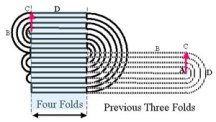
A diagram that illustrates how Britney derived her equation.

A diagram that illustrates how Britney derived her equation.

The best place to read more about Britney’s story in this article at pomonahistorical.org—the historical website of Britney’s hometown. Britney’s story shows that even when everyone else says that something’s impossible, that doesn’t mean you can’t be the one to do it. Awesome.

I hope you enjoy trying some Numenko puzzles, tinkering with Turning Square, and reading about Britney’s toilet paper adventure.

Bon appetit!

PS Want to see a video of some toilet-paper folding? Check out the very first “family math” video by Mike Lawler and his kids.

Reflection Sheet – Numenko, Turning Square, and Toilet Paper

Solitons, Contours, and Thinking Sdrawkcab

Welcome to this week’s Math Munch!

Meet Nalini Joshi, a mathematician at the University of Sydney in Australia. I’ll let her introduce herself to you.

Nalini has an amazing story and amazing passion. What does her video make you think? To hear more from Nalini, you can watch this talk she gave last month at the Women in Mathematics conference at the Isaac Newton Institute in Cambridge, England. Her talk is called “Mathematics and life: a personal journey.” You might also enjoy reading this interview or others on her media page.

Nalini Joshi lecturing about solitons.

Nalini Joshi lecturing about solitons.

I’d like to share three clumps of ideas that might give you a flavor for the math that Nalini enjoys doing. Most of it is way over my head, but I’m reaching for it! You can, too, if you try.

Here’s clump number one. Two of the main objects that Nalini studies are dynamical systems and differential equations. You can think of a dynamical system as some objects that interact with each other and evolve over time. Think of the stars that Nalini described in the video, heading toward each other and tugging on each other. Differential equations are one way of describing these interactions in a mathematically precise way. They capture how tiny changes in one amount affect tiny changes in another amount.

Vlasov billiards.

Vlasov billiards.

To play around with some simple dynamical systems that can still produce some complex behaviors, check out dynamical-systems.org. Vlasov billiards was new to me. I think it’s really cool. The three-body problem is one of the oldest and most famous dynamical systems, and you can tinker around with examples of it here and here. There’s even a three-body problem game you can try playing. I’m not too crazy about it, but maybe you’ll enjoy it. It certainly gives you a sense for how chaotic the a three-body system can be!

Nalini doesn’t study just any old dynamical systems. She’s particularly interested in ones where the chaotic parts of the system cancel each other out. Remember in the video how she described the stars that go past each other and don’t destroy each other, that are “transparent to each other”? Places where this happens in dynamical systems are called soliton solutions. They’re like steady waves that can pass through each other. Check out these four videos on solitons, each of which gives a different perspective on them. If you’re feeling adventurous, you could try reading this article called What is a Soliton?

vid1

Making a water wave soliton in the Netherlands.

vid2

A computer animation of interacting solitons.

vid3

Japanese artist Takashi Suzuki tests a soliton to be used in a piece of performance art.

vid4

Students studying and building solitons in South Africa.

Level curves that are generalized Cassini curves. Also, kind of looks like a four-body problem. (click for video)

Level curves that are generalized Cassini curves.
Also, it kind of looks like a four-body problem.
(click for video)

The second idea that Nalini uses that I’d like to share is level curves, or contours. Instead of studying complicated differential equations directly, it’s possible to get at them geometrically by studying families of curves—contours—that are produced by related algebraic equations. They’re just like the lines on a topographic map that mark off areas of equal elevation.

Here’s a blog post by our friend Tim Chartier about colorful contour lines that arise from the differential equation governing heat flow. The temperature maps by Zachary Forest Johnson from a few weeks ago also used contour lines. And I found some great pieces of art that take contours as their inspiration. Click to check these out!

level_curves Utopia-70 Visual_Topography_of_a_Generation_Gap_Brooklyn_2

The last idea clump I’ll share involves integrable systems. In an integrable system, it’s possible to uniquely “undo” what has happened—the rules are such that there’s only one possible past that could lead to the present. Most systems don’t work this way—you can’t tell what was in your refrigerator a week ago by looking at it now! Nalini mentions on her research page that “ideas on integrable differential equations also extend to difference equations, and even to extended versions of cellular automata.” I enjoyed reading this article about reversible cellular automata, especially the section about Critters.

What move did Black just play? A puzzle by Raymond Smullyan.

What move did Black just play?
A puzzle by Raymond Smullyan.

And this made me think of a really nifty kind of chess puzzle called retrograde analysis—a fancy way of saying “thinking backwards”. Instead of trying to find the best chess move to play next, you instead have to figure out what move was made to get to the position in the puzzle. Most chess positions could be arrived at through multiple moves, but the positions in these puzzles are specially designed so that only one move will work. There’s a huge index of this kind of problem at The Retrograde Analysis Corner, and there are some great starter problems on this page.

Maurice Ashley

Maurice Ashley

And perhaps you’d like to hear a little bit about thinking backwards from one of the greatest teachers of chess, Grandmaster Maurice Ashley. Check out his TED video here.

I hope you’ve enjoyed finding out about Nalini Joshi and the mathematics that she loves. I asked Nalini if she would do a Q&A with us, and she said yes! Do you have a question you’d like to ask her? Send it to us below and we’ll include it in the interview, which I send to Nalini in about a week.

UPDATE: We’re no longer accepting questions for Nalini, because the interview has happened! Check it out!

Bon appetit!

Faces, Blackboards, and Dancing PhDs

Welcome to this week’s Math Munch!

What does a mathematician look like? What does a mathematician do? Here are a couple of things I ran across recently that give a window into what it’s like to be a professional research mathematician—someone who works on figuring out new math as their job.

Gary Davis, who blogs over at Republic of Mathematics, recently posted a short piece that challenges stereotypes about mathematicians. It’s called What does a mathematician look like?

Who here is a mathematician? Click through to find out!

Gary’s point is that you can’t tell who is or isn’t a mathematician just by looking at them. Mathematicians come from every background and heritage. Gary followed up on this idea in another post where he highlighted some notable mathematicians who are black women. Here’s a website called Black Women in Mathematics that shares some biographies and history. And here’s a link to the Infinite Possibilities Conference, a yearly gathering “designed to promote, educate, encourage and support minority women interested in mathematics and statistics.” Suzanne Weekes, one of the five mathematicians pictured above, was a speaker at this conference in 2010.

Richard Tapia, another of the mathematicians above, is featured in the following video. His life story both inspires and delights.

And what does this diversity of mathematicians do all day? Well, one thing they do is talk to each other about math! And though there are many new technologies that help people to do and share and collaborate on mathematics (like blogs!), it’s hard to beat a handy chalkboard as a scribble pad for sharing ideas.

At Blackboard of the Day, Mathieu Rémy and Sylvain Lumbroso share the results of these impromptu math jam sessions. Every day they post a photograph of a blackboard covered in doodles and calculations and sketches of ideas. The website is in French, but the mathematical pictures are a universal language.

Diana Davis, putting the finishing touches on a blackboard masterpiece

Sharing mathematical ideas can take many forms, and sometimes choosing the right medium can make all the difference. Mathematicians use pictures, words, symbols, sculptures, movies, songs—even dances! Let me point you to the “Dance your Ph.D.” Contest. It’s exactly what it sounds like—people sharing the ideas of their dissertations (their first big piece of original work) through dance. Entries come in from physicists, chemists, biologists, and more.  Below you’ll find an entry by Diana Davis, a mathematician who completed her dissertation at Brown University this past spring. Diana often studies regular polgyons and especially ways of “dissecting” them—breaking them up into pieces in interesting ways.

Thanks to The Aperiodical—a great math blog—for sharing Diana’s wonderful video!

http://www.youtube.com/watch?v=iAJBuGwQEHg

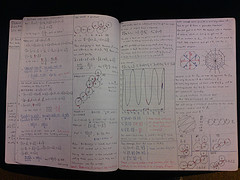
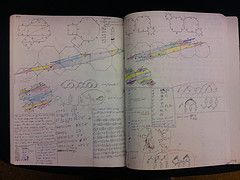
Some pages from Diana’s notebooks

All kinds of mathematicians study math and share it in so many ways. It’s like a never-ending math buffet!

Bon appetit!