Tag Archives: games

Dots-and-Boxes, Choppy Waves, and Psi Day

Welcome to this week’s Math Munch!

And happy Psi Day! But more on that later.

dots

Click to play Dots-and-Boxes!

Recently I got to thinking about the game Dots-and-Boxes. You may already know how to play; when I was growing up, I can only remember tic-tac-toe and hangman as being more common paper and pencil games. If you know how to play, maybe you’d like to try a quick game against a computer opponent? Or maybe you could play a low-tech round with a friend? If you don’t know how to play or need a refresher, here’s a quick video lesson:

In 1946, a first grader in Ohio learned these very same rules. His name was Elwyn Berlekamp, and he went on to become a mathematician and an expert about Dots-and-Boxes. He’s now retired from being a professor at UC Berkeley, but he continues to be very active in mathematical endeavors, as I learned this week when I interviewed him.

Elwyn Berlekamp

Elwyn Berlekamp

In his book The Dots and Boxes Game: Sophisticated Child’s Play, Elwyn shares: “Ever since [I learned Dots-and-Boxes], I have enjoyed recurrent spurts of fascination with this game. During several of these burst of interest, my playing proficiency broke through to a new and higher plateau. This phenomenon seems to be common among humans trying to master any of a wide variety of skills. In Dots-and-Boxes, however, each advance can be associated with a new mathematical insight!”

Elwyn's booklet about Dots-and-Boxes

Elwyn’s booklet about
Dots-and-Boxes

In his career, Elywen has studied many mathematical games, as well as ideas in coding. He has worked in finance and has been involved in mathematical outreach and community building, including involvement with Gathering for Gardner (previously).

Elywn generously took the time to answer some questions about Dots-and-Boxes and about his career as a mathematician. Thanks, Elywn! Again, you should totally check out our Q&A session. I especially enjoyed hearing about Elwyn’s mathematical heros and his closing recommendations to young people.

As I poked around the web for Dots-and-Boxes resources, I enjoyed listening to the commentary of Phil Carmody (aka “FatPhil”) on this high-level game of Dots-and-Boxes. It was a part of a tournament held on a great games website called Little Golem where mathematical game enthusiasts from around the world can challenge each other in tournaments.

What's the best move?A Sam Loyd Dots-and-Boxes Puzzle

What’s the best move?
A Dots-and-Boxes puzzle by Sam Loyd.

And before I move on, here are two Dots-and-Boxes puzzles for you to try out. The first asks you to use the fewest lines to saturate or “max out” a Dots-and-Boxes board without making any boxes. The second is by the famous puzzler Sam Loyd (previously). Can you help find the winning move in The Boxer’s Puzzle?

Next up, check out these fantastic “waves” traced out by “circling” these shapes:
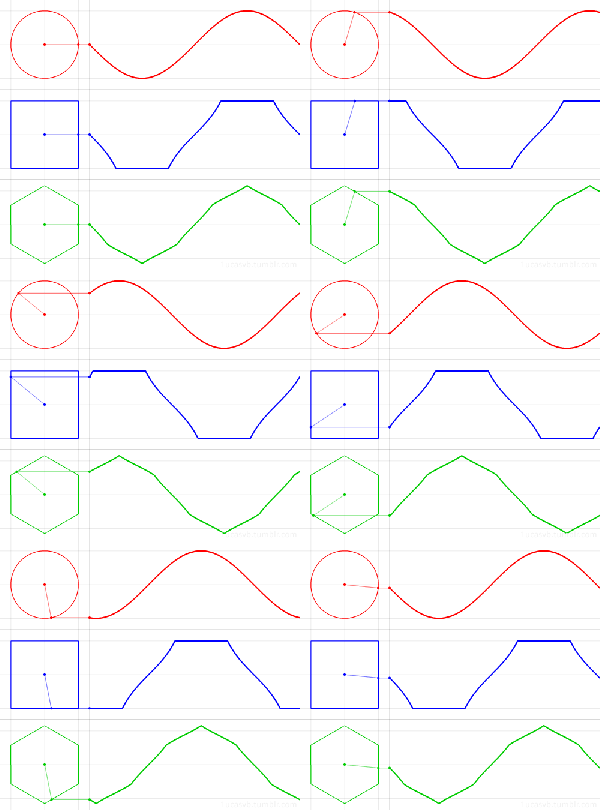
Click the picture to see the animation!

Lucas Vieira—who goes by LucasVB—is 27 years old and is from Brazil. He makes some amazing mathematical illustrations, many of them to illustrate articles on Wikipedia. He’s been sharing them on his Tumblr for just over a month. I’ll let his images and animations speak for themselves—here are a few to get you started!
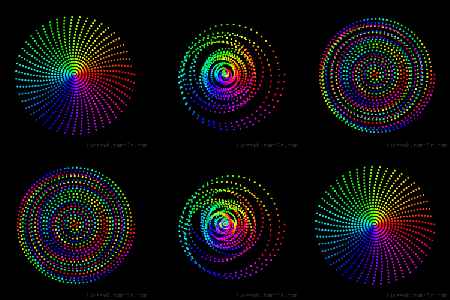
A colored-by-arc-length Archimedean spiral.

A colored-by-arc-length Archimedean spiral.

File:Sphere-like_degenerate_torus

A sphere-like degenerate torus.

A Koch cube.

A Koch cube.

There’s a great write-up about Lucas over at The Daily Dot, which includes this choice quote from him: “I think this sort of animated illustration should be mandatory in every math class. Hopefully, they will be some day.” I couldn’t agree more. Also, Lucas mentioned to me that one of his big influences in making mathematical imagery has always been Paul Nylander. More on Paul in a future post!

Psi is the 23rd letter in the Greek alphabet.

Psi is the 23rd letter in the Greek alphabet.

Finally, today—March 11—is Psi Day! Psi is an irrational number that begins 3.35988… And since March is the 3rd month and today is .35988… of the way through it–11 out of 31 days—it’s the perfect day to celebrate this wonderful number!

What’s psi you ask? It’s the Reciprocal Fibonacci Constant. If you take the reciprocals of the Fibonnaci numbers and add them add up—all infinity of them—psi is what you get.

psisum

Psi was proven irrational not too long ago—in 1989! The ancient irrational number phi—the golden ratio—is about 1.61, so maybe Phi Day should be January 6. Or perhaps the 8th of May—8/5—for our European readers. And e Day—after Euler’s number—is of course celebrated on February 7.

That seems like a pretty good list at the moment, but maybe you can think of other irrational constants that would be fun to have a “Day” for!

And finally, I’m sure I’m not the only one who’d love to see a psi or Fibonacci-themed “Gangham Style” video. Get it?

Bon appetit!

******

EDIT (3/14/13): Today is Pi Day! I sure wish I had thought of that when I was making my list of irrational number Days…
Folds, GIMPS, and More Billiards

Welcome to this week’s Math Munch!

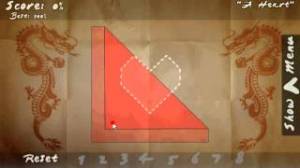
First up, we’ve often featured mathematical constructions made of origami. (Here are some of those posts.) Origami has a careful and peaceful feel to it—a far cry from, say, the quick reflexes often associated with video games. I mean, can you imagine an origami video game?

heartfolds

One of Fold’s many origami puzzles.

Well, guess what—you don’t have to, because Folds is just that! Folds is the creation of Bryce Summer, a 21-year-old game designer from California. It’s so cool. The goal of each level of its levels is simple: to take a square piece of paper and fold it into a given shape. The catch is that you’re only allowed a limited number of folds, so you have to be creative and plan ahead so that there aren’t any loose ends sticking out. As I’ve noted before, my favorite games often require a combo of visual intuition and careful thinking, and Folds certainly fits the bill. Give it a go!

Once you’re hooked, you can find out more about Bryce and how he came to make Folds in this awesome Q&A. Thanks so much, Bryce!

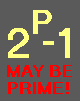
gimpsNext up, did you know that a new largest prime number was discovered less than a month ago? It’s very large—over 17 million digits long! (How many pages would that take to print or write out?) That makes it way larger than the previous record holder, which was “only” about 13 million digits long. Here is an article published on the GIMPS website about the new prime number and about the GIMPS project in general.

What’s GIMPS you ask? GIMPS—the Great Internet Mersenne Primes Search—is an example of what’s called “distributed computing”. Testing whether a number is prime is a simple task that any computer can do, but to check many or large numbers can take a lot of computing time. Even a supercomputer would be overwhelmed by the task all on its own, and that’s if you could even get dedicated time on it. Distributed computing is the idea that a lot of processing can be accomplished by having a lot of computers each do a small amount of work. You can even sign up to help with the project on your own computer. What other tasks might distributed computing be useful for? Searching for aliens, perhaps?

GIMPS searches only for a special kind of prime called Mersenne primes. These primes are one less than a power of two. For instance, 7 is a Mersenne prime, because it’s one less that 8, which is the third power of 2. For more on Mersenne primes, check out this video by Numberphile.

Finally, we’ve previously shared some resources about the math of billiards on Math Munch. Below you’ll find another take on bouncing paths as Michael Moschen combines the math of billiards with the art of juggling.

So lovely. For more on this theme, here’s a second video to check out.

Bon appetit!

Ghost Diagrams, Three New Games, and Scrabble Tiles

Welcome to this week’s Math Munch!

gd0

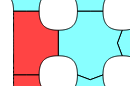
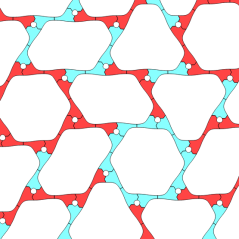
A ghost diagram composed of two different tiles.

An organism is more than the sum of its organs. When the organs are fitted together, the organism becomes something more. This surprising something more we call “spirit” or “ghost”. Ghost Diagrams finds the ghosts implicit in simple sets of tiles.

So writes Paul Harrison, creator of the amazing Ghost Diagram applet. Paul creates all kinds of free software and has his Ph.D. in Computer Science. I found his Ghost Diagram applet through this huge list of links about generative art.

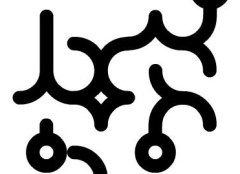
A '111-' tile connected to a '1aA1' tile.

A ‘111-‘ tile connected to a ‘1aA1’ tile.

Given a collection of tile types, the applet tries to find a way to connect them so that no tile has any loose ends. A tile type is specified through a string of letters, numbers, and dashes. Each of these specifies an edge. You can think of a four-character tile as being a modified square and a six-character tile as being a modified hexagon. Two tiles can connect if they have edges that match. Number edges match with themselves—1 matches with 1—while letter edges match with the same letter with opposite capitalization—a matches with A.

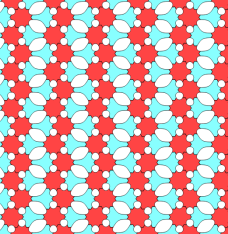
It’s amazing the variety of patterns that can emerge out of a few simple tiles. Here are a couple of ghost diagrams that I created. You can click them to see live versions in the applet. There are many other nice ghost diagrams that Paul has compiled on the site. Also, be sure to check out the random button—it’s a great way to get started on making a pattern of your own. I hope you enjoy tinkering with the ghost diagram applet as much as I have.

gd1 gd3
gd4 gd2

loops-of-zenAnd now for some more fun: three new games! When I ran across Loops of Zen, I had ghost diagrams on my mind. I think they have a similar feel to them. The goal in each level of Loops of Zen is to orient the paths and loops so that they connect up without any loose edges. I feel like this game—like good mathematics—requires both a big-picture, intuitive grasp of the playing field and detailed, logical thinking. Put another way, you need both global strategy  and local tactics. Also, if you like playing Entanglement, then I bet you’ll like Loops of Zen, too.

z-rox

Last week we wrote about Flatland. This book and the movies it inspired describe what it might be like if creatures of different dimensionality were to meet each other. The game Z-Rox puts you in the shoes of a Flatlander. Mystery shapes pass through your field of vision a slice at a time, and it’s up to you to identify what they are. It’s a tricky task that requires a good imagination.

Hat tip to Casual Girl Gamer for both of these great mathy games.

steppin-stones

Steppin’ Stones

Steppin’ Stones is a fun little spatial puzzle game I recently came across. You should definitely check it out. It also provides a nice segue to our last mathy item for the week, because a Steppin’ Stones board looks a lot like a Scrabble board. Scrabble, of course, is a word game. Aside from the arithmetic of keeping score, there isn’t much mathematics involved in playing it. In addition, the universe of Scrabble—the English dictionary—is not particularly elegant from a math standpoint. However, it’s the amazing truth that even in arenas that don’t seem very mathematical, math can often be applied in useful ways.

From a comic about Prime Scrabble on Spiked Math.

From a comic about Prime Scrabble on Spiked Math.

In Re-evaluating the values of the tiles in Scrabble™, the author—who goes by DTC and is a physics graduate student at Cornell—wonders whether the point values assigned to letters in Scrabble are correctly balanced. The basic premise is that the harder a letter is to play, the more it should be worth. DTC does what any good mathematician does—lays out assumptions clearly, reasons from them to make a model, critiques the arguments of others, and of course makes lots of useful calculations. One tool DTC uses is the Monte Carlo method. In the end, DTC finds that the current Scrabble point values are very close to what the model would assign.

MATHI really enjoyed the article, and I hope you will, too. And since Scrabble is a “crossword game”, I think I’ll leave you with a couple of “crossnumber” puzzles. Here are some straightforward ones, while these require a little more thinking.

Have a great week, and bon appetit!

P.S. I can’t resist sharing this video as a bonus: a cellular automaton of rock-paper-scissors! Blue beats green, green beats red, and red beats blue. Hooray for non-transitive swirls!