Tag Archives: origami

Andrew Hoyer, Cameron Browne, & Sphere Inversion

Welcome to this week’s Math Munch! Fractals, origami, math art, games, and a mind-bending video are all ahead, so let’s get into it.

Andrew Hoyer

Andrew Hoyer

First up, let’s take a look at the work of Andrew Hoyer.  According to his website, he’s a “software engineer in his mid-twenties living it up in sometimes sunny San Francisco.” I came across his work when I found his beautiful and completely engaging introduction to simple fractals.  (Go on! Click. Then read, experiment and play!)

Cantor Set

A Cantor set

At the bottom of that page, Andrew links to a wonderful, long list of fractals, arranged by Hausdorff dimension, which is a way of measuring fractals as being something like 2.5 dimensions.  A line is 1 dimensional.  A plane is 2D, and you can find many fractals with dimension in between!!  Weird, right?

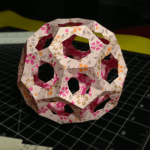
I was also really pleased to find Andrew’s Instagram feed, which features some of his beautiful origami creations.  Andrew’s agreed to answer your questions for an upcoming Q&A, so ask away!

Compound of 5 tetrahedra Truncated Icosahedron Cube Dodecahedron
Cameron Browne

Cameron Browne

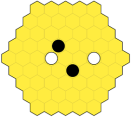
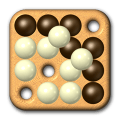
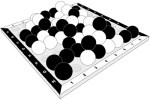
Up next, meet Cameron Browne. He’s an accomplished researcher who designs and studies games. Take a look at the many many games Cameron has created. The rules and descriptions are there, and Cameron sent along links to playable versions of a few, which you can find by clicking the pictures below.  For the third one, you’ll need to search for “Margo” or “Spargo.” For his research, Cameron investigates the possibilities of artificial intelligence, and how a computer can be used to generate games and puzzles.
Yavalath

Yavalath
description

Margo and Spargo

Margo and Spargo
description
description

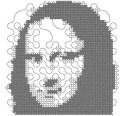
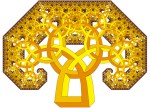
Cameron is also an artist, and he has a page full of his graphic designs.  I found Cameron through his page of Truchet curves.  I love the way his pages are full of diagrams and just enough information to start making sense of things, even if it’s not perfectly clear.  Cameron also has MANY pages of wonderful fractal-ish graphics: Impossible Fractals, Cantor Knots, Fractal Board Games, Woven Horns, Efficient Trees, and on and on…  And he has agreed to do a Q&A with us, so please, submit a question. What are you wondering?

A Cantor Knot

A Cantor Knot

A Truchet curve "Mona Lisa"

A Truchet curve “Mona Lisa”

An "impossible" fractal

An “impossible” fractal

And, as if that wasn’t enough mathy awesomeness, check out this video about turning a sphere inside out.  A bit of personal history, I actually used this video  (though it was only on VHS back then, checked out from the library) as part of the research for my independent research project during my senior year of college.  It gets pretty tricky, but if you watch it all the way through it starts to make some sense.

Have a great week.  Bon appetit!

Reflection sheet – Andrew Hoyer, Cameron Browne, & Sphere Inversion

MoMA, Pop-Up Books, and A Game of Numbers

Welcome to this week’s Math Munch!

Thank you so much to everyone who participated in our Math Munch “share campaign” over the past two weeks. Over 200 shares were reported and we know that even more sharing happened “under the radar”. Thanks for being our partners in sharing great math experiences and curating the mathematical internet.

Of course, we know that the sharing will continue, even without a “campaign”. Thanks for that, too.

All right, time to share some math. On to the post!

N_JoshiTo kick things off, you might like to check out our brand-new Q&A with Nalini Joshi. A choice quote from Nalini:

In contrast, doing math was entirely different. After trying it for a while, I realized that I could take my time, try alternative beginnings, do one step after another, and get to glimpse all kinds of possibilities along the way.

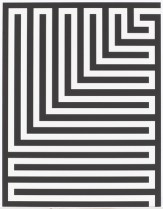
By Philippe Decrauzat.

By Philippe Decrauzat.

I hope the math munches I share with you this week will help you to “glimpse all kinds of possibilities,” too!

Recently I went to the Museum of Modern Art (MoMA) in New York City. (Warning: don’t confuse MoMA with MoMath!) On display was an exhibit called Abstract Generation. You can view the pieces of art in the exhibit online.

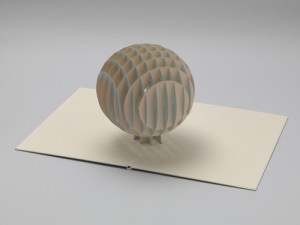
As I browsed the galley, the sculptures by Tauba Auerbach particularly caught my eye. Here are two of the sculptures she had on display at MoMA:

CRI_244599 CRI_244605

Just looking at them, these sculptures are definitely cool. However, they become even cooler when you realize that they are pop-up sculptures! Can you see how the platforms that the sculptures sit on are actually the covers of a book? Neat!

Here’s a video that showcases all of Tauba’s pop-ups in their unfolding glory. Why do you think this series of sculptures is called [2,3]?

This idea of pop-up book math intrigued me, so I started searching around for some more examples. Below you’ll find a video that shows off some incredible geometric pop-ups in action. To see how you can make a pop-up sculpture of your own, check out this how-to video. Both of these videos were created by paper engineer Peter Dahmen.

Taura Auerbach.

Tauba Auerbach.

Tauba got me thinking about math and pop-up books, but there’s even more to see and enjoy on her website! Tauba’s art gives me new ways to connect with and reimagine familiar structures. Remember our post about the six dimensions of color? Tauba created a book that’s a color space atlas! The way that Tauba plays with words in these pieces reminds me both of the word art of Scott Kim and the word puzzles of Douglas Hofstadter. Some of Tauba’s ink-on-paper designs remind me of the work of Chloé Worthington. And Tauba’s piece Componants, Numbers gives me some new insight into Brandon Todd Wilson’s numbers project.

0108 MM MM-Tauba-Auerbach-large

This piece by Tauba is a Math Munch fave!

For me, both math and art are all about playing with patterns, images, structures, and ideas. Maybe that’s why math and art make such a great combo—because they “play” well together!

Speaking of playing, I’d like to wrap up this week’s post by sharing a game about numbers I ran across recently. It’s called . . . A Game of Numbers! I really like how it combines the structure of arithmetic operations with the strategy of an escape game. A Game of Numbers was designed by a software developer named Joseph Michels for a “rapid” game competition called Ludum Dare. Here’s a Q&A Joseph did about the game.

A Game of Numbers.

A Game of Numbers.

If you enjoy A Game of Numbers, maybe you’ll leave Joseph a comment on his post about the game’s release or drop him an email. And if you enjoy A Game of Numbers, then you’d probably enjoy checking out some of the other games on our games page.

Bon appetit!

PS Tauba also created a musical instrument called an auerglass that requires two people to play. Whooooooa!

Reflection Sheet – MoMA, Pop-Up Books, and A Game of Numbers

Prime Gaps, Mad Maths, and Castles

Welcome to this week’s Math Munch!

It has been a thrilling last month in the world of mathematics. Several new proofs about number patterns have been announced. Just to get a flavor for what it’s all about, here are some examples.

I can make 15 by adding together three prime numbers: 3+5+7. I can do this with 49, too: 7+11+31. Can all odd numbers be written as three prime numbers added together? The Weak Goldbach Conjecture says that they can, as long as they’re bigger than five. (video)

11 and 13 are primes that are only two apart. So are 107 and 109. Can we find infinitely many such prime pairs? That’s called the Twin Prime Conjecture. And if we can’t, are there infinitely many prime pairs that are at most, say, 100 apart? (video, with a song!)

Harald Helfgott

Harald Helfgott

Yitang "Tom" Zhang

Yitang “Tom” Zhang

People have been wondering about these questions for hundreds of years. Last month, Harald Helfgott showed that the Weak Goldbach Conjecture is true! And Yitang “Tom” Zhang showed that there are infinitely many prime pairs that are at most 70,000,000 apart! You can find lots of details about these discoveries and links to even more in this roundup by Evelyn Lamb.

What’s been particularly fabulous about Tom’s result about gaps between primes is that other mathematicians have started to work together to make it even better. Tom originally showed that there are an infinite number of prime pairs that are at most 70,000,000 apart. Not nearly as cute as being just two apart—but as has been remarked, 70,000,000 is a lot closer to two than it is to infinity! That gap of 70,000,000 has slowly been getting smaller as mathematicians have made improvements to Tom’s argument. You can see the results of their efforts on the polymath project. As of this writing, they’ve got the gap size narrowed down to 12,006—you can track the decreasing values down the page in the H column. So there are infinitely many pairs of primes that are at most 12,006 apart! What amazing progress!

Two names that you’ll see in the list of contributors to the effort are Andrew Sutherland and Scott Morrison. Andrew is a computational number theorist at MIT and Scott has done research in knot theory and is at the Australian National University. They’ve improved arguments and sharpened figures to lower the prime gap value H. They’ve contributed by doing things like using a hybrid Schinzel/greedy (or “greedy-greedy”) sieve. Well, I know what a sieve is and what a greedy algorithm is, but believe me, this is very complicated stuff that’s way over my head. Even so, I love getting to watch the way that these mathematicians bounce ideas off each other, like on this thread.

Andrew Sutherland

Andrew Sutherland

Click through to see Andrew next to an amazing Zome creation!

Andrew. Click this!

Scott Morrison

Scott Morrison

Andrew and Scott have agreed to answer some of your questions about their involvement in this research about prime gaps and their lives as mathematicians. I know I have some questions I’m curious about! You can submit your questions in the form below:

I can think of only two times in my life where I was so captivated by mathematics in the making as I am by this prime gaps adventure. Andrew Wiles’s proof of Fermat’s Last Theorem was on the fringe of my awareness when it came out in 1993—its twentieth anniversary of his proof just happened, in fact. The result still felt very new and exciting when I read Fermat’s Enigma a couple of years later. Grigori Perelman’s proof of the Poincare Conjecture made headlines just after I moved to New York City seven years ago. I still remember reading a big article about it in the New York Times, complete with a picture of a rabbit with a grid on it.

This work on prime gaps is even more exciting to me than those, I think. Maybe it’s partly because I have more mathematical experience now, but I think it’s mostly because lots of people are helping the story to unfold and we can watch it happen!

fig110u2bNext up, I ran across a great site the other week when I was researching the idea of a “cut and slide” process. The site is called Mad Maths and the page I landed on was all about beautiful dissections of simple shapes, like circles and squares. I’ve picked out one that I find especially charming to feature here, but you might enjoy seeing them all. The site also contains all kinds of neat puzzles and problems to try out. I’m always a fan of congruent pieces problems, and these paper-folding puzzles are really tricky and original. (Or maybe, origaminal!) You’ll might especially like them if you liked Folds.

Christian's applet displaying the original four-room castle.

Christian’s applet displaying the original four-room castle.

Finally, we previously posted about Matt Parker’s great video problem about a princess hiding in a castle. Well, Christian Perfect of The Aperiodical has created an applet that will allow you to explore this problem—plus, it’ll let you build and try out other castles for the princess to hide in. Super cool! Will I ever be able to find the princess in this crazy star castle I designed?!

Crazy star castle!

My crazy star castle!

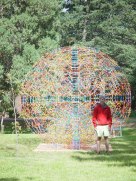
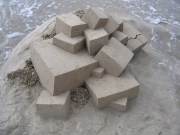
And as summer gets into full swing, the other kind of castle that’s on my mind is the sandcastle. Take a peek at these photos of geometric sandcastles by Calvin Seibert. What shapes can you find? Maybe Calvin’s creations will inspire your next beach creation!

Bon appetit!

167739151_ec142bbfe8 3342635687_f847918e0e 5945114420_c950231830