Welcome to this week’s Math Munch!
Did you see the Google doodle on Monday?
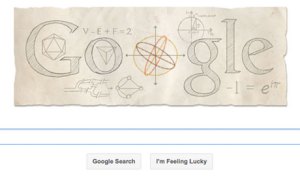 This medley of Platonic solids, graphs, and imaginary numbers honors the birthday of mathematician and physicist Leonhard Euler. (His last name is pronounced “Oiler.” Confusing because the mathematician Euclid‘s name is not pronounced “Oiclid.”) Many mathematicians would say that Euler was the greatest mathematician of all time – if you look at almost any branch of mathematics, you’ll find a significant contribution made by Euler.
 Euler was born on April 15, 1707, and he spent much of his life working as a mathematician for one of the most powerful monarchs ever, Frederick the Great of Prussia. In Euler’s time, the kings and queens of Europe had resident mathematicians, philosophers, and scientists to make their countries more prestigious. The monarchs could be moody, so mathematicians like Euler had to be careful to keep their benefactors happy. (Which, sadly, Euler did not. After almost 20 years, Frederick the Great’s interests changed and he sent Euler away.) But, the academies helped mathematicians to work together and make wonderful discoveries.
Want to read some of Euler’s original papers? Check out the Euler Archive. Here’s a little bit of an essay called, “Discovery of a Most Extraordinary Law of Numbers, Relating to the Sum of Their Divisors,” which you can find under the subject “Number Theory”:
Mathematicians have searched so far in vain to discover some order in the progression of prime numbers, and we have reason to believe that it is a mystery which the human mind will never be able to penetrate… This situation is all the more surprising since arithmetic gives us unfailing rules, by means of which we can continue the progression of these numbers as far as we wish, without however leaving us the slightest trace of any order.
Mathematicians still find this baffling today! If you’re interested in dipping your toes into Euler’s writings, I’d suggest checking out other articles in “Number Theory,” such as “On Amicable Numbers,” or some articles in “Combinatorics and Probability,” like “Investigations on a New Type of Magic Square.”
 Want to work, like Euler did, on important math problems that will stretch you to make connections and discoveries? Check out Project Euler, an online set of math and computer programming problems. You can join the site and, as you work on the problems, talk to other problem-solvers, contribute your solutions, and track your progress. The problems aren’t easy – the first one on the list is, “Find the sum of all the multiples of 3 and 5 below 1000” – but they build on one another (and are pretty fun).
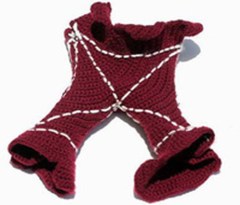
Pants made from a crocheted model of the hyperbolic plane, by Daina Taimina.
Finally, if someone asked you what a pair of pants is, you probably wouldn’t say, “a sphere with three open disks removed.” But maybe you also didn’t know that pants are important mathematical objects!
I ran into a math problem involving pants on Math Overflow (previously). Math Overflow is a site on which mathematicians can ask and answer each other’s questions. The question I’m talking about was asked by Tony Huynh. He knew it was possible to turn pants inside-out if your feet are tied together. (Check out the video below to see it done!) Tony was wondering if it’s possible to turn your pants around, so that you’re wearing them backwards, if your feet are tied together.
Is this possible? Another mathematician answered Tony’s question – but maybe you want to try it yourself before reading about the solution. Answering questions like this about transformations of surfaces with holes in them is part of a branch of mathematics called topology – which Euler is partly credited with starting. A more mathematical way of stating this problem is: is it possible to turn a torus (or donut) with a single hole in it inside-out? Here’s another video, by James Tanton, about turning things inside-out mathematically.
Bon appetit!
 P.S. – The Math Munch team will be speaking next weekend, on April 27th, at TEDxNYED! We’re really excited to get to tell the story of Math Munch on the big stage. Thank you for being such enthusiastic and curious readers and allowing us to share our love of math with you. Maybe we’ll see some of you there!






 Math Munch