Tag Archives: puzzles

Linking Newspaper Rings, Pascal’s Colors, and Poetry of Math

Welcome to this week’s Math Munch!

Here’s something that sounds impossible: turn a single newspaper page into two rings, linked together, using only scissors and folding. No tape, no glue– just folding and a few little cuts.

Want to know how to do it? Check out this video by Mariano Tomatis:

On his website, Mariano calls himself the “Wonder Injector,” a “writer of science with the mission of the magician.” And that video certainly looked like magic! I wonder how the trick works…

Mariano’s website is full of fun videos involving mathe-magical tricks. I like watching them, being completely baffled, and then figuring out how the trick works. Here’s another one that I really like, about a fictional plane saved from crashing. It’s a little creepy.

How does this trick work???

Next up is one of my favorite number pattern — Pascal’s Triangle. Pascal’s Triangle appears all over mathematics– from algebra to combinatorics to number theory.
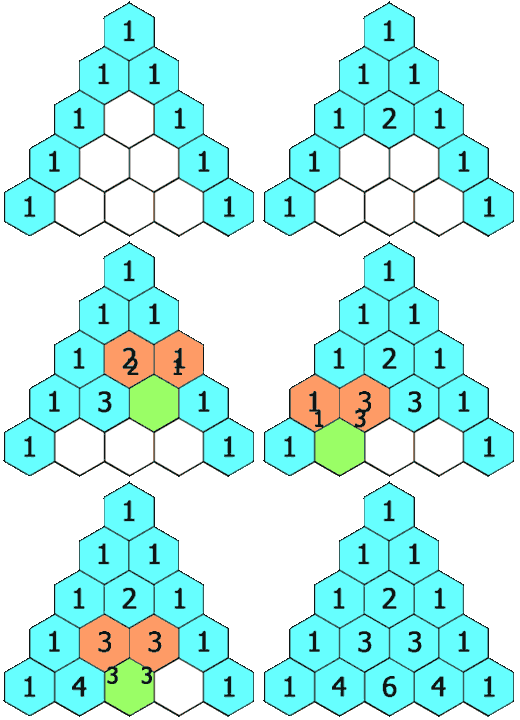
Pascal’s Triangle always starts with a 1 at the top. To make more rows, you add together two numbers next to each other and put their sum between them in the row below. For example, see the two threes beside each other in the fourth row? They add to 6, which is placed between them in the fifth row.

Pascal’s Triangle is full of interesting patterns (what can you find?)– but my favorite patterns appear when you color the numbers according to their factors.

That’s just what Brent Yorgey, computer programmer and author of the blog “The Math Less Travelled,” did! Here’s what you get if you color all of the numbers that are multiples of 2 gray and all of the numbers that aren’t multiples of 2 blue.

Recognize that pattern? It’s a Sierpinski triangle fractal!

If you thought that was cool, check out this one based on what happens if you divide all the numbers in the triangle by 5. The multiples of 5 are gray; the numbers that leave a remainder of 1 when divided by 5 are blue, remainder 2 are red, remainder 3 are yellow, and remainder 4 are green. And here’s one based on what happens if you divide all the numbers in the triangle by 6.

See the yellow Sierpinski triangle below the blue, red, green, and purple pattern? Why might the pattern for multiples of two appear in the triangle colored based on multiples of 6?

If you want to learn more about how Brent made these images and want to see more of them, check out his blog post, “Visualizing Pascal’s Triangle Remainders.”

Finally, I just stumbled across this collection of mathematical poems written by students at Arcadia University, in a class called “Mathematics in Literature.” They’re the result of a workshop led by mathematician and poet Sarah Glaz, who I met this summer at the Bridges Mathematical Art Conference. Sarah gave the students this prompt:

Step1: Brainstorm three recent school or other situations in your

present life – you can just write a few words to reference them.

Step 2: List 10-20 mathematical words you’ve used in class in the
past month.

Step 3: Write about one of the previous situations using as many
of these words as possible. Try to avoid referencing the situation
directly. Write no more than seven words per line.

Here’s one that I like:

ASPARAGUS, by Sarah Goldfarb

An infinity of hunger within me
Dividing a bunch of green
Snap and sizzle,
Green parentheses in a pan
The aromatic property
Simplifying my want
Producing a need
Each fraction of a second
Dragging its feet impatiently as I wait
And when it is distributed on my plate
It is only a moment before zero
Units of nourishment remain.

Maybe you’ll try writing a poem of your own! If you do, we’d love to see it.

Bon appetit!
Isomorphisms in Five, Parquet Deformations, and POW!

Welcome to this week’s Math Munch!

Here’s a catchy little video. It’s called “Isomorphisms in Five.” Can you figure out why? The note posted below the video says:

An isomorphism is an underlying structure that unites outwardly different mathematical expressions. What underlying structure do these figures share? What other isomorphisms of this structure will you discover?

One of the reasons I LOVE this video is because I really like how the shapes change with the music– which is played in a very interesting time signature. I also love how you can learn a lot about the different growing shape patterns by comparing them. Watch how they grow as the video flips from pattern to pattern. What do you notice? What does the music tell you about their growth?

This video is by a math educator from North Carolina named Stuart Jeckel. The only thing written about him on his “About” page is, “The Art of Math”– so he’s a bit of a mystery! He has three more beautiful videos, all of which present little puzzles for you to solve. Check them out!

(Five-four isn’t a common time-signature for music, but it makes some great pieces. Check out this particularly awesome one. Anyone want to try making a growing shape pattern video to this tune?)

parquet-10

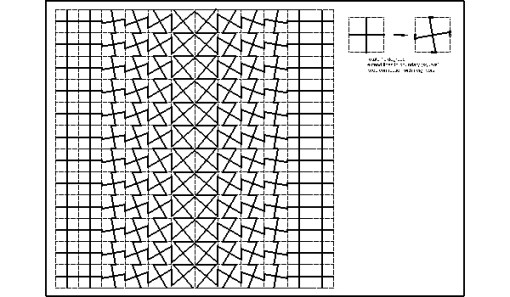
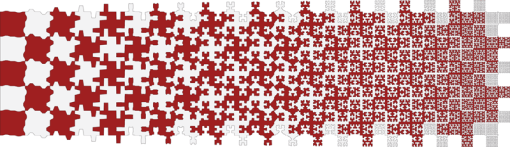
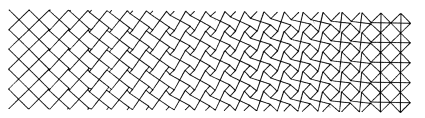
Here is an example of one of my favorite types of geometric patterns– the parquet deformation. To make one, you start with a tessellation. Then you change it- very gradually- until you’ve made a completely different tessellation that’s connected by many tiny steps to the original one.

I love to draw them. It’s challenging, but full of surprises. I never know what it’s going to look like in the end.

2012_10_31-par5Want to try making your own? Check out this site by the professors/architects Tuğrul Yazar and Serkan Uysal. They had one of their classes map out how some different parquet deformations are made. They mostly used computers, but you could follow their instructions by hand, if you like. The image above is a map for the first deformation I showed.

Click on this link to see some awesome deformations made out of tiles. Aren’t they beautiful? And here’s one made by mathematical artist Craig Kaplan. It has a great fractal quality to it:

hilbert_ih62_a

Finally, here’s something I’ve been meaning to share with you for ages! Do you ever crave a good puzzle and aren’t sure where to find one? Look no farther than the Saint Ann’s School Problem of the Week! Each week, math teacher Richard Mann writes a new awesome problem and posts it on this website. Here’s this week’s problem:

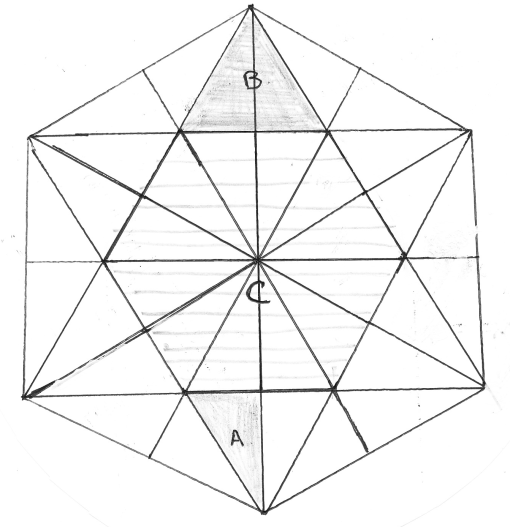
For November 26, 2013– In the picture below, find the shaded right triangle marked A, the equilateral triangle marked B and the striped regular hexagon marked C. Six students make the following statements about the picture below: Anne says “I can find an equilateral triangle three times the area of B.”  Ben says I can find an equilateral triangle four times the area of B.” Carol says, “I can find a find a right triangle triple the area of A.” Doug says, “I can find a right triangle five times the area of A.” Eloise says, “I can find a regular hexagon double the area of C.” Frank says, “I can find a regular hexagon three times the area of C.” Which students are undoubtedly mistaken?

30- 60-90

If you solve this week’s problem, send us a solution!

Bon appetit!

Numenko, Turning Square, and Toilet Paper

Welcome to this week’s Math Munch!

Have you ever played Scrabble or Bananagrams? Can you imagine versions of these games that would use numbers instead of letters?

Meet Tom Lennett, who imagined them and then made them!

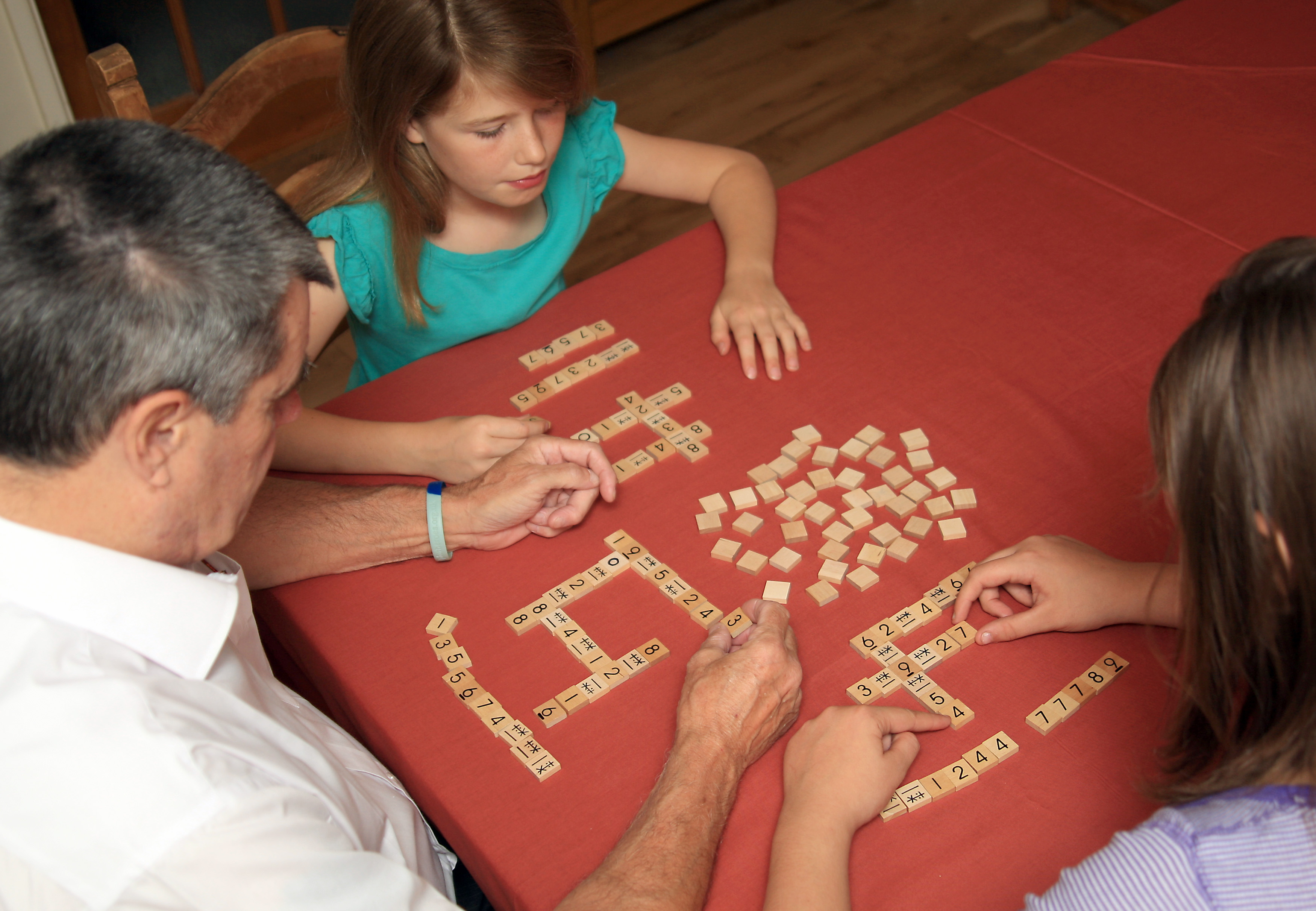
Tom playing Numenko with his grandkids.

Tom playing Numenko with his grandkids.

Numemko is a crossnumber game. Players build up number sentences, like 4×3+8=20, that cross each other like in a crossword puzzle. There is both a board game version of Numenko (like Scrabble) and a bag game version (like Banagrams). Tom invented the board game years ago to help his daughter get over her fear of math. He more recently invented the bag game for his grandkids because they wanted a game to play where they didn’t have to wait their turn!

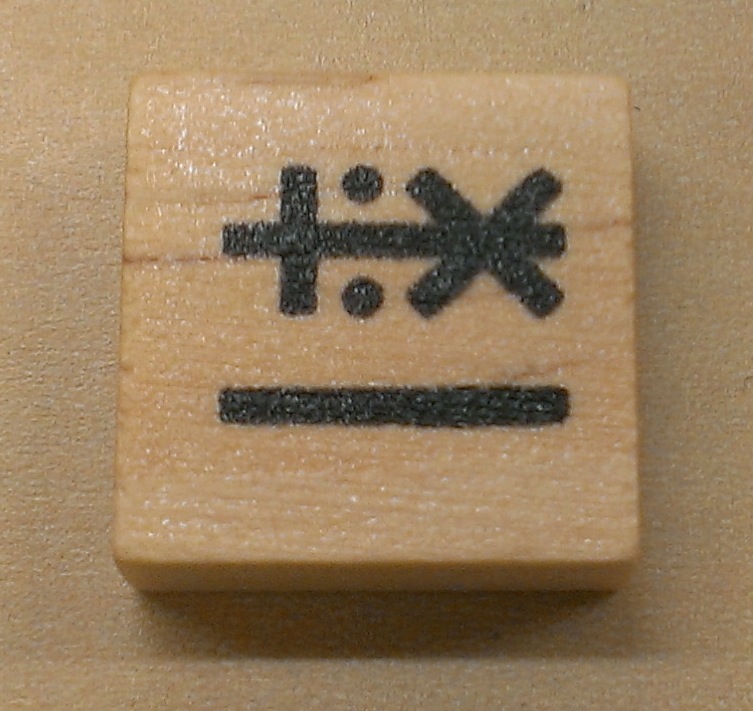
The Multichoice tile.

The Multichoice tile.

One important feature of Numenko is the Multichoice tile. Can you see how it can represent addition, subtraction, multiplication, division, or equality?

How would you like to have a Numenko set of your own? Well, guess what—Tom holds weekly Numenko puzzle competitions with prizes! You can see the current puzzle on this page, as well as the rules. Here’s the puzzle at the time of this post—the week of November 3, 2013.

Can you replace the Multichoice tiles to create a true number sentence?

Challenge: replace the Multichoice tiles to create a true number sentence.

I can assure you that it’s possible to win Tom’s competitions, because one of my students and I won Competition 3! I played my first games of Numenko today and really enjoyed them. I also tried making some Numenko puzzles of my own; see the sheet at the bottom of this post to see some of them.

Tom in 1972.

Tom in 1972.

In emailing with Tom I’ve found that he’s had a really interesting life. He grew up in Scotland and left school before he turned 15. He’s been a football-stitcher, a barber, a soldier, a distribution manager, a paintball site operator, a horticulturist, a property developer, and more. And, of course, also a game developer!

Do you have a question you’d like to ask Tom? Send it in through the form below, and we’ll try to include it in our upcoming Q&A!

leveledit

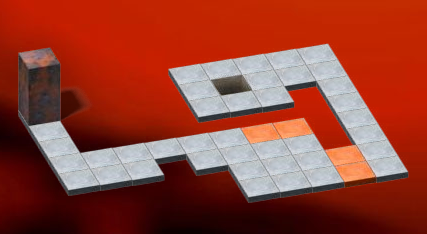
The level editor.

Say, do you like Bloxorz? I sure do—it’s one of my favorite games! So imagine my delight when I discovered that a fan of the game—who goes by the handle Jz Pan—created an extension of it where you can make your own levels. Awesome, right? It’s called Turning Square, and you can download it here.

(You’ll need to uncompress the file after downloading, then open TurningSquare.exe. This is a little more involved than what’s usual here on Math Munch, but I promise it’s worth it! Also, Turning Square has only been developed for PC. Sorry, Mac fans.)

The level!

The level I made!

But wait, there’s more! Turning Square also introduces new elements to Bloxorz, like slippery ice and pyramids you can trip over. It has a random level generator that can challenge you with different levels of difficulty. Finally, Turning Square includes a level solver—it can determine whether a level that you create is possible or not and how many steps it takes to complete.

Jz Pan is from China and is now a graduate student at the Chinese Academy of Sciences, majoring in mathematics and studying number theory. Jz Pan made Turning Square in high school, back in 2008.

Jz Pan has agreed to answer some of your questions! Use the form below to send us some.

If you make a level in Turning Square that you really like, email us the .box file and we can share it with everyone through our new Readers’ Gallery! Here is my level from above, if you want to try it out.

Jz Pan has also worked on an even more ambitious extension of Bloxorz called Turning Polyhedron. The goal is the same, but like the game Dublox, the shape that you maneuver around is different. Turning Polyhderon features several different shapes. Check out this video of it being played with a u-polyhedron!

And if you think that’s wild, check out this video with multiple moving blocks!

Last up this week, have you ever heard that it’s impossible to fold a piece of paper in half more than eight times? Or maybe it’s seven…? Either way, it’s a “fact” that seems to be common knowledge, and it sure seems like it’s true when you try to fold up a standard sheet of paper—or even a jumbo sheet of paper. The stack sure gets thick quickly!

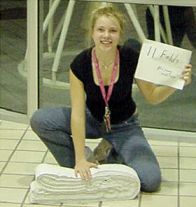
Britney Gallivan and her 11th fold.

Britney and her 11th fold.

Well, here’s a great story about a teenager who decided to debunk this “fact” with the help of some math and some VERY big rolls of toilet paper. Her name is Britney Gallivan. Back in 2001, when she was a junior in high school, Britney figured out a formula for how much paper she’d need in order to fold it in half twelve times. Then she got that amount of paper and actually did it!

Due to her work, Britney has a citation in MathWorld’s article on folding and even her own Wikipedia article. After high school, Britney went on to UC Berkeley where she majored in Environmental Science. I’m trying to get in touch with Britney for an interview—if you have a question for her, hold onto it, and I’ll keep you posted!

EDIT: I got in touch with Britney, and she’s going to do an interview!

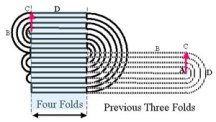
A diagram that illustrates how Britney derived her equation.

A diagram that illustrates how Britney derived her equation.

The best place to read more about Britney’s story in this article at pomonahistorical.org—the historical website of Britney’s hometown. Britney’s story shows that even when everyone else says that something’s impossible, that doesn’t mean you can’t be the one to do it. Awesome.

I hope you enjoy trying some Numenko puzzles, tinkering with Turning Square, and reading about Britney’s toilet paper adventure.

Bon appetit!

PS Want to see a video of some toilet-paper folding? Check out the very first “family math” video by Mike Lawler and his kids.

Reflection Sheet – Numenko, Turning Square, and Toilet Paper