Welcome to this week’s Math Munch!
Before we begin, we’d like to thank all of you who have checked out the site in the past week. Since we’ve kicked off our share campaign, we’ve had so many new visitors and heard from many of them, too! Reading your feedback – whether a recommendation, some praise, a question, or just a brief, “Hello!” – brings us great joy and helps us to know that you all are out there.
Whether you’re a regular reader or visiting the site for the first time, we’d like to ask you for a little favor. If you see some math you like, share it with someone who you think would like it, too! Do you love the burst of excitement that you get from reading about a new mathematical idea, seeing an original piece of math artwork, or trying out a new game? Do you know someone who would love that, too? Then tell them about Math Munch – we’d love to spread the joy.
If you enjoy Math Munch, join in our “share campaign” this week.
You can read more about the share campaign here. There are lots of ways to participate, and you can let us know about your sharing through this form. We’d love to see the share total rise up to 1000 over the course of the next week.
Now for the post!
***
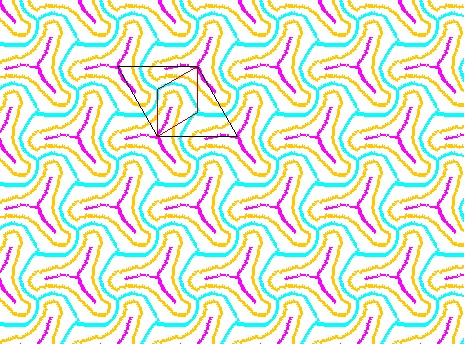
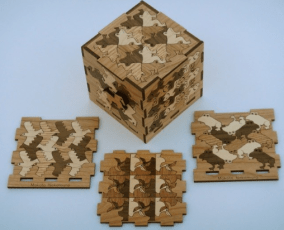 This beautiful tessellated wooden box was made by computer scientist and mathematical artist Kevin Lee. I met Kevin two weeks ago at the MOVES conference (which Justin and Paul have both written about already). Kevin teaches computer science at Normandale Community College in Minnesota. He makes woodcut tessellations (which won an award for the “Best Textile, Sculpture, or Other Medium” at the Joint Mathematics Meetings art exhibition this year!). He’s also used a combination of his knowledge of computer science and his love of Escher-type tessellations to make software that helps you create tessellations. His new software, TesselManiac!, is due out soon (watch this short movie Kevin made about it for the Bridges conference), but you can download an older version of the software here and play a preview version of The Flipping Tile Game.
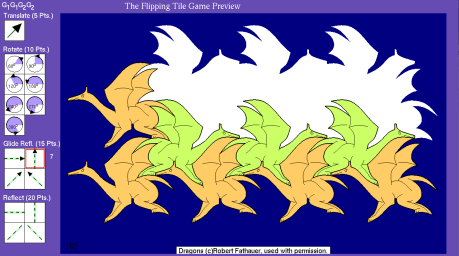
To play this game, you must fill in an outline of a tessellation with the piece given. You can use any of four symmetry motions – translation (or shift), rotation, reflection, or glide reflection (which reflects the tile and then translates it along a line parallel to the line of reflection). You get points for each correct tile placed (and lose points if you have to delete). Translations are the simplest, and only give you 5 points each. Reflections are the most difficult – you get 20 points for each one used!
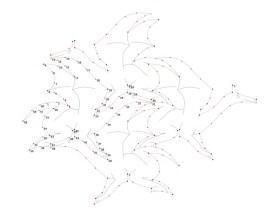 While you’re downloading The Flipping Tile Game, try one of Kevin’s Dot-to-Dot puzzles. These are definitely not your typical dot-to-dot. Only the portion of the image corresponding to one tile in the tessellation is numbered. Once you figure out the shape of that single tile, you have to figure out how to number the rest of the puzzle!
Lucky for us, Kevin has agreed to answer some questions about his life and work as a math artist and computer scientist. Leave a question for Kevin here. (We’ll take questions for the next two weeks.)
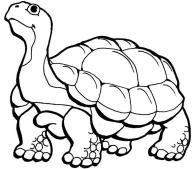 I’ve recently been thinking about a paradox that has puzzled mathematicians for centuries. Maybe you’ve heard of it. It’s one of the ancient Greek philosopher Zeno‘s paradoxes of motion, and it goes like this: Achilles (a really fast Greek hero) and a tortoise are going to run a race. Achilles agrees to give the tortoise a head-start, because the tortoise is so slow. Achilles then starts to run. But as Achilles catches up with the tortoise, the tortoise moves a little further. So the tortoise is still ahead. And as Achilles moves to catch up again, the tortoise moves even further! Sounds like Achilles will never catch up to the tortoise, let alone pass him… But that doesn’t make sense…
Will Achilles lose the race??? Check out this great video from Numberphile that explains both the paradox and the solution.
 While I was looking for information about this paradox, I stumbled across a great math resource site called Platonic Realms. The homepage of this site has a daily historical fact, mathematical quote, and puzzle.
The site hosts a math encyclopedia with explanations of all kinds of math terms and little biographies of famous mathematicians. You can also read “mini-texts” about different mathematical topics, such as this one about M. C. Escher (the inspiration behind the art at the beginning of this post!) or this one about coping with math anxiety.
I hope we here at Math Munch have given you something to tantalize your mathematical taste buds this week! If so, we’d love it if you would pass it along.
Thank you for reading, and bon appetit!
 P.S. – We’ve posted a new game, suggested to us by one of our readers! It’s an online version of Rush Hour. Check it out!






 Math Munch