Tag Archives: video

God’s Number, Chocolate, and Devil’s Number

Welcome to this week’s Math Munch! This week, I’m sharing with you some math things that make me go, “What?!” Maybe you’ll find them surprising, too.

The first time I heard about this I didn’t believe it. If you’ve never heard it, you probably won’t believe it either.

Ever tried to solve one of these? I’ve only solved a Rubik’s cube once or twice, always with lots of help – but every time I’ve worked on one, it’s taken FOREVER to make any progress. Lots of time, lots of moves…. There are 43,252,003,274,489,856,000 (yes, that’s 43 quintillion) different configurations of a Rubik’s cube, so solving a cube from any one of these states must take a ridiculous number of moves. Right?

Nope. In 2010, some mathematicians and computer scientists proved that every single Rubik’s cube – no matter how it’s mixed up – can be solved in at most 20 moves. Because only an all-knowing being could figure out how to solve any Rubik’s cube in 20 moves or less, the mathematicians called this number God’s Number.

Once you get over the disbelief that any of the 43 quintillion cube configurations can be solved in less than 20 moves, you may start to wonder how someone proved that. Maybe the mathematicians found a really clever way that didn’t involve solving every cube?

Not really – they just used a REALLY POWERFUL computer. Check out this great video from Numberphile about God’s number to learn more:
Screen Shot 2013-10-02 at 2.48.01 PM

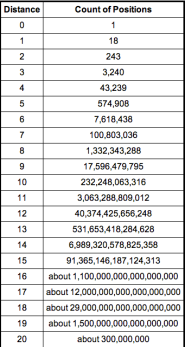
Here’s a chart that shows how many Rubik’s cube configurations need different numbers of moves to solve. I think it’s surprising that so few required all 20 moves. Even though every cube can be solved in 20 or less moves, this is very hard to do. I think it’s interesting how in the video, one of the people interviewed points out that solving a cube in very few moves is probably much more impressive than solving a cube in very little time. Just think – it takes so much thought to figure out how to solve a Rubik’s cube at all. If you also tried to solve it efficiently… that would really be a puzzle.

Next, check out this cool video. Its appealing title is, “How to create chocolate out of nothing.”

This type of puzzle, where area seems to magically appear or disappear when it shouldn’t, is called a geometric vanish. We’ve been talking about these a lot at school, and one of the things we’re wondering is whether you can do what the guy in the video did again, to make a second magical square of chocolate. What do you think?

infinityJHFinally, I’ve always found infinity baffling. It’s so hard to think about. Here’s a particularly baffling question: which is bigger, infinity or infinity plus one? Is there something bigger than infinity?

I found this great story that helps me think about different sizes of infinity. It’s based on similar story by mathematician Raymond Smullyan. In the story, you are trapped by the devil until you guess the devil’s number. The story tells you how to guarantee that you’ll guess the devil’s number depending on what sets of numbers the devil chooses from.

Surprisingly, you’ll be able to guess the devil’s number even if he picks from a set of numbers with an infinite number of numbers in it! You’ll guess his number if he picked from the counting numbers larger than zero, positive or negative counting numbers, or all fractions and counting numbers. You’d think that there would be too many fractions for you to guess the devil’s number if he included those in his set. There are infinitely many counting numbers – but aren’t there even more fractions? The story tells you about a great way to organize your guessing that works even with fractions. (And shows that the set of numbers with fractions AND counting numbers is the same size as the set of numbers with just counting numbers… Whoa.)

Is there something mathematical that makes you go, “What?!” How about, “HUH?!” If so, send us an email or leave us a note in the comments. We’d love to hear about it!

Bon appetit!

Partial Cubes, Open Cubes, and Spidrons

Welcome to this week’s Math Munch!

Recently the videos that Paul and I made about the Yoshimoto Cube got shared around a bit on the web. That got me to thinking again about splitting cubes apart, because the Yoshimoto Cube is made up of two pieces that are each half of a cube.

A part of Wall Drawing #601 by Sol LeWitt

A part of Wall Drawing #601
by Sol LeWitt

A friend of mine once shared with me some drawings of cubes by the artist Sol LeWitt. The cubes were drawn as solid objects, but parts of them were cut away and removed. It was fun trying to figure out what fraction of a cube remained.

On the web, I found a beautiful image that Sol made called Wall Drawing #601. In the clipping of it to the left, I see 7/8 of a cube and 3/4 of a cube. Do you? You can view the whole of this piece by Sol on the website of the Greater Des Moines Public Art Foundation.

The Cube Vinco by Vaclav Obsivac.

The Cube Vinco by Vaclav Obsivac.

There are other kinds of objects that break a cube into pieces in this way, like this tricky puzzle by Vaclav Obsivac and this “shaved” Rubik’s cube modification. Maybe you’ll design a cube dissection of your own!

As I further researched Sol LeWitt’s art, I found that he had investigated partial cubes in other ways, too. My favorite of Sol’s tinkerings is the sculpture installation called “Variations of Incomplete Cubes“. You can check out this piece of artwork on the SFMOMA site, as well as in the video below.

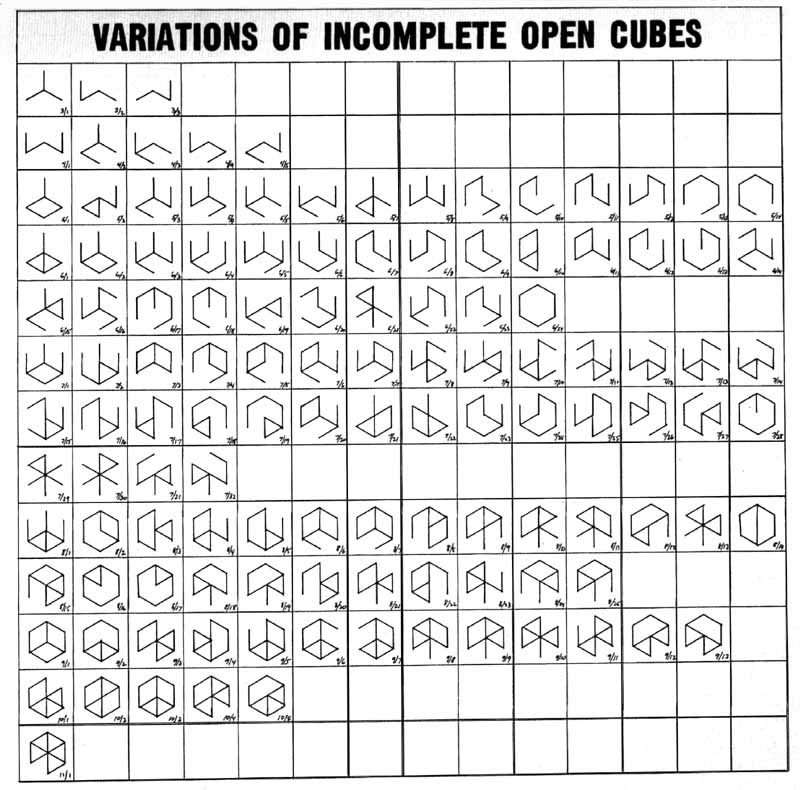
In the video, a diagram appears that Sol made of all of the incomplete open cubes. He carefully listed out and arranged these pictures to make sure that he had found them all—a very mathematical task. It reminds me of the list of rectangle subdivisions I wrote about in this post.

sollewitt_variationsonincompleteopencubes_1974

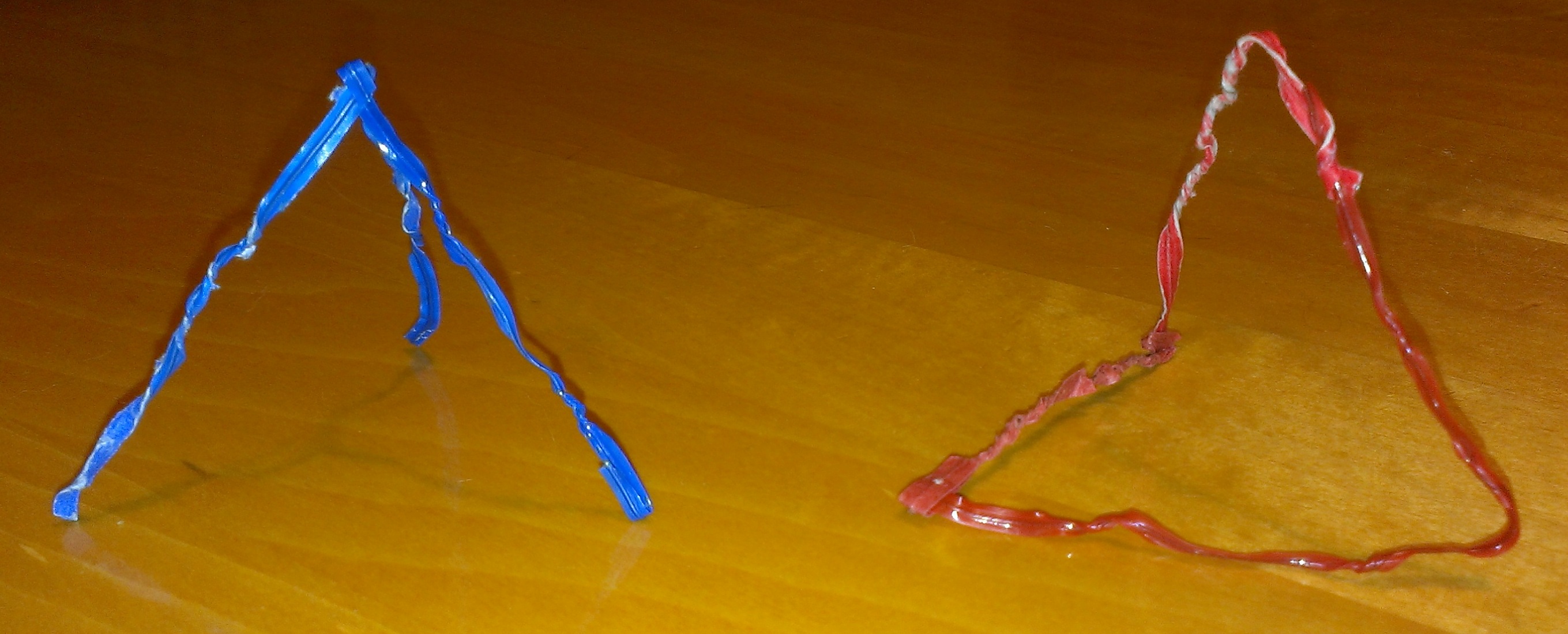
Sol’s diagram got me to thinking and making: what other shapes might have interesting “incomplete open” variations? I started working on tetrahedra. I think I might try to find and make them all. How about you?

Two open tetrahedra I made. Can you find some more?

Two open tetrahedra I made. Can you find some more?

Finally, as I browsed Google Images for “half cube”, one image in particular jumped out at me.

half-cube-newnweb

What are those?!?!

Dániel's original spidron from 1979

Dániel’s original spidron from 1979

These lovely rose-shaped objects are called spidrons—or more precisely, they appear to be half-cubes built out of fold-up spidrons. What are spidrons? I had never heard of them, but there’s one pictured to the right and they have their own Wikipedia article.

The first person who modeled a spidron was Dániel Erdély, a Hungarian designer and artist. Dániel started to work with spidrons as a part of a homework assignment from Ernő Rubik—that’s right, the man who invented the Rubik’s cube.

A cube with spidron faces.

A cube with spidron faces.

Two halves of an icosahedron.

Two halves of an icosahedron.

A hornflake.

A hornflake.

Here are two how-to videos that can help you to make a 3D spidron—the first step to making lovely shapes like those pictured above. The first video shows how to get set up with a template, and the second is brought to you by Dániel himself! Watching these folded spidrons spiral and spring is amazing. There’s more to see and read about spidrons in this Science News article and on Dániel’s website.

And how about a sphidron? Or a hornflake—perhaps a cousin to the flowsnake? So many cool shapes!

To my delight, I found that Dániel has created a video called Yoshimoto Spidronised—bringing my cube splitting adventure back around full circle. You’ll find it below. Bon appetit!

Reflection Sheet – Partial Cubes, Open Cubes, and Spidrons

Polyominoes, Clock Calculator, and Nine Bells

Welcome to this week’s Math Munch!

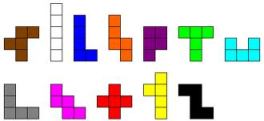
pentominoes!The first thing I have to share with you comes with a story. One day several years ago, I discovered these cool little shapes made of five squares. Maybe you’ve seen these guys before, but I’d never thought about how many different shapes I could make out of five squares. I was trying to decide if I had all the possible shapes made with five squares and what to call them, when along came Justin. He said, “Oh yeah, pentominoes. There’s so much stuff about those.”

Justin proceeded to show me that I wasn’t alone in discovering pentominoes – or any of their cousins, the polyominoes, made of any number of squares. I spent four happy years learning lots of things about polyominoes. Until one day… one of my students asked an unexpected question. Why squares? What if we used triangles? Or hexagons?

pentahexesWe drew what we called polyhexes (using hexagons) and polygles (using triangles). We were so excited about our discoveries! But were we alone in discovering them? I thought so, until…

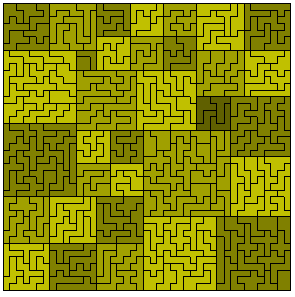
whoa square

A square made with all polyominoes up to heptominoes (seven), involving as many internal squares as possible.

… I found the Poly Pages. This is the polyform site to end all polyform sites. You’ll find information about all kinds of polyforms — whether it be a run-of-the-mill polyomino or an exotic polybolo — on this site. Want to know how many polyominoes have a perimeter of 14? You can find the answer here. Were you wondering if polyominoes made from half-squares are interesting? Read all about polyares.

I’m so excited to have found this site. Even though I have to share credit for my discovery with other people, now I can use my new knowledge to ask even more interesting questions.

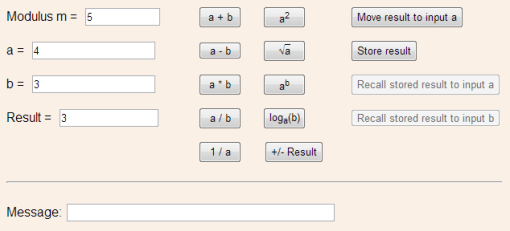
Next up, check out this clock arithmetic calculator. This calculator does addition, subtraction, multiplication, and division, and even more exotic things like square roots, on a clock.

clock calculatorWhat does that mean? Well, a clock only uses the whole numbers 1 through 12. Saying “15 o’clock” doesn’t make a lot of sense (unless you use military time) – but you can figure out what time “15 o’clock” is by determining how much more 15 is than 12. 15 o’clock is 3 hours after 12 – so 15 o’clock is actually 3 o’clock. You can use a similar process to figure out the value of any positive or negative counting number on a 12 clock, or on a clock of any size. This process (called modular arithmetic) can get a bit time consuming (pun time!) – so, give this clock calculator a try!

Finally, here is some wonderful mathemusic by composer Tom Johnson. Tom writes music with underlying mathematics. In this piece (which is almost a dance as well as a piece of music), Tom explores the possible paths between nine bells, hung in a three-by-three square. I think this is an example of mathematical art at its best – it’s interesting both mathematically and artistically. Observe him traveling all of the different paths while listening to the way he uses rhythm and pauses between the phrases to shape the music. Enjoy!

Bon appetit!