Author Archives: Anna Weltman

Isomorphisms in Five, Parquet Deformations, and POW!

Welcome to this week’s Math Munch!

Here’s a catchy little video. It’s called “Isomorphisms in Five.” Can you figure out why? The note posted below the video says:

An isomorphism is an underlying structure that unites outwardly different mathematical expressions. What underlying structure do these figures share? What other isomorphisms of this structure will you discover?

One of the reasons I LOVE this video is because I really like how the shapes change with the music– which is played in a very interesting time signature. I also love how you can learn a lot about the different growing shape patterns by comparing them. Watch how they grow as the video flips from pattern to pattern. What do you notice? What does the music tell you about their growth?

This video is by a math educator from North Carolina named Stuart Jeckel. The only thing written about him on his “About” page is, “The Art of Math”– so he’s a bit of a mystery! He has three more beautiful videos, all of which present little puzzles for you to solve. Check them out!

(Five-four isn’t a common time-signature for music, but it makes some great pieces. Check out this particularly awesome one. Anyone want to try making a growing shape pattern video to this tune?)
parquet-10

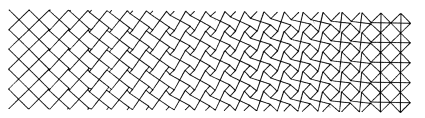
Here is an example of one of my favorite types of geometric patterns– the parquet deformation. To make one, you start with a tessellation. Then you change it- very gradually- until you’ve made a completely different tessellation that’s connected by many tiny steps to the original one.

I love to draw them. It’s challenging, but full of surprises. I never know what it’s going to look like in the end.
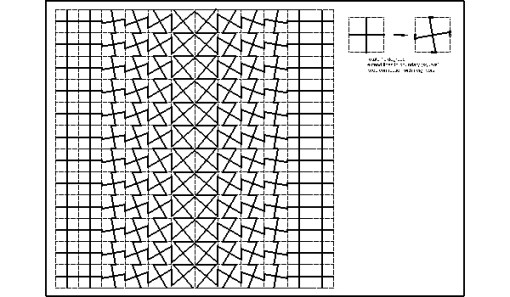
2012_10_31-par5Want to try making your own? Check out this site by the professors/architects Tuğrul Yazar and Serkan Uysal. They had one of their classes map out how some different parquet deformations are made. They mostly used computers, but you could follow their instructions by hand, if you like. The image above is a map for the first deformation I showed.

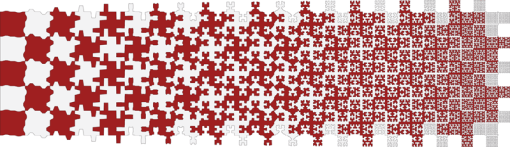
Click on this link to see some awesome deformations made out of tiles. Aren’t they beautiful? And here’s one made by mathematical artist Craig Kaplan. It has a great fractal quality to it:
hilbert_ih62_a

Finally, here’s something I’ve been meaning to share with you for ages! Do you ever crave a good puzzle and aren’t sure where to find one? Look no farther than the Saint Ann’s School Problem of the Week! Each week, math teacher Richard Mann writes a new awesome problem and posts it on this website. Here’s this week’s problem:

For November 26, 2013– In the picture below, find the shaded right triangle marked A, the equilateral triangle marked B and the striped regular hexagon marked C. Six students make the following statements about the picture below: Anne says “I can find an equilateral triangle three times the area of B.”  Ben says I can find an equilateral triangle four times the area of B.” Carol says, “I can find a find a right triangle triple the area of A.” Doug says, “I can find a right triangle five times the area of A.” Eloise says, “I can find a regular hexagon double the area of C.” Frank says, “I can find a regular hexagon three times the area of C.” Which students are undoubtedly mistaken?
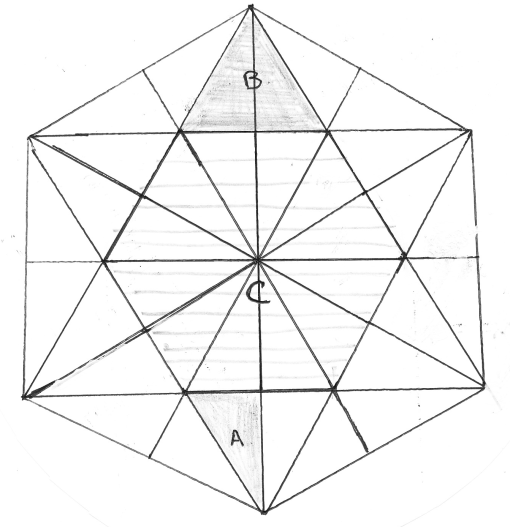
30- 60-90

If you solve this week’s problem, send us a solution!

Bon appetit!

Digital Art, Mastermind, and Pythagoras

Welcome to this week’s Math Munch… on (approximately) Math Munch’s second birthday! Hooray!

Check out this video of mathematical art made by artist Nathan Selikoff:

Cool, right? This piece is called “Beautiful Chaos.” The curves on the screen are made from equations (if you’ve ever graphed a line or a parabola you’ll know what I mean). As the viewer waves her hands around, the equations change– and as the equations change, so do the curves! The result is something that might remind you of the images your computer makes when you play music on it or maybe of something you’d make using a spirograph. All in all, a beautiful and interactive piece of mathematical art.

nathanNathan lives and works as a mathematical artist in Orlando, Florida. As he writes on his website, Nathan uses computer code along with other materials to make art that plays with the mathematical ideas of space, motion, and interaction between objects. To see more of how Nathan does this, check out his giant, interactive marionette or this song that explores the first, second, third, and fourth dimensions:

My school is really lucky to be hosting Nathan this week! We didn’t want any of you, dear readers, to miss out on the excitement, though– so Nathan has kindly agreed to answer your interview questions! Got a question for Nathan? Write it in the box below. He’ll answer seven of your best questions in two weeks!

565px-MastermindNext up, who doesn’t love to play Mastermind? It’s a great combination of logic, patterns, and trickery… but I just hate having to use all those tiny pegs. Well, guess what? You can play it online— no pegs (or opponent) necessary!

As I was playing Mastermind, I started wondering about strategy. What’s the best first guess to make? If I were as smart as a computer, is there a number of guesses in which I could guess any Mastermind code? (This kind of question reminds me of God’s Number and the Rubik’s cube…)

Well, it turns out there is a God’s Number for Mastermind – and that number is five. Just five. If you played perfectly and followed the strategy demonstrated by recreational mathematician Toby Nelson on his website, you could guess ANY Mastermind code in five guesses or less. Toby shares many more interesting questions about Mastermind on his website— I suggest you check it out.

What ARE those irrational numbers, so weird that they get their own bubble??

What ARE those irrational numbers, so weird that they get their own bubble??

Finally, sometime in your mathematical past you may have heard of irrational numbers. These are numbers like the square-root of 2 or pi or e that can’t be written as a fraction– or so people claim. When you start thinking about this claim, however, it may seem strange. There are A LOT of fractions– and none of them equal the square-root of 2? Really? What kind of number is that? It seems like only an irrational person would believe that, at least without proof.

Vi Hart to the rescue! Irrational numbers were encountered long, long ago by the ancient Greek mathematician (and cult leader) Pythagoras– and he didn’t like them much. In this great video, Vi tells all about Pythagoras and the controversial discovery of numbers that aren’t fractions.

If you didn’t follow her explanation of why the square-root of 2 is irrational on your first watch, don’t worry– it’s a complicated idea that’s worth a second (or third or fourth) run-through.

Thanks for a great two years of Math Munch! Bon appetit!

God’s Number, Chocolate, and Devil’s Number

Welcome to this week’s Math Munch! This week, I’m sharing with you some math things that make me go, “What?!” Maybe you’ll find them surprising, too.

The first time I heard about this I didn’t believe it. If you’ve never heard it, you probably won’t believe it either.

Ever tried to solve one of these? I’ve only solved a Rubik’s cube once or twice, always with lots of help – but every time I’ve worked on one, it’s taken FOREVER to make any progress. Lots of time, lots of moves…. There are 43,252,003,274,489,856,000 (yes, that’s 43 quintillion) different configurations of a Rubik’s cube, so solving a cube from any one of these states must take a ridiculous number of moves. Right?

Nope. In 2010, some mathematicians and computer scientists proved that every single Rubik’s cube – no matter how it’s mixed up – can be solved in at most 20 moves. Because only an all-knowing being could figure out how to solve any Rubik’s cube in 20 moves or less, the mathematicians called this number God’s Number.

Once you get over the disbelief that any of the 43 quintillion cube configurations can be solved in less than 20 moves, you may start to wonder how someone proved that. Maybe the mathematicians found a really clever way that didn’t involve solving every cube?

Not really – they just used a REALLY POWERFUL computer. Check out this great video from Numberphile about God’s number to learn more:

Screen Shot 2013-10-02 at 2.48.01 PM

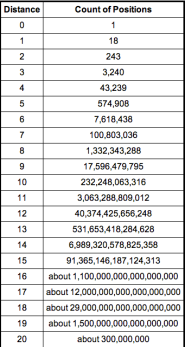
Here’s a chart that shows how many Rubik’s cube configurations need different numbers of moves to solve. I think it’s surprising that so few required all 20 moves. Even though every cube can be solved in 20 or less moves, this is very hard to do. I think it’s interesting how in the video, one of the people interviewed points out that solving a cube in very few moves is probably much more impressive than solving a cube in very little time. Just think – it takes so much thought to figure out how to solve a Rubik’s cube at all. If you also tried to solve it efficiently… that would really be a puzzle.

Next, check out this cool video. Its appealing title is, “How to create chocolate out of nothing.”

This type of puzzle, where area seems to magically appear or disappear when it shouldn’t, is called a geometric vanish. We’ve been talking about these a lot at school, and one of the things we’re wondering is whether you can do what the guy in the video did again, to make a second magical square of chocolate. What do you think?

infinityJHFinally, I’ve always found infinity baffling. It’s so hard to think about. Here’s a particularly baffling question: which is bigger, infinity or infinity plus one? Is there something bigger than infinity?

I found this great story that helps me think about different sizes of infinity. It’s based on similar story by mathematician Raymond Smullyan. In the story, you are trapped by the devil until you guess the devil’s number. The story tells you how to guarantee that you’ll guess the devil’s number depending on what sets of numbers the devil chooses from.

Surprisingly, you’ll be able to guess the devil’s number even if he picks from a set of numbers with an infinite number of numbers in it! You’ll guess his number if he picked from the counting numbers larger than zero, positive or negative counting numbers, or all fractions and counting numbers. You’d think that there would be too many fractions for you to guess the devil’s number if he included those in his set. There are infinitely many counting numbers – but aren’t there even more fractions? The story tells you about a great way to organize your guessing that works even with fractions. (And shows that the set of numbers with fractions AND counting numbers is the same size as the set of numbers with just counting numbers… Whoa.)

Is there something mathematical that makes you go, “What?!” How about, “HUH?!” If so, send us an email or leave us a note in the comments. We’d love to hear about it!

Bon appetit!