Author Archives: Anna Weltman

“Happy Birthday, Euler!”, Project Euler, and Pants

Welcome to this week’s Math Munch!

Did you see the Google doodle on Monday?
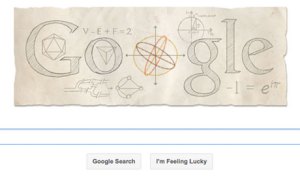
Leonhard Euler Google doodleThis medley of Platonic solids, graphs, and imaginary numbers honors the birthday of mathematician and physicist Leonhard Euler. (His last name is pronounced “Oiler.” Confusing because the mathematician Euclid‘s name is not pronounced “Oiclid.”) Many mathematicians would say that Euler was the greatest mathematician of all time – if you look at almost any branch of mathematics, you’ll find a significant contribution made by Euler.

480px-Leonhard_Euler_2Euler was born on April 15, 1707, and he spent much of his life working as a mathematician for one of the most powerful monarchs ever, Frederick the Great of Prussia. In Euler’s time, the kings and queens of Europe had resident mathematicians, philosophers, and scientists to make their countries more prestigious.  The monarchs could be moody, so mathematicians like Euler had to be careful to keep their benefactors happy. (Which, sadly, Euler did not. After almost 20 years, Frederick the Great’s interests changed and he sent Euler away.) But, the academies helped mathematicians to work together and make wonderful discoveries.

Want to read some of Euler’s original papers? Check out the Euler Archive. Here’s a little bit of an essay called, “Discovery of a Most Extraordinary Law of Numbers, Relating to the Sum of Their Divisors,” which you can find under the subject “Number Theory”:

Mathematicians have searched so far in vain to discover some order in the progression of prime numbers, and we have reason to believe that it is a mystery which the human mind will never be able to penetrate… This situation is all the more surprising since arithmetic gives us unfailing rules, by means of which we can continue the progression of these numbers as far as we wish, without however leaving us the slightest trace of any order.

Mathematicians still find this baffling today! If you’re interested in dipping your toes into Euler’s writings, I’d suggest checking out other articles in “Number Theory,” such as “On Amicable Numbers,” or some articles in “Combinatorics and Probability,” like “Investigations on a New Type of Magic Square.”

pe_banner_lightWant to work, like Euler did, on important math problems that will stretch you to make connections and discoveries? Check out Project Euler, an online set of math and computer programming problems. You can join the site and, as you work on the problems, talk to other problem-solvers, contribute your solutions, and track your progress. The problems aren’t easy – the first one on the list is, “Find the sum of all the multiples of 3 and 5 below 1000” – but they build on one another (and are pretty fun).

pants200-8bb43915cd34ea1718d8fe4716cf33c5e60a5a2d-s3

Pants made from a crocheted model of the hyperbolic plane, by Daina Taimina.

Finally, if someone asked you what a pair of pants is, you probably wouldn’t say, “a sphere with three open disks removed.” But maybe you also didn’t know that pants are important mathematical objects!

I ran into a math problem involving pants on Math Overflow (previously). Math Overflow is a site on which mathematicians can ask and answer each other’s questions. The question I’m talking about was asked by Tony Huynh. He knew it was possible to turn pants inside-out if your feet are tied together. (Check out the video below to see it done!) Tony was wondering if it’s possible to turn your pants around, so that you’re wearing them backwards, if your feet are tied together.

Is this possible? Another mathematician answered Tony’s question – but maybe you want to try it yourself before reading about the solution. Answering questions like this about transformations of surfaces with holes in them is part of a branch of mathematics called topology – which Euler is partly credited with starting. A more mathematical way of stating this problem is: is it possible to turn a torus (or donut) with a single hole in it inside-out? Here’s another video, by James Tanton, about turning things inside-out mathematically.

Bon appetit!

MMteam-240x240P.S. – The Math Munch team will be speaking next weekend, on April 27th, at TEDxNYED! We’re really excited to get to tell the story of Math Munch on the big stage. Thank you for being such enthusiastic and curious readers and allowing us to share our love of math with you. Maybe we’ll see some of you there!


Maths Ninja, Folding Fractals, and Pi Fun

Welcome to this week’s Math Munch!

ninjaFirst up, have you ever been stuck on a gnarly math problem and wished that a math ninja would swoop in and solve the problem before it knew what hit it?  Have you ever wished that you had a math dojo who would impart wisdom to you in cryptic but, ultimately, extremely timely and useful ways?  Well, meet Colin Beverige, a math (or, as he would say, maths) tutor from England who writes a fun blog called Flying Colours Maths.  On his blog, he publishes a weekly series called, “Secrets of the Mathematical Ninja,” in which the mathematical ninja (maybe Colin himself?  He’s too stealthy to tell)  imparts nuggets of sneaky wisdom to help you take down your staunchest math opponent.

colin_bridgeFor example, you probably know the trick for multiplying by 9 using your fingers – but did you know that there’s a simple trick for dividing by 9, too?  Ever wondered how to express thirteenths as decimals, in your head?  (Probably not, but maybe you’re wondering now!)  Want to know how to simplify fractions like a ninja?  Well, the mathematical ninja has the answers – and some cute stories, too.  Check it out!

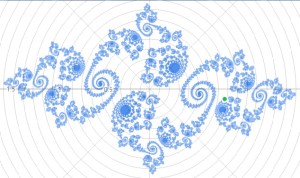
A picture of the Julia set.

A picture of a Julia set.

Next, I find fractals fascinating, but – I’ll admit it – I don’t know much about them.  I do know a little about the number line and graphing, though.  And that was enough to learn a lot more about fractals from this excellent post on the blog Hackery, Math, and Design by Steven Wittens.  In the post How to Fold a Julia Fractal, Steven describes how the key to understanding fractals is understanding complex numbers, which are the numbers we get when we combine our normal numbers with imaginary numbers.

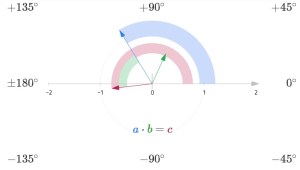
complex multiplicationNow, I think imaginary numbers are some of the most interesting numbers in mathematics – not only because they have the enticing name “imaginary,” but because they do really cool things and have some fascinating history behind them.  Steven does a really great job of telling their history and showing the cool things they do in this post.  One of the awesome things that imaginary numbers do is rotate.  Normal numbers can be drawn on a line – and multiplying by a negative number can be thought of as changing directions along the number line.  Steven uses pictures and videos to show how multiplying by an imaginary number can be thought of as rotating around a point on a plane.

here comes the julia set

A Julia set in the making.

The Julia set fractal is generated by taking complex number points and applying a function to them that squares each point and adds some number to it.  The fractal is the set of points that don’t get infinitely larger and larger as the function is applied again and again.  Steven shows how this works in a series of images.  You can watch the complex plane twist around on itself to make the cool curves and figures of the Julia set fractal.

Steven’s blog has many more interesting posts.  Check out another of my favorites, To Infinity… and Beyond! for an exploration of another fascinating, but confusing, topic – infinity.

Finally, a Pi Day doesn’t go by without the mathematicians and mathematical artists of the world putting out some new Pi Day videos!  Pi Day was last Thursday (3/14, of course).  Here’s a video from Numberphile in which Matt Parker calculates pi using pies!

In this video, also from Numberphile, shows how you only need 39 digits of pi to make really, really accurate measurements for the circumference of the observable universe:

Finally, it wouldn’t be Pi Day without a pi video from Vi Hart.  Here’s her contribution for this year:

Bon appetit!

Marjorie Rice, Inspired by Math, and Subways

Welcome to this week’s Math Munch!

A few weeks ago, I learned about an amazing woman named Marjorie Rice.  Marjorie is a mathematician – but with a very unusual background.

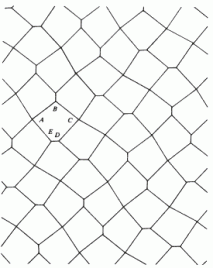
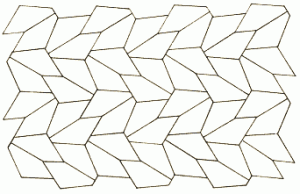
mrice_picMarjorie had no mathematical education beyond high school.  But, Marjorie was always interested in math.  When her children were all in school, Marjorie began to read about and work on math problems for fun.  Her son had a subscription to Scientific American, and Marjorie enjoyed reading articles by Martin Gardner (of hexaflexagon fame).  One day in 1975, she read an article that Martin Gardner wrote about a new discovery about pentagon tessellations.  Before several years earlier, mathematicians had believed that there were only five different types of pentagons that could tessellate – or cover the entire plane without leaving any gaps.   But, in 1968, three more were discovered, and, in 1975, a fourth was found – which Martin Gardner reported on in his article.

Marjorie's first type of pentagonWhen she read about this, Marjorie became curious about whether she could find her own new type of pentagon that could tile the plane.  So, she got to work.  She came up with her own notation for the relationships between the angles in her pentagons.  Her new notation helped her to see things in ways that professional mathematicians had overlooked.  And, eventually… she found one!  Marjorie wrote to Martin Gardner to tell him about her discovery.  By 1977, Marjorie had discovered three more types of pentagons that tile the plane and her new friend, the mathematician Doris Schattschneider, had published an article about Marjorie’s work  in Mathematics Magazine.

type11There are now fourteen different types of pentagons known to tile the plane… but are there more?  No one knows for sure.  Whether or not there are more types of pentagons that tile the plane is what mathematicians call an open problem.  Maybe you can find a new one – or prove that one can’t be found!

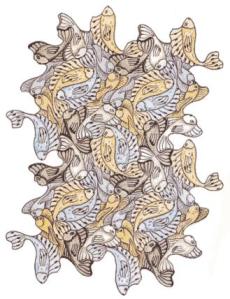
Marjorie has a website called Intriguing Tessellations on which she’s written about her work and posted some of her tessellation artwork.  Here is one of her pentagon tilings transformed into a tessellation of fish.

fishgrid fishsm

By the way, it was Marjorie’s birthday a few weeks ago.  She just turned 90 years old.  Happy Birthday, Marjorie!

wild about math logoNext up, I just ran across a great blog called Wild About Math!  This blog is written by Sol Lederman, who used to work with computers and LOVES math.  My favorite part about this blog is a series of interviews that Sol calls, “Inspired by Math.”  Sol has interviewed about 23 different mathematicians, including Steven Strogatz (who has written two series of columns for the New York Times about mathematics) and Seth Kaplan and Deno Johnson, the producer and writer/director of the Flatland movies.  You can listen to Sol’s podcasts of these interviews by visiting his blog or iTunes.  They’re free – and very interesting!

subway map 2Finally, what New York City resident or visitor isn’t fascinated by the subway system? And what New York City resident or visitor doesn’t spend a good amount of time thinking about the fastest way to get from point A to point B?  Do you stay on the same train for as long as possible and walk a bit?  Or do you transfer, and hope that you don’t miss your train?

chris and matt

Chris and Matt, on the subway.

Well, in 2009, two mathematicians from New York – Chris Solarz and Matt Ferrisi – used a type of mathematics called graph theory to plan out the fastest route to travel the entire New York City subway system, stopping at every station.  They did the whole trip in less than 24 hours, setting a world record!  Graph theory is the branch of mathematics that studies the connections between points or places.  In their planning, Chris and Matt used graph theory to find a route that had the most continuous travel, minimizing transfers, distance, and back-tracking.  You can listen to their fascinating story in an interview with Chris and Matt done by the American Mathematical Society here.

If you’re interested in how graph theory can be used to improve the efficiency of a subway system, check out this article about the Berlin subway system (the U-bahn).  Students and professors from the Technical University Berlin used graph theory to create a schedule that minimized transfer time between trains.  If only someone would do this in New York…

Bon appetit!