Category Archives: Math Munch

Continents, Math Explorers’ Club, and “I use math for…”

Welcome to this week’s Math Munch!

stevestrogatz

Steven Strogatz.

All of our munches this week come from the recent tweets of mathematician, author, and friend of the blog Steven Strogatz. Steve works at Cornell University as an applied mathematician, tackling questions like “If people shared taxis with strangers, how much money could be saved?” and “What caused London’s Millennium Bridge to wobble on its opening day?”

On top of his research, Steve is great at sharing math with others. (This week I learned one great piece of math from him, and then another, and suddenly there was a very clear theme to my post!) Steve has written for the New York Times and was recently awarded the Lewis Thomas Prize as someone “whose voice and vision can tell us about science’s aesthetic and philosophical dimensions, providing not merely new information but cause for reflection, even revelation.”

NMFLogo_Horiz_RGB_300DPI2This Saturday, Steve will be presenting at the first-ever National Math Festival. The free and fun main event is at the Smithsonian in Washington, DC, and there are related math events all around the country this weekend. Check and see if there’s one near you!

Here are a few pieces of math that Steve liked recently. I liked them as well, and I hope you will, too.

First up, check out this lovely image:

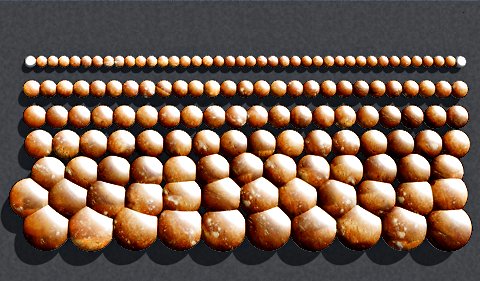
tesselation1-blog480It appeared on Numberplay and was created by Hamid Naderi Yeganeh, a student at University of Qom in Iran. Look at the way the smaller and smaller tiles fit together to make the design. It’s sort of like a rep-tile, or this scaly spiral. And do those shapes look familiar? Hamid was inspired by the shapes of the continents of Africa and South America (if you catch my continental drift). Maybe you can create your own Pangaea-inspired tiling.

If you think that’s cool, you should definitely check out Numberplay, where there’s a new math puzzle to enjoy each week!

Next, up check out the Math Explorers’ Club, a collection of great math activities for people of all ages. The Club is a project of Cornell University’s math department, where Steve teaches.

The first item every sold on the auction site eBay. Click through for the story!

The first item every sold on the auction site eBay. Click through for the story!

One of the bits of math that jumped out to me was this page about auctions. There’s so much strategy and scheming that’s involved in auctions! I remember being blown away when I first learned about Vickrey auctions, where the winner pays not what they bid but what the second-highest bidder did!

If auctions aren’t your thing, there’s lots more great math to browse at the Math Explorer’s Club—everything from chaos and fractals to error correcting codes. Even Ehrenfeucht-Fraïssé games, which are brand-new to me!

And finally this week: have you ever wondered “What will I ever use math for?” Well, SIAM—the Society for Industrial and Applied Mathematics—has just the video for you. They asked people attending one of their meetings to finish the sentence, “I use math for…”. Here are 32 of their answers in just 60 seconds.

Thanks for sharing all this great math, Steve! And bon appetit, everyone!

The Colorspace Atlas, allRGB, and Hyperbolic Puzzles

Welcome to this week’s Math Munch!

Update: A few weeks ago we met Dearing Wang, mathematical artist and creator of Dearing Draws. Now you can read a Math Munch Q&A with Dearing Wang.

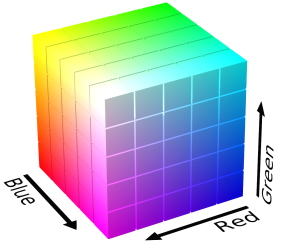
OK, first up in this week’s post, do you remember when we talked about the six dimensions of color and the RGB color system? Well either way, consider this:

color-4

Artist Tauba Auerbach (one of my absolute favorite contemporary artists) made a book that contains every possible color!!! Tauba calls it “The RGB Colorspace Atlas.” The book is a perfect 8″ by 8″ by 8″ cube, matching the classic RGB color cube.

RGB_Cube_Show_lowgamma_cutout_aThe primary colors of light (red, blue, and green) increase as you move in each of the three directions. This leaves white and black at opposite corners of the cube, and all the wonderful colors spread around throughout the cube, with the primary and secondary colors on the other corners. You can read more here, if you like.

The book shows cross-sections moving through a single axis, so Tauba really had 3 choices for how the pages should flip through the cube. In fact, she made all three books!  Jonathan Turner made simulations of all three axes however, so we can see each one if we like. Can you tell which one is open in the pictures above?

That’s the Red Axis. Compare that to the Green Axis and Blue Axis.

For computer graphics, RGB color codes are ordered triples of numbers like (120, 15, 28). Each number says how much of each color should be included in the mix.  There are 256 possible values for each one, with values from 0 to 255. [Examples: (0,0,0) is black. (255,255,255) is white.  (255,0,0) is red. (127,0,0) is a red that’s half as bright.] Since there are only so many number combinations, computers have exactly 16,777,216 possible colors. That’s where allRGB comes in.

starry-night

Starry Night

hilbert

Hilbert Coloring

escher-reptiles

Escher LIzards

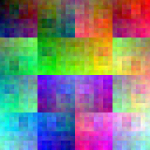
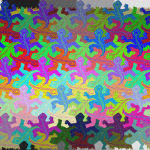
As they say, “The objective of allRGB is simple: To create images with one pixel for every RGB color (16777216); not one color missing, and not one color twice.” AllRGB is a bounded concept, since there are only finitely many ways to rearrange those 16777216 pixels. But of course there are a HUUUUGGGEEEE number of ways to rearrange them, so there’s lots to see. (In fact if you wrote a 1 with 100 million zeroes after it, that number would still be smaller than the number of allRGB pictures!! And that’s only part of the story)  Click the pictures above for zoomable versions as well as descriptions of their creation.

hyperbolic maze 1 hyperbolic maze

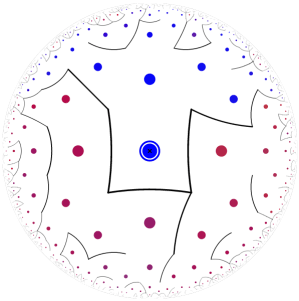
We’ve posted a little before about hyperbolic geometry. Very very briefly, the hyperbolic plane is a 2D surface where some of our usual intuition gets a little warped. For example, two lines can be parallel to the same line but not parallel to each other, which seems a little awkward. Click the images above to really experience what it’s like to walk through a hyperbolic world. David Madore created these hyperbolic “mazes,” which give you a birds eye view as you walk through a strange new land.

Finally, you might enjoy this old Numberplay puzzle with a hyperbolic feel, based on the movements of whales.

Gary Antonick asks "What is the fewest-bun path between the two white buns? (The two white buns are the first and last — or 40th — buns in the top row."

Gary Antonick asks “What is the fewest-bun path between the two white buns? (The two white buns are the first and last — or 40th — buns in the top row.”

What do buns have to do with whales and hyperbolic geometry? You’ll just have to click and find out.

Have a great week and bon appetit!

Sphericon, National Curve Bank, and Cardioid String Art

Welcome to this week’s Math Munch!

Behold the Sphericon!

What is that? Well, it rolls like a sphere, but is made of two cones attached with a twist– hence, the spheri-con! The one in the video is made out of pie (not sure why…), but you can make sphericons out of all kinds of materials.

Wooden sphericonIt was developed by a few people at different times– like many brilliant new objects. But it entered the world of math when mathematician Ian Stewart wrote about it in his column in Scientific American. The wooden sphericon was made by Steve Mathias, an engineer from Sacramento, California, who read Ian’s article and thought sphericons would be fun to make. To learn more about how Steve made those beautiful wooden sphericons, check out his site!

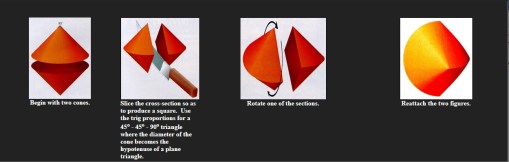
Even if you’re not a woodworker, like Steve, you can still make your own sphericon. You can start with two cones and make one this way, by attaching the cones at their bases, slicing the whole thing in half, rotating one of the halves 90 degrees, and attaching again:How to make a sphericon

Or you can print out this image, cut it out, fold it up, and glue (click on the image for a larger printable size):

Sphericon pattern

If you do make your own sphericon (which I recommend, because they’re really cool), watch the path it makes as it rolls. See how it wiggles? What shape do you think the path is?

ncbmastertitleI found out about the sphericon while browsing through an awesome website– the National Curve Bank. It’s just what it sounds like– an online bank full of curves! You can even make a deposit– though, unlike a real bank, you can take out as many curves as you like. The goal of the National Curve Bank is to provide great pictures and animations of curves that you’d never find in a normal math book. Think of how hard it would be to understand how a sphericon works if you couldn’t watch a video of it rolling?

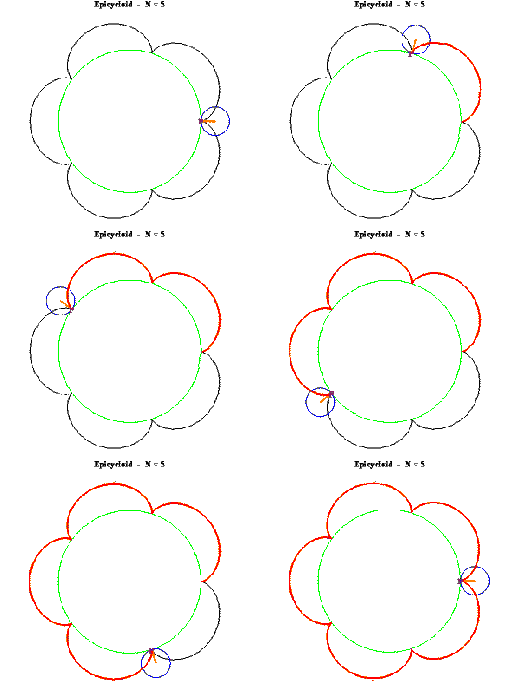
epicycloidaThere are lots of great animations of curves and other shapes in the National Curve Bank– like the sphericon! Another of my favorites is the “cycloid family.” A cycloid is the curve traced by a point on a circle as the circle rolls– like if you attached a pen to the wheel of your bike and rode it next to a wall, so that the pen drew on the wall. It’s a pretty cool curve– but there are lots of other related curves that are even cooler. The epicycloid (image on the right) is the curve made by the pen on your bike wheel if you rode the bike around a circle. Nice!

You should explore the National Curve Bank yourself, and find your own favorite curve! Let us know in the comments if you find one you like.

String cardioid

String art cardioid

Finally, to round out this week’s post on circle-y curves (pun intended), check out another of my favorite curves– the cardioid. A cardioid looks like a heart (hence the name). There are lots of ways to make a cardioid (some of which we posted about for Valentine’s Day a few years ago). But my favorite way is to make it out of string!

String art is really fun. If you’ve never done any string art, check out the images made by Julia Dweck’s class that we posted last year. Or, try making your own string art cardioid! This site shows you how to draw circles, ovals, cardioids, and spirals using just straight lines– you could follow the same instructions, replacing the straight lines you’d draw with pieces of string attached to tacks! If you’re not sure how the string part would work, check out this site for basic string art instructions.

Bon appetit!