Welcome to this week’s Math Munch!
I recently ran across a very ancient puzzle with a very modern solution– and a very funny name. It’s called the Stomachion, and it looks like this:
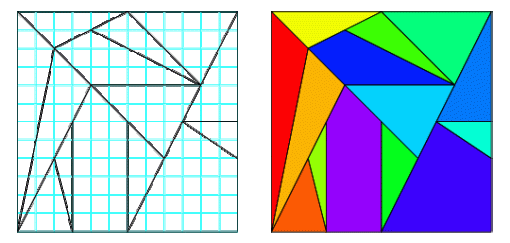 So, what do you do? The puzzle is made up of these fourteen pieces carved out of a 12 by 12 square– and the challenge is to make as many different squares as possible using all of the pieces. No one is totally sure who invented the Stomachion puzzle, but it’s definite that Archimedes, one of the most famous Ancient Greek mathematicians, had a lot of fun working on it.
 Sometimes Archimedes used the Stomachion pieces to make fun shapes, like elephants and flying birds. (If you think that sounds like fun, check out this page of Stomachion critters to try making and this lesson about the Stomachion puzzle from NCTM.) But his favorite thing to do with the Stomachion pieces was to arrange them into squares!
It’s clear that you can arrange the Stomachion pieces into a square in at least one way– because that’s how they start before you cut them out. But is there another way to do it? And, if there’s a second way, is there a third? How about a fourth? Because Archimedes was wondering about how many ways there are to make a square with Stomachion pieces, some mathematicians give him credit for being an inventor of combinatorics, the branch of math that studies counting things.
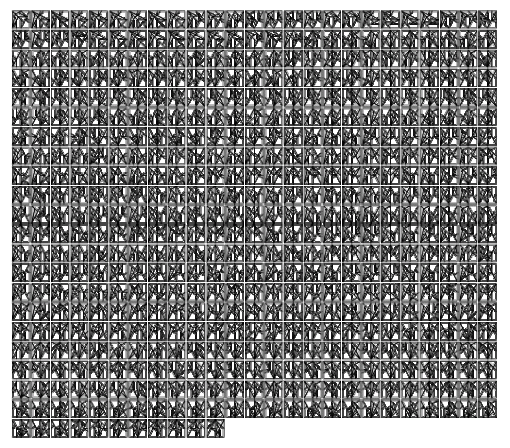 It turns out that there are many, many ways to make squares (the picture above shows all of them– click on it for greater detail)– and Archimedes didn’t find them all. But someone else did, over 2,000 years later! He used a computer to solve the problem– something Archimedes could never have done– but mathematician Bill Cutler found that there are 536 ways to make a square with Stomachion pieces! That’s a lot! If you’ve tried to make squares with the pieces, you might be particularly surprised– it’s pretty tricky to arrange them into one unique square, let alone 536. This finding was such a big deal that it made it into the New York Times. (Though you may notice that the number reported in the article is different– that’s how many ways there are to make a square if you include all of the solutions that are symmetrically the same.)
Other mathematicians have worked on finding the number of ways to arrange the Stomachion pieces into other shapes– such as triangles and diamonds. Given that it took until 2003 for someone to find the solution for squares, there are many, many open questions about the Stomachion puzzle just waiting to be solved! Who knows– if you play with the Stomachion long enough, maybe you’ll discover something new!
Next up, the mathematicians over at Numberphile have worked out a solution to a problem that plagued me a few weeks ago while I was camping– choosing the best outdoor toilet to use without checking all of them for grossness first. Is there a way to ensure that you won’t end up using the most disgusting toilet without having to look in every single one of them? Turns out there is! Watch this video to learn how:
Finally, a little blast from the past. Almost two years ago I share with you a video of something really awesome– a computer made entirely out of dominoes! Well, this year, some students and I finally got the chance to make one of our own! It very challenging and completely exhausting, but well worth the effort. Our domino computer recently made its debut on the mathematical internet, so I thought I’d share it with all of you! Enjoy!
Bon appetit!







 Math Munch