Tag Archives: geometry

Girls’ Angle, Spiral Tilings, and Coins

Welcome to this week’s Math Munch!

GirlsAngleCoverGirls’ Angle is a math club for girls. Since 2007 it has helped girls to grow their love of math through classes, events, mentorship, and a vibrant mathematical community. Girls’ Angle is based in Cambridge, Massachusetts, but its ideas and resources reach around the world through the amazing power of the internet. (And don’t you worry, gentlemen—there’s plenty for you to enjoy on the site as well.)

Amazingly, the site contains an archive of every issue of Girls’ Angle Bulletin, a wonderful bimonthly journal to “foster and nurture girls’ interest in mathematics.” In their most recent issue, you’ll find an interview with mathematician Karen E. Smith, along with several articles and puzzles about balance points of shapes.

There’s so much to dig into at Girls’ Angle! In addition to the Bulletins, there are two pages of mathematical videos. The first page shares a host of videos of women in mathematics sharing a piece of math that excited them when they were young. The most recent one is by Bridget Tenner, who shares about Pick’s Theorem. The second page includes several videos produced by Girls’ Angle, including this one called “Summer Vacation”.

Girls’ Angle can even help you buy a math book that you’d like, if you can’t afford it. For so many reasons, I hope you’ll find some time to explore the Girls’ Angle site over your summer break. (And while you’ve got your explorer’s hat on, maybe you’ll tour around Math Munch, too!)

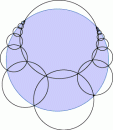
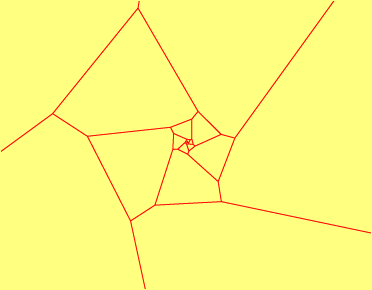
I did a Google search recently for “regular tilings.” I needed a few quick pictures of the usual triangle, square, and hexagon tilings for a presentation I was making. As I scrolled along, this image jumped out at me:
hexspiral

What is that?! It certainly is a tiling, and all the tiles are the “same”—even if they are different sizes. Neat!

Clicking on the image, I found myself transported to a page all about spiral tilings at the Geometry Junkyard. The site is a whole heap of geometrical odds and ends—and a place that I’ve stumbled across many times over the years. Here are a few places to get started. I’m sure you’ll enjoy poking around the site to find some favorite “junk” of your own.
Spirals

Spirals

Circles and spheres

Circles & spheres

Coloring

Coloring

Last up this week, you may have seen this coin puzzle before. Can you make the triangle point downwards by moving just three pennies?triangleflip
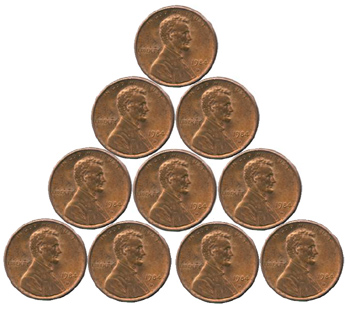
There are lots of variants of this puzzle. You can find some in an online puzzle game called Coins. In the game you have to make arrangements of coins, but the twist is that you can only move a coin to a spot where would it touch at least two other coins. I’m enjoying playing Coins—give it a try!
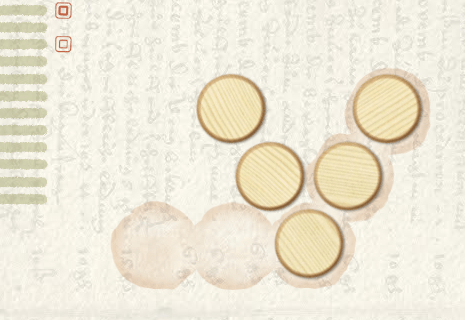
I solved this Coins puzzle in four moves. Can you? Can you do better?

I solved this Coins puzzle in four moves. Can you? Can you do better?

That’s it for this week’s Math Munch. Bon appetit!
 

Origami Stars, Tessellation Stars, and Chaotic Stars

Welcome to this week’s star-studded Math Munch!

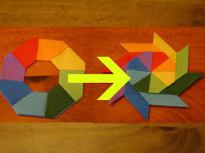
downloadModular origami stars have taken the school I teach in by storm in recent months! We love making them so much that I thought I’d share some instructional videos with you. My personal favorite is this transforming eight-pointed star. It slides between a disk with a hole the middle (great for throwing) and a gorgeous, pinwheel-like eight-pointed star. Here’s how you make one:

Another favorite is this lovely sixteen-pointed star. You can make it larger or smaller by adding or removing pieces. It’s quite impressive when completed and not that hard to make. Give it a try:

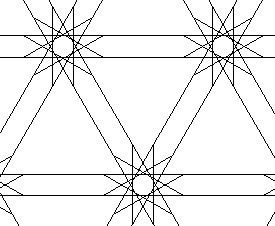
type6thContinuing on our theme of stars, check out these beautiful star tessellations. They come from a site made by Jim McNeil featuring oh-so-many things you can do with polygons and polyhedra. On this page, Jim tells you all about tessellations, focusing on a category of tessellations called star and retrograde tessellations.

type3b400px-Tiling_Semiregular_3-12-12_Truncated_Hexagonal.svgTake, for example, this beautiful star tessellation that he calls the Type 3. Jim describes how one way to make this tessellation is to replace the dodecagons in a tessellation called the 12.12.3 tessellation (shown to the left) with twelve-pointed stars. He uses the 12/5 star, which is made by connecting every fifth dot in a ring of twelve dots. Another way to make this tessellation is in the way shown above. In this tessellation, four polygons are arranged around a single point– a 12/5 star, followed by a dodecagon, followed by a 12/7 star (how is this different from a 12/5 star?), and, finally, a 12/11-gon– which is exactly the same as a dodecagon, just drawn in a different way.

I think it’s interesting that the same pattern can be constructed in different ways, and that allowing for cool shapes like stars and different ways of attaching them can open up crazy new worlds of tessellations! Maybe you’ll want to try drawing some star tessellations of your own after seeing some of these.

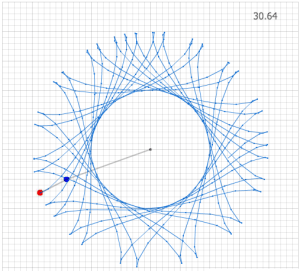
Screenshot 2014-05-12 10.48.46Finally, to finish off our week of everything stars, check out the star I made with this double pendulum simulator.  What’s so cool about the double pendulum? It’s a pendulum– a weight attached to a string suspended from a point– with a second weight hung off the bottom of the first. Sounds simple, right? Well, the double pendulum actually traces a chaotic path for most sizes of the weights, lengths of the strings, and angles at which you drop them. This means that very small changes in the initial conditions cause enormous changes in the path of the pendulum, and that the path of the pendulum is not a predictable pattern.

Using the simulator, you can set the values of the weights, lengths, and angles and watch the path traced on the screen. If you select “star” under the geometric settings, the simulator will set the parameters so that the pendulum traces this beautiful star pattern. Watch what happens if you wiggle the settings just a little bit from the star parameters– you’ll hardly recognize the path. Chaos at work!

Happy star-gazing, and bon appetit!

Tangent Spaces, Transplant Matches, and Golyhedra

Welcome to this week’s Math Munch!

You might remember our post on Tilman Zitzmann’s project called Geometry Daily. If you haven’t seen it before, go check it out now! It will help you to appreciate Lawrie Cape’s work, which both celebrates and extends the Geometry Daily project. Lawrie’s project is called Tangent Spaces. He makes Tilman’s geometry sketches move!

A box of rays, by Tilman

A box of rays, by Tilman

A box of rays, by Lawrie.

A box of rays, by Lawrie

409 66 498

Not only do Lawrie’s sketches move, they’re also interactive—you can click on them, and they’ll move in response. All kinds of great mathematical questions can come up when you set a diagram in motion. For instance, I’m wondering what moon patterns are possible to make by dragging my mouse around—and if any are impossible. What questions come up for you as you browse Tangent Spaces?

Next up, Dorry Segev and Sommer Gentry are a doctor and a mathematician. They collaborated on a new system to help sick people get kidney transplants. They are also dance partners and husband and wife. This video shares their amazing, mathematical, and very human story.

Dorry and Sommer’s work involves building graphs, kind of like the game that Paul posted about last week. Thinking about the two of them together has been fun for me. You can read more about the life-saving power of Kidney Paired Donation on optimizedmatch.com.

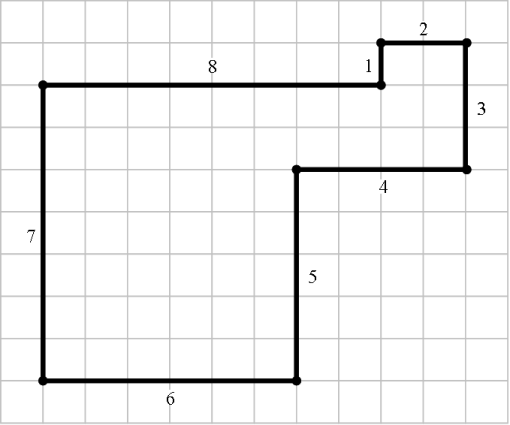
Last up this week, here’s some very fresh math—discovered in the last 24 hours! Joe O’Rourke is one of my favorite mathematicians. (previously) Joe recently asked whether a golyhedron exists. What’s a golyhedron? It’s the 3D version of a golygon. What’s a golygon? Glad you asked. It’s a grid polygon that has side lengths that grow one by one, from 1 up to some number. Here, a diagram will help:

The smallest golygon. It has sides of lengths 1 through 8.

The smallest golygon. It has sides of lengths 1 through 8.

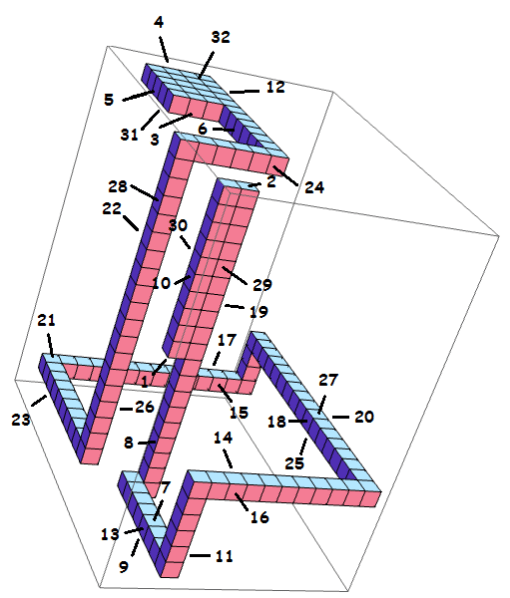
A golyhedron is like this, but in 3D: a grid shape that has one face of each area from 1 up to some number. After tinkering around some with this new shape idea, Joe conjectured that no golyhedra exist. It’s kind of like coming up with the idea of a unicorn, but then deciding that there aren’t any real ones. But Joseph wasn’t sure, so he shared his golyhedron shape idea on the internet at MathOverflow. Adam P. Goucher read the post, and decided to build a golyhedron himself.

And he found one!

The first ever golyhedron, by Adam P. Goucher

The first ever golyhedron, by Adam P. Goucher

Adam wrote all about the process of discovering his golyhedron in this blog post. I recommend it highly.

And the story and the math don’t stop there! New questions arise—is this the smallest golyhedron? Are there types of sequences of face sizes that can’t be constructed—for instance, what about a sequence of odd numbers? Curious and creative people, new discoveries, and new questions—that’s how math grows.

If this story was up your alley, you might enjoy checking out the story of holyhedra in this previous post.

Bon appetit!