Tag Archives: interview

Digital Art, Mastermind, and Pythagoras

Welcome to this week’s Math Munch… on (approximately) Math Munch’s second birthday! Hooray!

Check out this video of mathematical art made by artist Nathan Selikoff:

Cool, right? This piece is called “Beautiful Chaos.” The curves on the screen are made from equations (if you’ve ever graphed a line or a parabola you’ll know what I mean). As the viewer waves her hands around, the equations change– and as the equations change, so do the curves! The result is something that might remind you of the images your computer makes when you play music on it or maybe of something you’d make using a spirograph. All in all, a beautiful and interactive piece of mathematical art.

nathanNathan lives and works as a mathematical artist in Orlando, Florida. As he writes on his website, Nathan uses computer code along with other materials to make art that plays with the mathematical ideas of space, motion, and interaction between objects. To see more of how Nathan does this, check out his giant, interactive marionette or this song that explores the first, second, third, and fourth dimensions:

My school is really lucky to be hosting Nathan this week! We didn’t want any of you, dear readers, to miss out on the excitement, though– so Nathan has kindly agreed to answer your interview questions! Got a question for Nathan? Write it in the box below. He’ll answer seven of your best questions in two weeks!

565px-MastermindNext up, who doesn’t love to play Mastermind? It’s a great combination of logic, patterns, and trickery… but I just hate having to use all those tiny pegs. Well, guess what? You can play it online— no pegs (or opponent) necessary!

As I was playing Mastermind, I started wondering about strategy. What’s the best first guess to make? If I were as smart as a computer, is there a number of guesses in which I could guess any Mastermind code? (This kind of question reminds me of God’s Number and the Rubik’s cube…)

Well, it turns out there is a God’s Number for Mastermind – and that number is five. Just five. If you played perfectly and followed the strategy demonstrated by recreational mathematician Toby Nelson on his website, you could guess ANY Mastermind code in five guesses or less. Toby shares many more interesting questions about Mastermind on his website— I suggest you check it out.

What ARE those irrational numbers, so weird that they get their own bubble??

What ARE those irrational numbers, so weird that they get their own bubble??

Finally, sometime in your mathematical past you may have heard of irrational numbers. These are numbers like the square-root of 2 or pi or e that can’t be written as a fraction– or so people claim. When you start thinking about this claim, however, it may seem strange. There are A LOT of fractions– and none of them equal the square-root of 2? Really? What kind of number is that? It seems like only an irrational person would believe that, at least without proof.

Vi Hart to the rescue! Irrational numbers were encountered long, long ago by the ancient Greek mathematician (and cult leader) Pythagoras– and he didn’t like them much. In this great video, Vi tells all about Pythagoras and the controversial discovery of numbers that aren’t fractions.

If you didn’t follow her explanation of why the square-root of 2 is irrational on your first watch, don’t worry– it’s a complicated idea that’s worth a second (or third or fourth) run-through.

Thanks for a great two years of Math Munch! Bon appetit!

MoMA, Pop-Up Books, and A Game of Numbers

Welcome to this week’s Math Munch!

Thank you so much to everyone who participated in our Math Munch “share campaign” over the past two weeks. Over 200 shares were reported and we know that even more sharing happened “under the radar”. Thanks for being our partners in sharing great math experiences and curating the mathematical internet.

Of course, we know that the sharing will continue, even without a “campaign”. Thanks for that, too.

All right, time to share some math. On to the post!

N_JoshiTo kick things off, you might like to check out our brand-new Q&A with Nalini Joshi. A choice quote from Nalini:

In contrast, doing math was entirely different. After trying it for a while, I realized that I could take my time, try alternative beginnings, do one step after another, and get to glimpse all kinds of possibilities along the way.

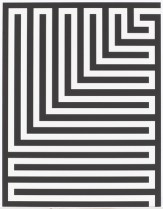
By Philippe Decrauzat.

By Philippe Decrauzat.

I hope the math munches I share with you this week will help you to “glimpse all kinds of possibilities,” too!

Recently I went to the Museum of Modern Art (MoMA) in New York City. (Warning: don’t confuse MoMA with MoMath!) On display was an exhibit called Abstract Generation. You can view the pieces of art in the exhibit online.

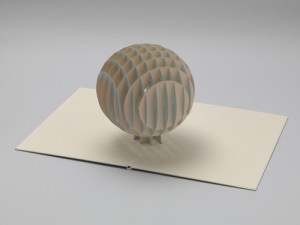
As I browsed the galley, the sculptures by Tauba Auerbach particularly caught my eye. Here are two of the sculptures she had on display at MoMA:

CRI_244599 CRI_244605

Just looking at them, these sculptures are definitely cool. However, they become even cooler when you realize that they are pop-up sculptures! Can you see how the platforms that the sculptures sit on are actually the covers of a book? Neat!

Here’s a video that showcases all of Tauba’s pop-ups in their unfolding glory. Why do you think this series of sculptures is called [2,3]?

This idea of pop-up book math intrigued me, so I started searching around for some more examples. Below you’ll find a video that shows off some incredible geometric pop-ups in action. To see how you can make a pop-up sculpture of your own, check out this how-to video. Both of these videos were created by paper engineer Peter Dahmen.

Taura Auerbach.

Tauba Auerbach.

Tauba got me thinking about math and pop-up books, but there’s even more to see and enjoy on her website! Tauba’s art gives me new ways to connect with and reimagine familiar structures. Remember our post about the six dimensions of color? Tauba created a book that’s a color space atlas! The way that Tauba plays with words in these pieces reminds me both of the word art of Scott Kim and the word puzzles of Douglas Hofstadter. Some of Tauba’s ink-on-paper designs remind me of the work of Chloé Worthington. And Tauba’s piece Componants, Numbers gives me some new insight into Brandon Todd Wilson’s numbers project.

0108 MM MM-Tauba-Auerbach-large

This piece by Tauba is a Math Munch fave!

For me, both math and art are all about playing with patterns, images, structures, and ideas. Maybe that’s why math and art make such a great combo—because they “play” well together!

Speaking of playing, I’d like to wrap up this week’s post by sharing a game about numbers I ran across recently. It’s called . . . A Game of Numbers! I really like how it combines the structure of arithmetic operations with the strategy of an escape game. A Game of Numbers was designed by a software developer named Joseph Michels for a “rapid” game competition called Ludum Dare. Here’s a Q&A Joseph did about the game.

A Game of Numbers.

A Game of Numbers.

If you enjoy A Game of Numbers, maybe you’ll leave Joseph a comment on his post about the game’s release or drop him an email. And if you enjoy A Game of Numbers, then you’d probably enjoy checking out some of the other games on our games page.

Bon appetit!

PS Tauba also created a musical instrument called an auerglass that requires two people to play. Whooooooa!

Reflection Sheet – MoMA, Pop-Up Books, and A Game of Numbers

TesselManiac, Zeno’s Paradox, and Platonic Realms

Welcome to this week’s Math Munch!

Before we begin, we’d like to thank all of you who have checked out the site in the past week. Since we’ve kicked off our share campaign, we’ve had so many new visitors and heard from many of them, too! Reading your feedback – whether a recommendation, some praise, a question, or just a brief, “Hello!” – brings us great joy and helps us to know that you all are out there.

Whether you’re a regular reader or visiting the site for the first time, we’d like to ask you for a little favor. If you see some math you like, share it with someone who you think would like it, too! Do you love the burst of excitement that you get from reading about a new mathematical idea, seeing an original piece of math artwork, or trying out a new game? Do you know someone who would love that, too? Then tell them about Math Munch – we’d love to spread the joy.

If you enjoy Math Munch, join in our “share campaign” this week.

You can read more about the share campaign here. There are lots of ways to participate, and you can let us know about your sharing through this form. We’d love to see the share total rise up to 1000 over the course of the next week.

Now for the post!

***

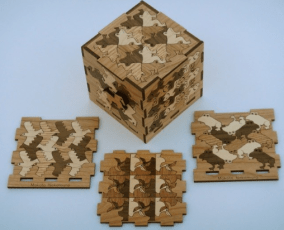
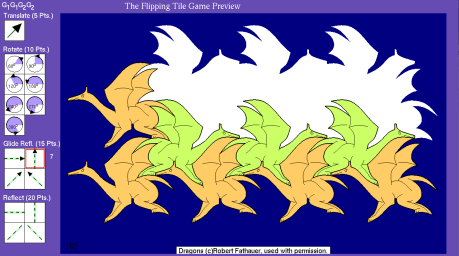
Lee boxThis beautiful tessellated wooden box was made by computer scientist and mathematical artist Kevin Lee. I met Kevin two weeks ago at the MOVES conference (which Justin and Paul have both written about already). Kevin teaches computer science at Normandale Community College in Minnesota. He makes woodcut tessellations (which won an award for the “Best Textile, Sculpture, or Other Medium” at the Joint Mathematics Meetings art exhibition this year!). He’s also used a combination of his knowledge of computer science and his love of Escher-type tessellations to make software that helps you create tessellations. His new software, TesselManiac!, is due out soon (watch this short movie Kevin made about it for the Bridges conference), but you can download an older version of the software here and play a preview version of The Flipping Tile Game.

tesselmaniac pictures

To play this game, you must fill in an outline of a tessellation with the piece given. You can use any of four symmetry motions – translation (or shift), rotation, reflection, or glide reflection (which reflects the tile and then translates it along a line parallel to the line of reflection). You get points for each correct tile placed (and lose points if you have to delete). Translations are the simplest, and only give you 5 points each. Reflections are the most difficult – you get 20 points for each one used!

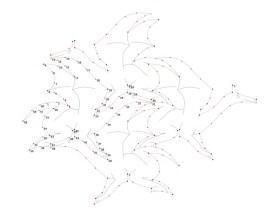
dot to dotWhile you’re downloading The Flipping Tile Game, try one of Kevin’s Dot-to-Dot puzzles. These are definitely not your typical dot-to-dot. Only the portion of the image corresponding to one tile in the tessellation is numbered. Once you figure out the shape of that single tile, you have to figure out how to number the rest of the puzzle!

Lucky for us, Kevin has agreed to answer some questions about his life and work as a math artist and computer scientist. Leave a question for Kevin here. (We’ll take questions for the next two weeks.)

tortoiseI’ve recently been thinking about a paradox that has puzzled mathematicians for centuries. Maybe you’ve heard of it. It’s one of the ancient Greek philosopher Zeno‘s paradoxes of motion, and it goes like this: Achilles (a really fast Greek hero) and a tortoise are going to run a race. Achilles agrees to give the tortoise a head-start, because the tortoise is so slow. Achilles then starts to run. But as Achilles catches up with the tortoise, the tortoise moves a little further. So the tortoise is still ahead. And as Achilles moves to catch up again, the tortoise moves even further! Sounds like Achilles will never catch up to the tortoise, let alone pass him… But that doesn’t make sense…

Will Achilles lose the race??? Check out this great video from Numberphile that explains both the paradox and the solution.

logo_PR_225_160While I was looking for information about this paradox, I stumbled across a great math resource site called Platonic Realms. The homepage of this site has a daily historical fact, mathematical quote, and puzzle.

The site hosts a math encyclopedia with explanations of all kinds of math terms and little biographies of famous mathematicians. You can also read “mini-texts” about different mathematical topics, such as this one about M. C. Escher (the inspiration behind the art at the beginning of this post!) or this one about coping with math anxiety.

I hope we here at Math Munch have given you something to tantalize your mathematical taste buds this week! If so, we’d love it if you would pass it along.

Thank you for reading, and bon appetit!

Rush hourP.S. – We’ve posted a new game, suggested to us by one of our readers! It’s an online version of Rush Hour. Check it out!