Tag Archives: puzzles

Polyominoes, Clock Calculator, and Nine Bells

Welcome to this week’s Math Munch!
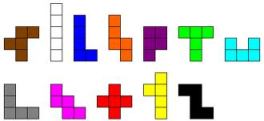
pentominoes!The first thing I have to share with you comes with a story. One day several years ago, I discovered these cool little shapes made of five squares. Maybe you’ve seen these guys before, but I’d never thought about how many different shapes I could make out of five squares. I was trying to decide if I had all the possible shapes made with five squares and what to call them, when along came Justin. He said, “Oh yeah, pentominoes. There’s so much stuff about those.”

Justin proceeded to show me that I wasn’t alone in discovering pentominoes – or any of their cousins, the polyominoes, made of any number of squares. I spent four happy years learning lots of things about polyominoes. Until one day… one of my students asked an unexpected question. Why squares? What if we used triangles? Or hexagons?

pentahexesWe drew what we called polyhexes (using hexagons) and polygles (using triangles). We were so excited about our discoveries! But were we alone in discovering them? I thought so, until…
whoa square

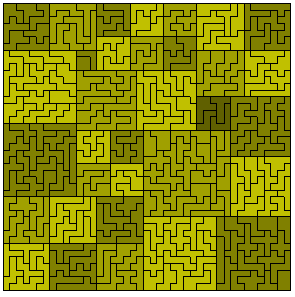
A square made with all polyominoes up to heptominoes (seven), involving as many internal squares as possible.

… I found the Poly Pages. This is the polyform site to end all polyform sites. You’ll find information about all kinds of polyforms — whether it be a run-of-the-mill polyomino or an exotic polybolo — on this site. Want to know how many polyominoes have a perimeter of 14? You can find the answer here. Were you wondering if polyominoes made from half-squares are interesting? Read all about polyares.

I’m so excited to have found this site. Even though I have to share credit for my discovery with other people, now I can use my new knowledge to ask even more interesting questions.

Next up, check out this clock arithmetic calculator. This calculator does addition, subtraction, multiplication, and division, and even more exotic things like square roots, on a clock.
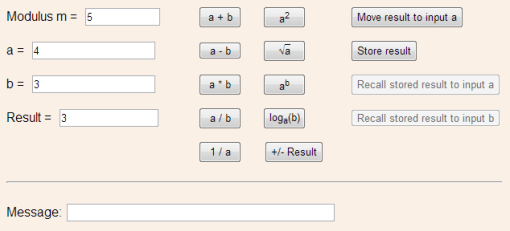
clock calculatorWhat does that mean? Well, a clock only uses the whole numbers 1 through 12. Saying “15 o’clock” doesn’t make a lot of sense (unless you use military time) – but you can figure out what time “15 o’clock” is by determining how much more 15 is than 12. 15 o’clock is 3 hours after 12 – so 15 o’clock is actually 3 o’clock. You can use a similar process to figure out the value of any positive or negative counting number on a 12 clock, or on a clock of any size. This process (called modular arithmetic) can get a bit time consuming (pun time!) – so, give this clock calculator a try!

Finally, here is some wonderful mathemusic by composer Tom Johnson. Tom writes music with underlying mathematics. In this piece (which is almost a dance as well as a piece of music), Tom explores the possible paths between nine bells, hung in a three-by-three square. I think this is an example of mathematical art at its best – it’s interesting both mathematically and artistically. Observe him traveling all of the different paths while listening to the way he uses rhythm and pauses between the phrases to shape the music. Enjoy!

Bon appetit!
TesselManiac, Zeno’s Paradox, and Platonic Realms

Welcome to this week’s Math Munch!

Before we begin, we’d like to thank all of you who have checked out the site in the past week. Since we’ve kicked off our share campaign, we’ve had so many new visitors and heard from many of them, too! Reading your feedback – whether a recommendation, some praise, a question, or just a brief, “Hello!” – brings us great joy and helps us to know that you all are out there.

Whether you’re a regular reader or visiting the site for the first time, we’d like to ask you for a little favor. If you see some math you like, share it with someone who you think would like it, too! Do you love the burst of excitement that you get from reading about a new mathematical idea, seeing an original piece of math artwork, or trying out a new game? Do you know someone who would love that, too? Then tell them about Math Munch – we’d love to spread the joy.

If you enjoy Math Munch, join in our “share campaign” this week.

You can read more about the share campaign here. There are lots of ways to participate, and you can let us know about your sharing through this form. We’d love to see the share total rise up to 1000 over the course of the next week.

Now for the post!

***

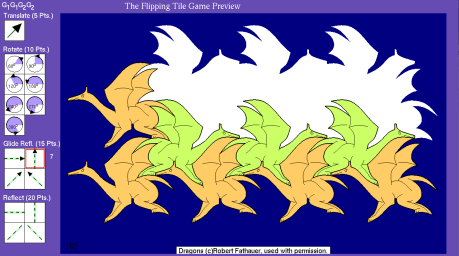
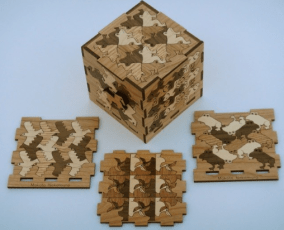
Lee boxThis beautiful tessellated wooden box was made by computer scientist and mathematical artist Kevin Lee. I met Kevin two weeks ago at the MOVES conference (which Justin and Paul have both written about already). Kevin teaches computer science at Normandale Community College in Minnesota. He makes woodcut tessellations (which won an award for the “Best Textile, Sculpture, or Other Medium” at the Joint Mathematics Meetings art exhibition this year!). He’s also used a combination of his knowledge of computer science and his love of Escher-type tessellations to make software that helps you create tessellations. His new software, TesselManiac!, is due out soon (watch this short movie Kevin made about it for the Bridges conference), but you can download an older version of the software here and play a preview version of The Flipping Tile Game.

tesselmaniac pictures

To play this game, you must fill in an outline of a tessellation with the piece given. You can use any of four symmetry motions – translation (or shift), rotation, reflection, or glide reflection (which reflects the tile and then translates it along a line parallel to the line of reflection). You get points for each correct tile placed (and lose points if you have to delete). Translations are the simplest, and only give you 5 points each. Reflections are the most difficult – you get 20 points for each one used!

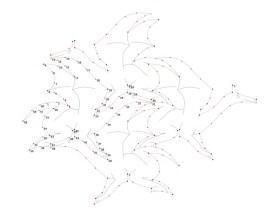
dot to dotWhile you’re downloading The Flipping Tile Game, try one of Kevin’s Dot-to-Dot puzzles. These are definitely not your typical dot-to-dot. Only the portion of the image corresponding to one tile in the tessellation is numbered. Once you figure out the shape of that single tile, you have to figure out how to number the rest of the puzzle!

Lucky for us, Kevin has agreed to answer some questions about his life and work as a math artist and computer scientist. Leave a question for Kevin here. (We’ll take questions for the next two weeks.)

tortoiseI’ve recently been thinking about a paradox that has puzzled mathematicians for centuries. Maybe you’ve heard of it. It’s one of the ancient Greek philosopher Zeno‘s paradoxes of motion, and it goes like this: Achilles (a really fast Greek hero) and a tortoise are going to run a race. Achilles agrees to give the tortoise a head-start, because the tortoise is so slow. Achilles then starts to run. But as Achilles catches up with the tortoise, the tortoise moves a little further. So the tortoise is still ahead. And as Achilles moves to catch up again, the tortoise moves even further! Sounds like Achilles will never catch up to the tortoise, let alone pass him… But that doesn’t make sense…

Will Achilles lose the race??? Check out this great video from Numberphile that explains both the paradox and the solution.

logo_PR_225_160While I was looking for information about this paradox, I stumbled across a great math resource site called Platonic Realms. The homepage of this site has a daily historical fact, mathematical quote, and puzzle.

The site hosts a math encyclopedia with explanations of all kinds of math terms and little biographies of famous mathematicians. You can also read “mini-texts” about different mathematical topics, such as this one about M. C. Escher (the inspiration behind the art at the beginning of this post!) or this one about coping with math anxiety.

I hope we here at Math Munch have given you something to tantalize your mathematical taste buds this week! If so, we’d love it if you would pass it along.

Thank you for reading, and bon appetit!

Rush hourP.S. – We’ve posted a new game, suggested to us by one of our readers! It’s an online version of Rush Hour. Check it out!

MOVES, the Tower of Hanoi, and Mathigon

Welcome to this week’s Math Munch!

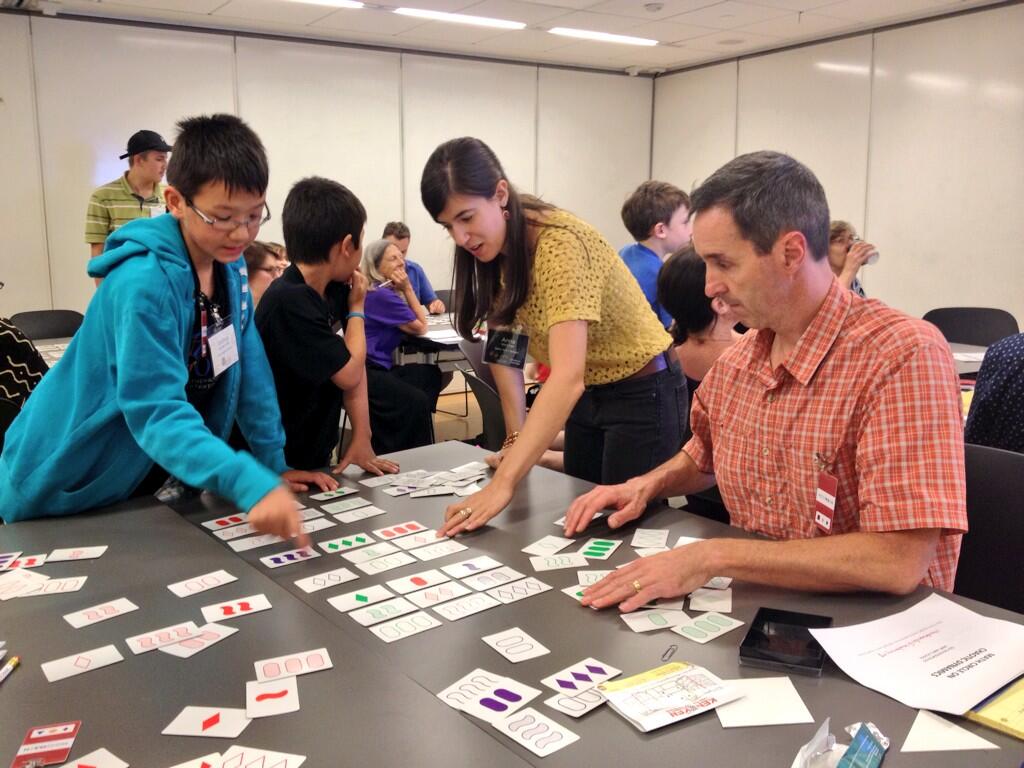
MOVESThe Math Munch team just wrapped up attending the first MOVES Conference, which was put on by the Museum of Math in NYC. MOVES is a recreational math conference and stands for Mathematics of Various Entertaining Subjects. Anna coordinated the Family Activities track at the conference and Paul gave a talk about his imbalance problems. I was just there as an attendee and had a blast soaking up wonderful math from some amazing people!

AnnaMOVES PaulMOVES JustinMOVES

Who all was there? Some of our math heroes—and familiar faces on Math Munch—like Erik Demaine, Tanya Khovanova, Tim and Tanya Chartier, and Henry Segerman, just to name just a few. I got to meet and learn from many new people, too! Even though I know it’s true, it still surprises me how big and varied the world of math and mathematicians is.

SuMOVES

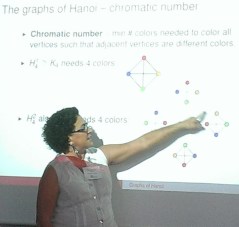
Suzanne Dorée at MOVES.

One of my favorite talks at MOVES was given by Suzanne Dorée of Augsburg College. Su spoke about research she did with a former student—Danielle Arett—about the puzzle known as the Tower of Hanoi. You can try out this puzzle yourself with this online applet. The applet also includes some of the puzzle’s history and even some information about how the computer code for the applet was written.

danielle

Danielle Arett

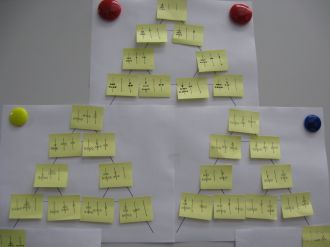
A pice of a Tower of Hanoi graph with three pegs and four disks.

A piece of a Tower of Hanoi graph with three pegs and four disks.

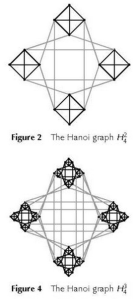
But back to Su and Danielle. If you think of the different Tower of Hanoi puzzle states as dots, and moving a disk as a line connecting two of these dots, then you can make a picture (or graph) of the whole “puzzle space”. Here are some photos of the puzzle space for playing the Tower of Hanoi with four disks. Of course, how big your puzzle space graph is depends on how many disks you use for your puzzle, and you can imagine changing the number of pegs as well. All of these different pictures are given the technical name of Tower of Hanoi graphs. Su and Danielle investigated these graphs and especially ways to color them: how many different colors are needed so that all neighboring dots are different colors?

Images from Su and Danielle's paper. Towers of Hanoi graphs with four pegs.

Images from Su and Danielle’s paper. Tower of Hanoi graphs with four pegs.


Su and Danielle showed that even as the number of disks and pegs grows—and the puzzle graphs get very large and complicated—the number of colors required does not increase quickly. In fact, you only ever need as many colors as you have pegs! Su and Danielle wrote up their results and published them as an article in Mathematics Magazine in 2010.

Today Danielle lives in North Dakota and is an analyst at Hartford Funds. She uses math every day to help people to grow and manage their money. Su teaches at Ausburg College in Minnesota where she carries out her belief “that everyone can learn mathematics.”

Do you have a question for Su or Danielle—about their Tower of Hanoi research, about math more generally, or about their careers? If you do, send them to us in the form below for an upcoming Q&A!

UPDATE: We’re no longer accepting questions for Su and Danielle. Their interview will be posted soon! Ask questions of other math people here.

MathigonLast up, here’s a gorgeous website called Mathigon, which someone shared with me recently. It shares a colorful and sweeping view of different fields of mathematics, and there are some interactive parts of the site as well. There are features about graph theory—the field that Su and Danielle worked in—as well as combinatorics and polyhedra. There’s lots to explore!

Bon appetit!