Tag Archives: puzzles

A Closet Full of Puzzles, Sphereland, and Math Doodles

Welcome to this week’s Math Munch!

After a few weeks off, we’re back with some exciting things to share.  First up is Futility Closet, a blog featuring “an idler’s miscellany of compendious amusements.”  The blog is full of big-worded phrases like that, but I most love the puzzles they often post – everything from chess to numbers, codes, and devilish word play.  I also love that the name of the person who wrote each puzzle accompanies it.  Take a look at the few I’ve posted below and click here for the full list of puzzles.

2012-12-30-swine-wave-1
Here’s a puzzle called Swine Wave, by Lewis Carroll. The puzzle: Lace 24 pigs in these sties so that, no matter how many times one circles the sties, he always find that the number in each sty is closer to 10 than the number in the previous one. Want to know the solution? Click on the image above to visit Futility Closet.
2012-12-31-project-management-1
This puzzle is called Project Management, by Paul Vaderlind. The question: If a blacksmith requires five minutes to put on a horseshoe, can eight blacksmiths shoe 10 horses in less than half an hour? The catch: A horse can stand on three legs, but not on two. Click on the image to visit Futility Closet for the solution!

Next, have you ever wondered what it would be like to visit another dimension?   In 1884, Edwin A. Abbott wrote about life in the second dimension, in a nice little book called Flatland: A Romance of Many Dimesnions.  (Fun fact: the “A” in Edwin’s name stands for Abbott.  So his name is Edwin Abbott Abbott.)  Click on that link and you can read the whole book, if you like.  The book is about a world of flat beings who have no idea that the third dimension exists.  In the book, the main character, A Square, is visited by a sphere from the unknown world “above” him.  Kind of makes me wonder whether we’re just like the characters in Flatland, three-dimensional creatures ignorant of the fourth dimension that exists “above” us…

spherelandWell, the recently released movie Flatland 2: Sphereland deals with precisely that issue.  The Math Munch team had the opportunity to preview this movie, and we loved it.  In Sphereland, the granddaughter of the Square from Flatland, Hex, and her friend Puncto try to understand some mysterious triangles that Puncto thinks will cause the disastrous end of a space exploration mission and go on an adventure to help their three-dimensional friend Spherius with a problem he brought back from the fourth dimension.

portfolio-TorusHigher dimensions can be very difficult to wrap your head around.  This movie does a great job of helping the movie-watcher to understand how higher and lower dimensions relate to each other through the plot twists and challenges that the characters face.  You can really learn a lot about dimensions and the shape of space by watching this movie.  Plus, the characters are engaging and the images are fun.  Sphereland features the voices of a number of really great actors, including Kristen Bell, Danny Pudi, Michael York, and Danica McKellar.

Want to learn more about Sphereland?  Check out the trailer:

And, here’s an interview with Danny Pudi, the voice of Puncto, and Tony Hale, who does a fantastic job as the King of Pointland:

By the way, the makers of Sphereland also made a movie of Flatland!  The Math Munch team loved that one, too.  Here’s a link to the trailer.

tumblr_mgw2ainZDX1s0payeo1_1280Finally, check out this beautiful blog of mathematical doodles by high school math student and artist Chloé Worthington!  Chloé started mathematically doodling a few years ago in… well, in class.  When she doodles in class, Chloé is better able to focus on what’s going on and makes beautiful art.   (We at Math Munch encourage you to pay attention in class while you doodle.)

Chloé does all of her doodles by hand with ink pens.  She does a lot of work with triangles, as shown here.  One of her signature doodles is this nested puzzle piece doodle:

tumblr_mfjypuxlqs1s0payeo1_1280

Doodling mathematically is one of the ways that Chloé does math and shares what she loves about it with the world.  She’s a trigonometry student, too.  How do you share what you love about math – or any other subject?

Bon appetit!

Mathpuzzle, Video Contests, and Snowflakes

Welcome to this week’s Math Munch!

mathpuzzle

One of my favorite math sites on the internet is mathpuzzle. It’s written and curated by recreational mathematician Ed Pegg Jr. About once a month, Ed makes a post that shares a ton of awesome math—interesting tilings, tricky puzzles, results about polyhedra and polyominos, and so much more. Below are some of my favorite finds at mathpuzzles. Go to the site to discover much more to explore!

z5l4l3

Shapes that three kinds of polyominoes can tile.

2

Erich Friedman’s 2012 holiday puzzles

Abyss_01

A slideable, flexible hypercube you can hold in your hands! Video below.

hero_01

Next, have you ever wanted to be a movie star? How about a math movie star? Then there are two math video contests that you should know about. The first is for middle schoolers— the Reel Math Challenge. It’s run by MATHCOUNTS, which has for many years run a middle school problem solving contest. (I competed in it when I was in middle school.) This is only the second year for the Reel Math Challenge, but lots of videos have already been created. You can check them out here.

MathovisionThe second contest is for high schoolers and is called Math-O-Vision. The challenge is to make a video that shows “the way Math fills our world.” Math-O-Vision is sponsored by the Dartmouth College Math Department and the Neukom Institute.

makeaflakeFinally, here’s a fun little applet I found called Make-a-Flake. You can use it to make intricate digital snowflake designs.

flake

Two snowflakes from the Make-a-Flake gallery.

Of course, it’s a lot of fun to make non-virtual snowflakes as well—find a pair of scissor and some paper and go for it! For basic instructions, head over to snowflakes.info. And for some inspiration, check out this Flickr group!

Bon appetit!

Factorization Dance, Vanishing, and Storm Infographics

Welcome to this week’s Math Munch!

Think fast!  How many dots are there in this picture?

This beautiful picture comes to you from Brent Yorgey and Stephen Von Worley.  If you counted the dots, you probably didn’t count them one at a time.  (And, if you did, can you think of another way to count them?)  If you counted them like I did, you noticed that the dots are arranged in rings of five.  Then maybe you noticed that the rings of five are themselves arranged in rings of five.  And then, finally, you may have noticed that those rings are also arranged in rings of five!  How many dots is that?  5x5x5 = 125!

In this blog post, Brent describes how he wrote the computer program that creates these pictures.  The program factors numbers into primes.  Then, starting with the smallest prime factor, the program arranges dots into regular polygons of the appropriate size with dots (or polygons of dots) at the vertices of the polygon.

Here’s how that works for 90.  90’s prime factorization is 2x3x3x5:

As Brent writes in his post, this counting gets much harder to do with numbers that have large prime factors.  For example, here is 183:

From this picture, I can tell that 183 has 3 as a prime factor.  But how many times does 3 go into 183?  It isn’t immediately clear.

When Stephen saw Brent’s creation, he decided the diagrams would be even more awesome if they danced.  And so he created what he calls the Factor Conga.  If you only click on one link today, click that one.  The Factor Conga is beautiful and totally mesmerizing.

For more factor diagrams, check out this post from the Aperiodical.  There’s a link to the factor diagram by Jason Davies that we posted about over the summer.

Next up, a few months ago we posted about the puzzles of Sam Loyd – one of which was a puzzle called Get Off the Earth.  In this puzzle, the Earth spins and – impossibly – one of the men seems to vanish.  This puzzle is a type of illusion called a geometrical vanish.  In a geometrical vanish, an image is chopped into pieces and the pieces are rearranged to make a new image that takes up the same amount of space as the original, but is missing something.

Here’s a video of another geometrical vanish:

No matter the picture, these illusions are baffling for the same reason.  Rearranging the pieces of an image shouldn’t change the image’s area.  And, yet, in these illusions, that’s exactly what seems to happen.

Check out some of these other links to geometrical vanishes.  Print out your own here.  And think about this: Are these illusions math – and, if it so, how?  I came across geometrical vanishes because a friend asked if I thought the Get Off the Earth puzzle was mathematical.  He isn’t convinced.  If you have any ideas that you think can convince him either way, leave them in the comments section!

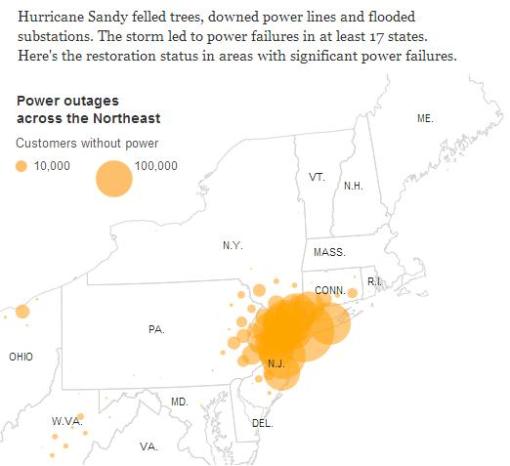
Finally, the Math Munch team’s home, New York City, (and this writer’s other home, New Jersey) was hit by a hurricane this week.  The city and surrounding areas are still recovering from the storm.  Sandy left millions of people without power and many without homes.  One way people have tried to communicate the magnitude of what happened is to make infographics of the data.  Making a good infographic requires a blend of mathematics, art, and persuasion.  Here some of the most interesting infographics about the storm that I’ve found.  Check out how they use size, placement, and color to communicate information and make comparisons.

This infographic from the New York Times shows the number of power outages in the northeast and their locations in different states. The size of the circle indicates the number of people without power. Why would the makers of this infographic choose circles? Why do you think they chose to place them on a map? What do you think of the overlapping?

This is part of an infographic from the Huffington Post that compares hurricanes Sandy and Katrina. Click on the image to see the rest of the infographic. What conclusions can you draw about the hurricanes from the information?

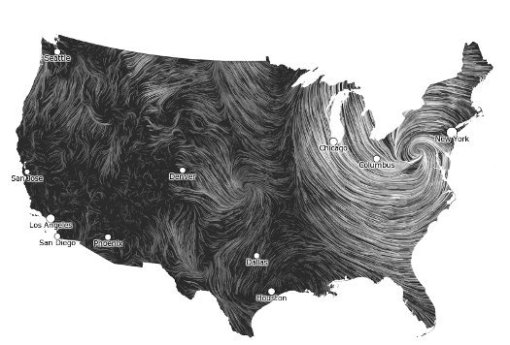
This is a wind map of the country captured at 10:30 in the morning on October 30th, the day hurricane Sandy hit. The infographic was made by scientist-artists Fernanda Viegas and Martin Wattenberg. It shows how wind is flowing around the United States in real-time. Check out their site (click on this image) to see what the wind is doing right now in your part of the country!

To those in places affected by Hurricane Sandy, be safe.  To all our readers, bon appetit!